
abolish - Master This Word
Master this word with our 5-step learning method – Learn English in English
Train English Through Brain Routes, Not Translation.
This page helps you stop memorizing isolated translations and start understanding a word through its shared mental image, native-style thinking, and practical training steps.
Master this word with our 5-step learning method – Learn English in English
Example sentences are the start of understanding. Don't rush to memorize. First feel how the word works in a sentence.
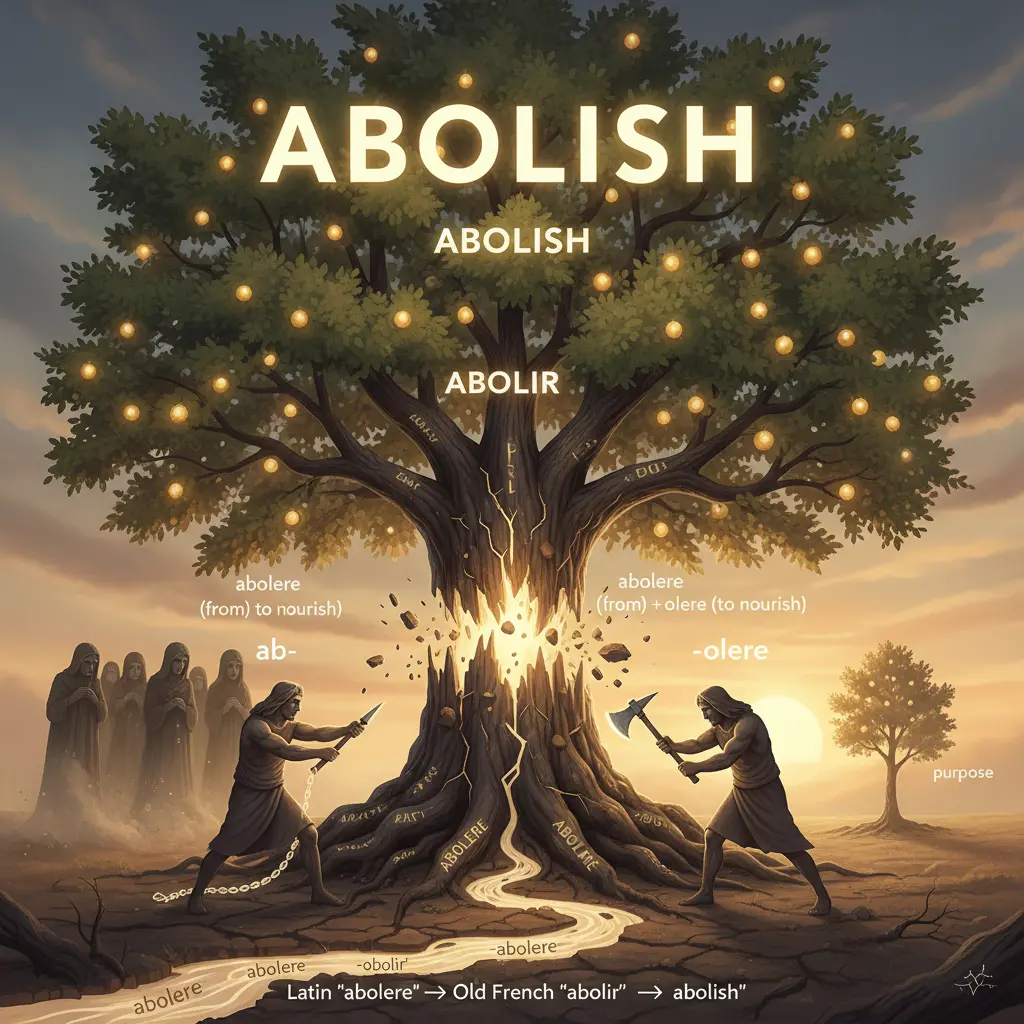
Root decomposition: 'ab-' (from) + 'olere' (to nourish). Historical origin: Latin 'abolere' → Old French 'abolir' → English 'abolish'. Memory image: Imagine a giant, nourishing tree being cut down, symbolizing the end of a longstanding tradition that no longer serves its purpose.
Note 1: These definitions and etymologies are not standard dictionary definitions, but extended explanations provided to help with memorization and understanding of the actual application of words. Through this background information, we strive to make words more vivid and easier to understand, and help you remember their meanings in real life.
Note 2: LexiTalk designs the learning flow around the linguistics principle of “Comprehensible Input.” When learners encounter material that is slightly above their level but still understandable from context, the brain naturally absorbs the language. That’s why we keep every word inside authentic contexts, using examples and associations to help you understand it and use it flexibly.
Read the FAQ explanation of Comprehensible InputI grip the handle firmly, turn the switch, and push the plan from loud action into a quiet pause. The room's old rule doors shift and slide out of the way, as if a policy has moved out of sight. I feel the effort in my chest, adjust my priorities, and decide to set that practice aside for good. The space settles, and what we do next grows from this hard change in how we act.
Abolish means to formally end a system, practice, or institution. In politics, law, and social debate, it signals a decisive move to remove something that is seen as unjust, outdated, or harmful. The word carries a formal, policy-oriented tone and often appears in discussions about reforms, constitutions, or traditions. When you use abolish, you imply a deliberate process rather than a temporary halt. It contrasts with simpler verbs like stop or end, and it often takes nouns such as laws, penalties, or practices. Abolition denotes a systemic conclusion, not a minor adjustment.
Abolish in English tends to carry formal, policy-level implications; learners often confuse it with stop or end without emphasizing the formal process.
What is the meaning of 'abolish'?
Which sentence uses 'abolish' correctly?
Which word is most similar to 'abolish'?
What is the opposite of 'abolish'?
Can you think of a real-life context where a law might be abolished?
Download LexiTalk app for personalized learning experience
Download AppCookies
We use cookies for essential site functions, analytics, and ads. You can accept, reject, or manage preferences. Privacy Policy