abstract - Master This Word
Master this word with our 5-step learning method – Learn English in English
Train English Through Brain Routes, Not Translation.
This page helps you stop memorizing isolated translations and start understanding a word through its shared mental image, native-style thinking, and practical training steps.
Master this word with our 5-step learning method – Learn English in English
Example sentences are the start of understanding. Don't rush to memorize. First feel how the word works in a sentence.
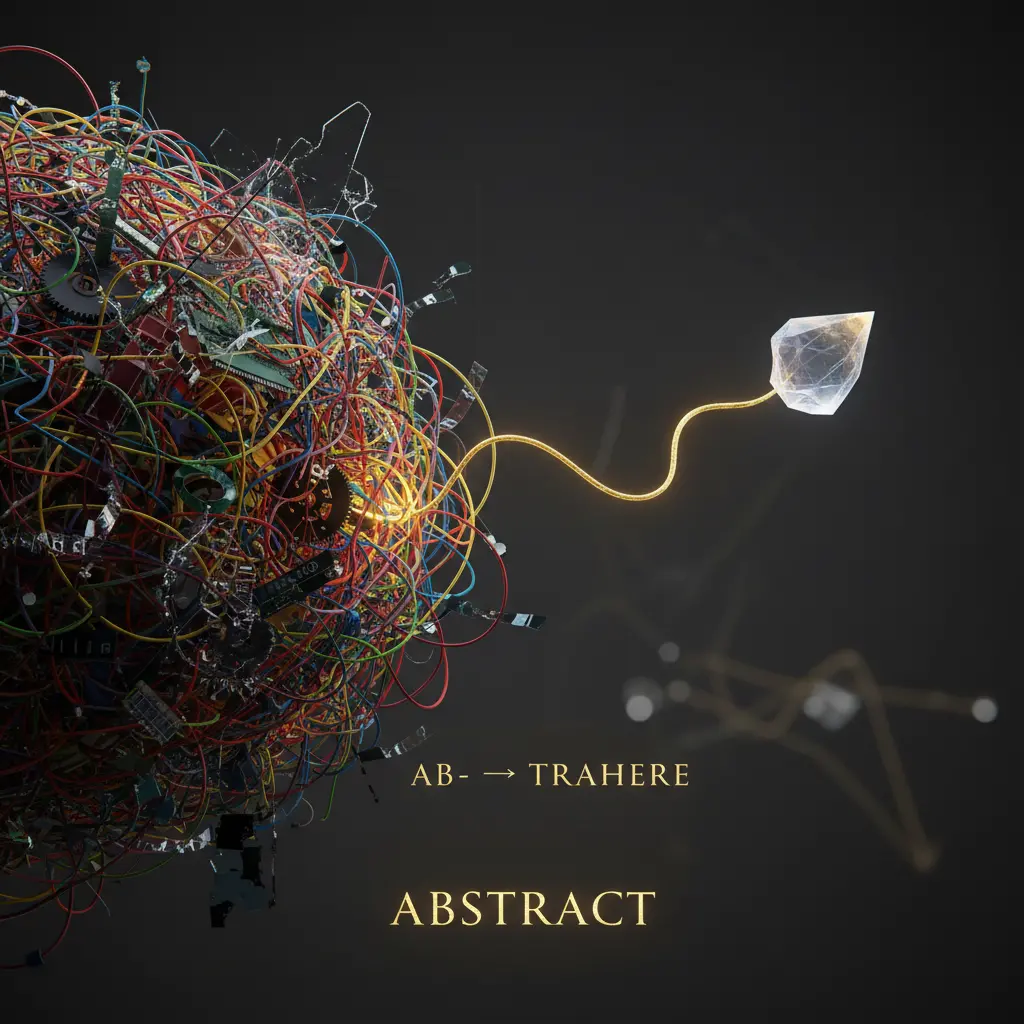
The word 'abstract' comes from the Latin 'abstrahere', where 'ab-' means 'away from' and 'trahere' means 'to draw'. It evolved through Old French into English. Imagine drawing the essence of an idea away from its chaotic surroundings, like pulling a single thread from a tangled ball of yarn.
Note 1: These definitions and etymologies are not standard dictionary definitions, but extended explanations provided to help with memorization and understanding of the actual application of words. Through this background information, we strive to make words more vivid and easier to understand, and help you remember their meanings in real life.
Note 2: LexiTalk designs the learning flow around the linguistics principle of “Comprehensible Input.” When learners encounter material that is slightly above their level but still understandable from context, the brain naturally absorbs the language. That’s why we keep every word inside authentic contexts, using examples and associations to help you understand it and use it flexibly.
Read the FAQ explanation of Comprehensible InputI lean forward, move a page across the desk, and watch the light catch the edge. I push my attention into a corner of my mind and shift the clues of a scene into a separate pocket, away from the noise. I adjust my grip on the thought, turn the pieces over, and hold a simple pattern steady as if I were testing it in air. In that quiet practice, the word abstract stops being a label and feels like a small map you keep in your head, guiding what you focus on when you compare ideas.
Abstract has three core senses: as an adjective, something existing in thought rather than having a physical form; as a noun, a short summary of a text or work; and as a verb, to consider something theoretically or separately from practical details. In everyday English it often pairs with words like idea, concept, or theory; in writing, an abstract is the concise synopsis at the start of an academic paper. In art, abstract art uses shapes and colors that do not depict real objects. The etymology traces to Latin abstrahere, away from and to draw; imagine pulling the essence of an idea away from its surroundings. Be careful not to confuse abstract with concrete, and note that summary is a related but distinct sense.
English users explicitly separate abstract into three senses (adjective, noun, verb). Learners often mix up the noun (summary) with the verb (to abstract) or confuse abstract with concrete. Practice context clues and check collocations.
What is the meaning of the word 'abstract'?
Which of the following sentences uses 'abstract' correctly?
Select the synonym for 'abstract':
Select the antonym for 'abstract':
How would you apply the concept of 'abstract' in a real-world situation?
Download LexiTalk app for personalized learning experience
Download AppCookies
We use cookies for essential site functions, analytics, and ads. You can accept, reject, or manage preferences. Privacy Policy