also - Master This Word
Master this word with our 5-step learning method – Learn English in English
Train English Through Brain Routes, Not Translation.
This page helps you stop memorizing isolated translations and start understanding a word through its shared mental image, native-style thinking, and practical training steps.
Master this word with our 5-step learning method – Learn English in English
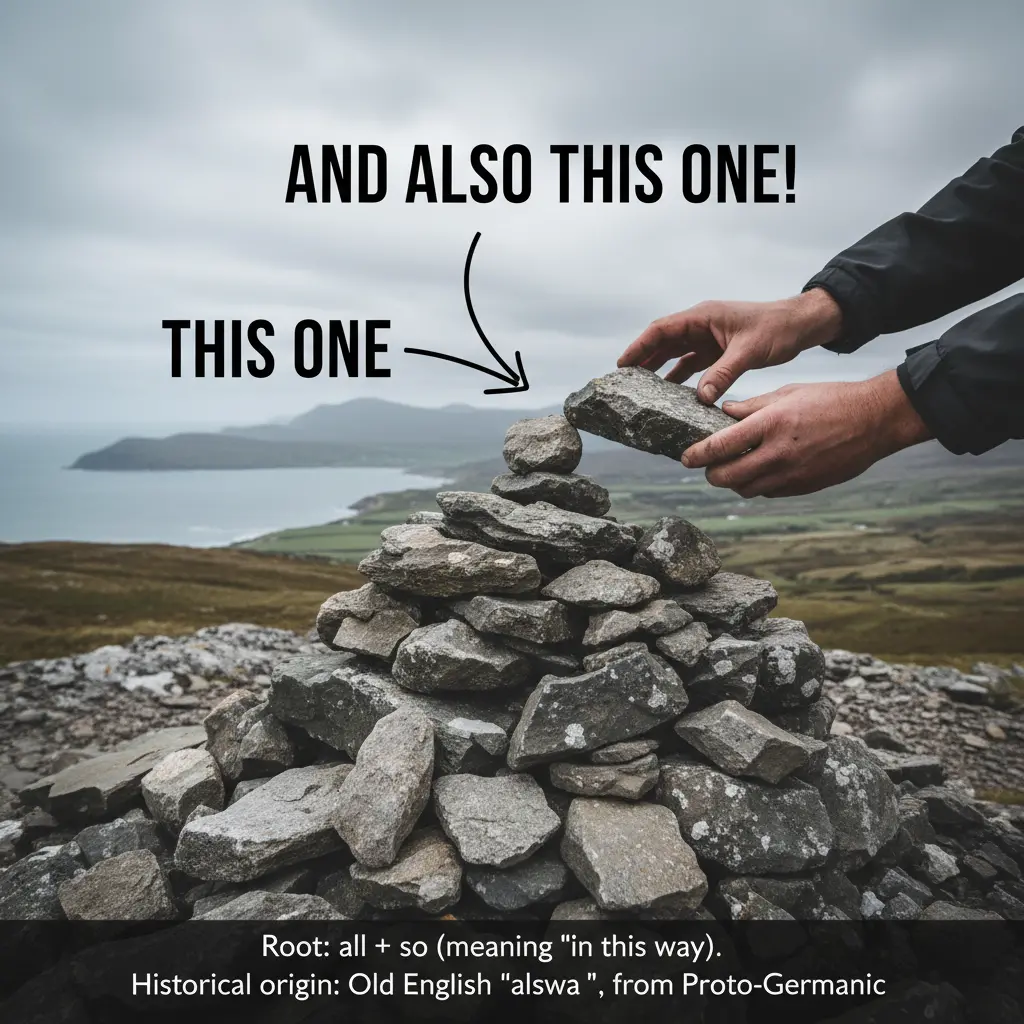
Example sentences are the start of understanding. Don't rush to memorize. First feel how the word works in a sentence.
Root: all + so (meaning 'in this way'). Historical origin: Old English 'alswa', from Proto-Germanic. Memory image: Imagine adding a rock to a pile, saying 'this one, and also this one!' to visualize addition.
Note 1: These definitions and etymologies are not standard dictionary definitions, but extended explanations provided to help with memorization and understanding of the actual application of words. Through this background information, we strive to make words more vivid and easier to understand, and help you remember their meanings in real life.
Note 2: LexiTalk designs the learning flow around the linguistics principle of “Comprehensible Input.” When learners encounter material that is slightly above their level but still understandable from context, the brain naturally absorbs the language. That’s why we keep every word inside authentic contexts, using examples and associations to help you understand it and use it flexibly.
Read the FAQ explanation of Comprehensible InputStarting with a small move of my hand, I reach for the mug and place it down a little farther along. I also notice another task nudging into the moment, like grabbing a spoon at the same time. The effort is quiet, a push of focus that changes the scene just enough. That feeling grows into real use when I say also to connect the first action with the next part of the moment, as if I’m adding one more detail.
Also is a versatile English adverb used to add information that is in addition to what has just been said. It can modify verbs, adjectives, and even entire clauses, and its main job is to signal that another fact is true alongside the first one. You often place also before the main verb, as in I also like that idea, or after an auxiliary: She has also finished the report. It can also start a sentence for emphasis: Also, we should consider other options. Be careful not to confuse also with too, which tends to appear at the end of a sentence. In not only … but also constructions, also links two pieces of information.
For English learners, also conveys parallel addition and has flexible placement. Learners often overuse it at the start of every sentence or confuse it with too. Focus on rhythm: place it near the verb it modifies and avoid forcing it in every clause.
What is the meaning of the word 'also'?
How is the word 'also' used in a sentence?
Which word is similar in meaning to 'also'?
Which word is the opposite of 'also'?
In what real-life context would you use the word 'also'?
Download LexiTalk app for personalized learning experience
Download AppCookies
We use cookies for essential site functions, analytics, and ads. You can accept, reject, or manage preferences. Privacy Policy