
ancestor - Master This Word
Master this word with our 5-step learning method – Learn English in English
Train English Through Brain Routes, Not Translation.
This page helps you stop memorizing isolated translations and start understanding a word through its shared mental image, native-style thinking, and practical training steps.
Master this word with our 5-step learning method – Learn English in English
Example sentences are the start of understanding. Don't rush to memorize. First feel how the word works in a sentence.
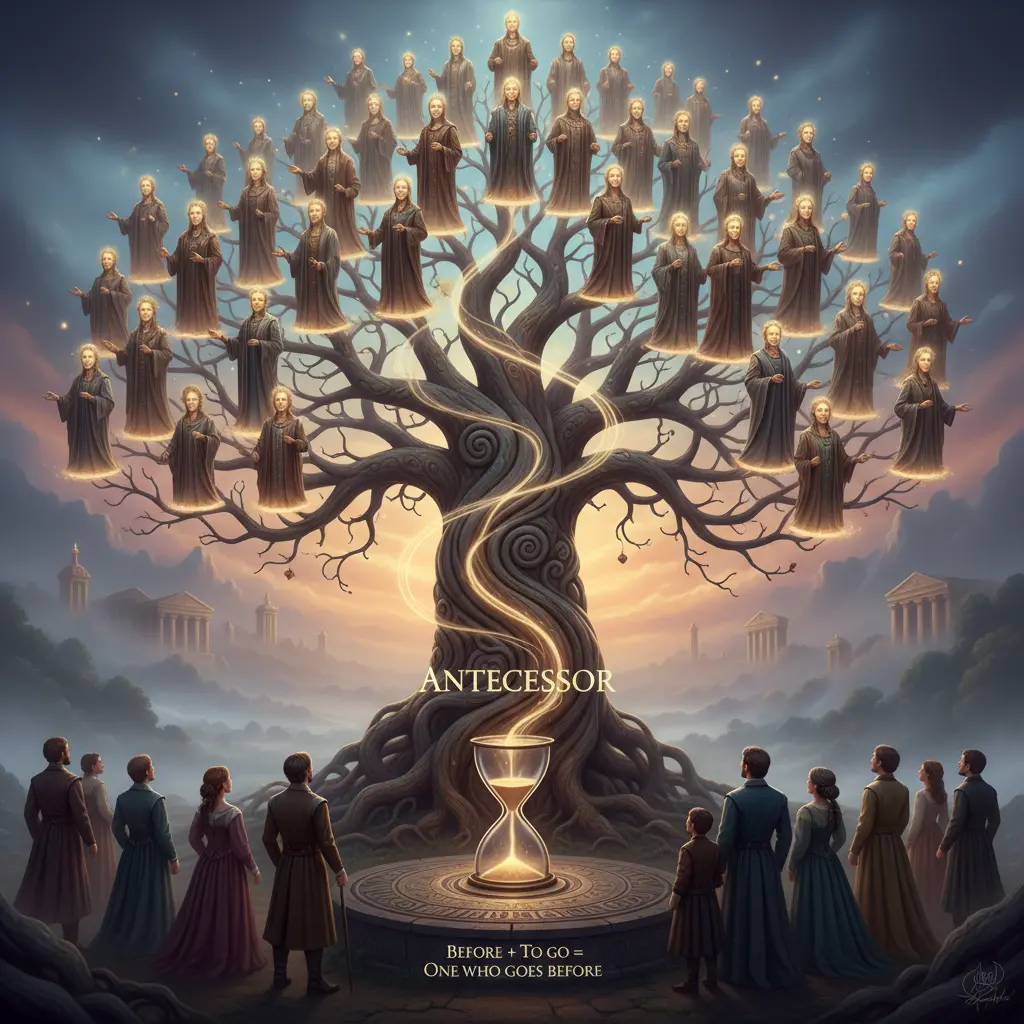
an- = before + cestor = to go; Latin 'antecessor', meaning 'one who goes before'. Imagine an ancient family tree with branches stretching to the past, where ancestors stand like wise figures guiding descendants.
Note 1: These definitions and etymologies are not standard dictionary definitions, but extended explanations provided to help with memorization and understanding of the actual application of words. Through this background information, we strive to make words more vivid and easier to understand, and help you remember their meanings in real life.
Note 2: LexiTalk designs the learning flow around the linguistics principle of “Comprehensible Input.” When learners encounter material that is slightly above their level but still understandable from context, the brain naturally absorbs the language. That’s why we keep every word inside authentic contexts, using examples and associations to help you understand it and use it flexibly.
Read the FAQ explanation of Comprehensible InputI hold a dusty photo album and turn the pages slowly. I push a memory forward, watching the faces in the pictures move toward the present. My hand steadies as I adjust how I see my own story. The sense of an ancestor settles in as I walk, a quiet presence I carry in my everyday life.
An ancestor is a person from whom you are descended, typically someone in your family tree who lived in earlier generations; the term can also refer to a forebear or the earliest form of something, such as the ancestor of a language or a species. It emphasizes lineage, history, and continuity across time. In everyday speech people say 'my ancestors' or 'our ancestors' to refer to forebears, while phrases like 'ancestral home' or 'ancestry' highlight roots and identity. The word contrasts with descendant, which denotes someone later in the line. It can also be used metaphorically for early versions of nonhuman things, like a tool's ancestor.
Learners of English often assume ancestors are only ancient, distant relatives; English uses 'ancestor' broadly for family history, language, and species, which may surprise speakers of languages with stricter kinship terms or fewer metaphorical uses.
What is the meaning of the word 'ancestor'?
In which sentence is the word 'ancestor' used correctly?
Which of the following is a synonym for 'ancestor'?
What is the opposite of 'ancestor'?
How does the concept of 'ancestor' apply in the context of genealogy?
Download LexiTalk app for personalized learning experience
Download AppCookies
We use cookies for essential site functions, analytics, and ads. You can accept, reject, or manage preferences. Privacy Policy