answers - Master This Word
Master this word with our 5-step learning method – Learn English in English
Train English Through Brain Routes, Not Translation.
This page helps you stop memorizing isolated translations and start understanding a word through its shared mental image, native-style thinking, and practical training steps.
Master this word with our 5-step learning method – Learn English in English
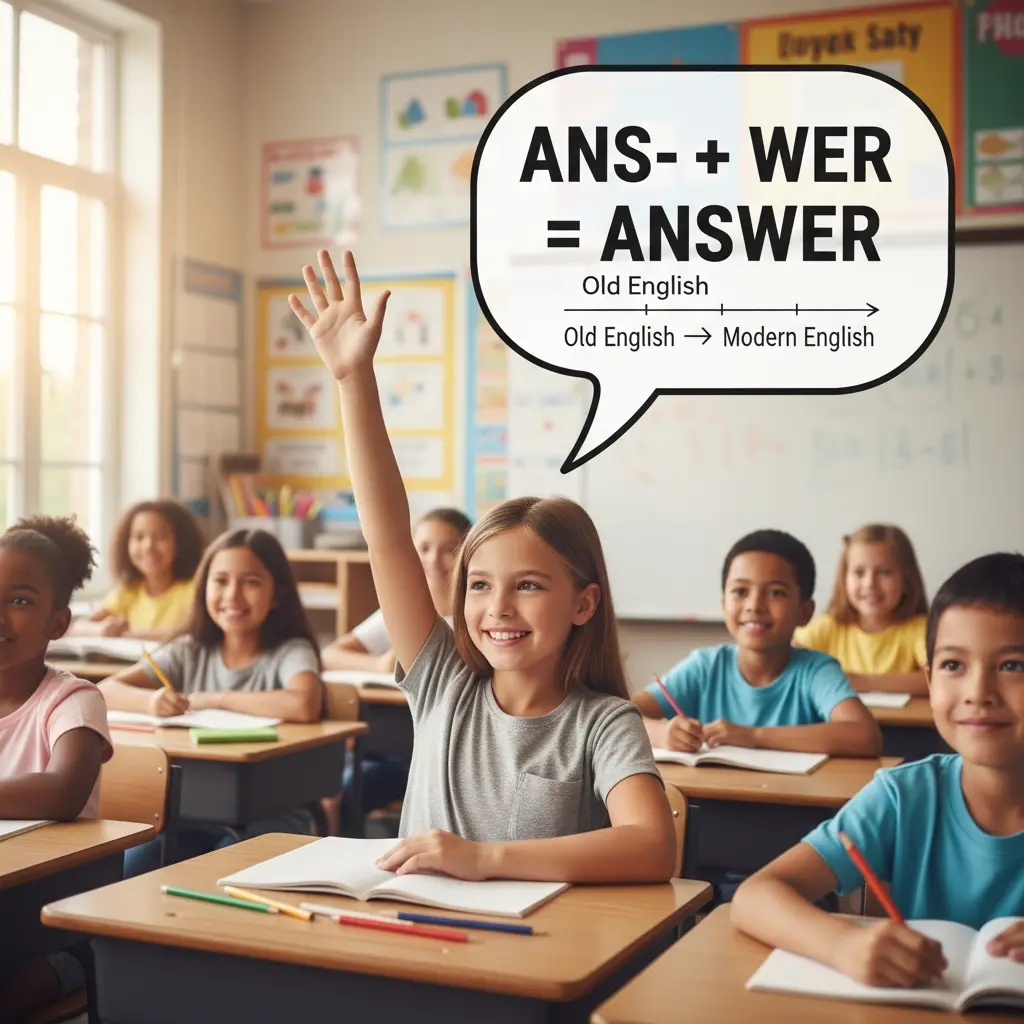
Example sentences are the start of understanding. Don't rush to memorize. First feel how the word works in a sentence.
Root: 'ans-' from Old English 'andswaru' (response) + 'wer-' (to speak). Historical origin: Old English → Middle English → Modern English. Memory image: Imagine someone raising their hand to respond in a classroom, symbolizing readiness to answer.
Note 1: These definitions and etymologies are not standard dictionary definitions, but extended explanations provided to help with memorization and understanding of the actual application of words. Through this background information, we strive to make words more vivid and easier to understand, and help you remember their meanings in real life.
Note 2: LexiTalk designs the learning flow around the linguistics principle of “Comprehensible Input.” When learners encounter material that is slightly above their level but still understandable from context, the brain naturally absorbs the language. That’s why we keep every word inside authentic contexts, using examples and associations to help you understand it and use it flexibly.
Read the FAQ explanation of Comprehensible InputI reach for my phone, press the answer button, and listen as the room quiets. A thread of ideas starts to move, I shift from doubt to focus, tightening my attention around what the question asks. I adjust my posture in my mind, hold back the noise, and set my mind on a possible reply, letting it settle in. The feel is practical and a little stubborn, like guiding a dial until it lands on the right spot, and that moment becomes the answer in use, ready to be shared or kept for later.
Answer operates as both verb and noun. As a verb, it means to respond to a question or request; as a noun, it denotes a solution, result, or reply. In everyday use, ‘answer’ emphasizes a concrete, direct response or a computed solution, whereas ‘reply’ can be more general or informal. Learners often confuse answer with respond or reply, or think ‘answer’ always refers to a solution rather than a person’s spoken response. Typical collocations include answer the phone, answer a question, give a correct/accurate answer, and the answer to the riddle. Notice the regular noun plural: answers; verb forms: answer, answers, answered, answering. Memory image: imagine a student raising a hand to answer in class.
In English, answer is a tight, formal term that can name a solution or a direct spoken reply; learners often overemphasize the 'solution' sense and neglect the spoken sense, or confuse with respond/reply in casual contexts.
What is the meaning of the word 'answers'?
Choose the sentence that uses 'answers' correctly.
Which of the following words is most similar to 'answers'?
What is the opposite of 'answers'?
Can you think of a real-life context where someone might provide solutions to inquiries?
Download LexiTalk app for personalized learning experience
Download AppCookies
We use cookies for essential site functions, analytics, and ads. You can accept, reject, or manage preferences. Privacy Policy