
argumentation - Master This Word
Master this word with our 5-step learning method – Learn English in English
Train English Through Brain Routes, Not Translation.
This page helps you stop memorizing isolated translations and start understanding a word through its shared mental image, native-style thinking, and practical training steps.
Master this word with our 5-step learning method – Learn English in English
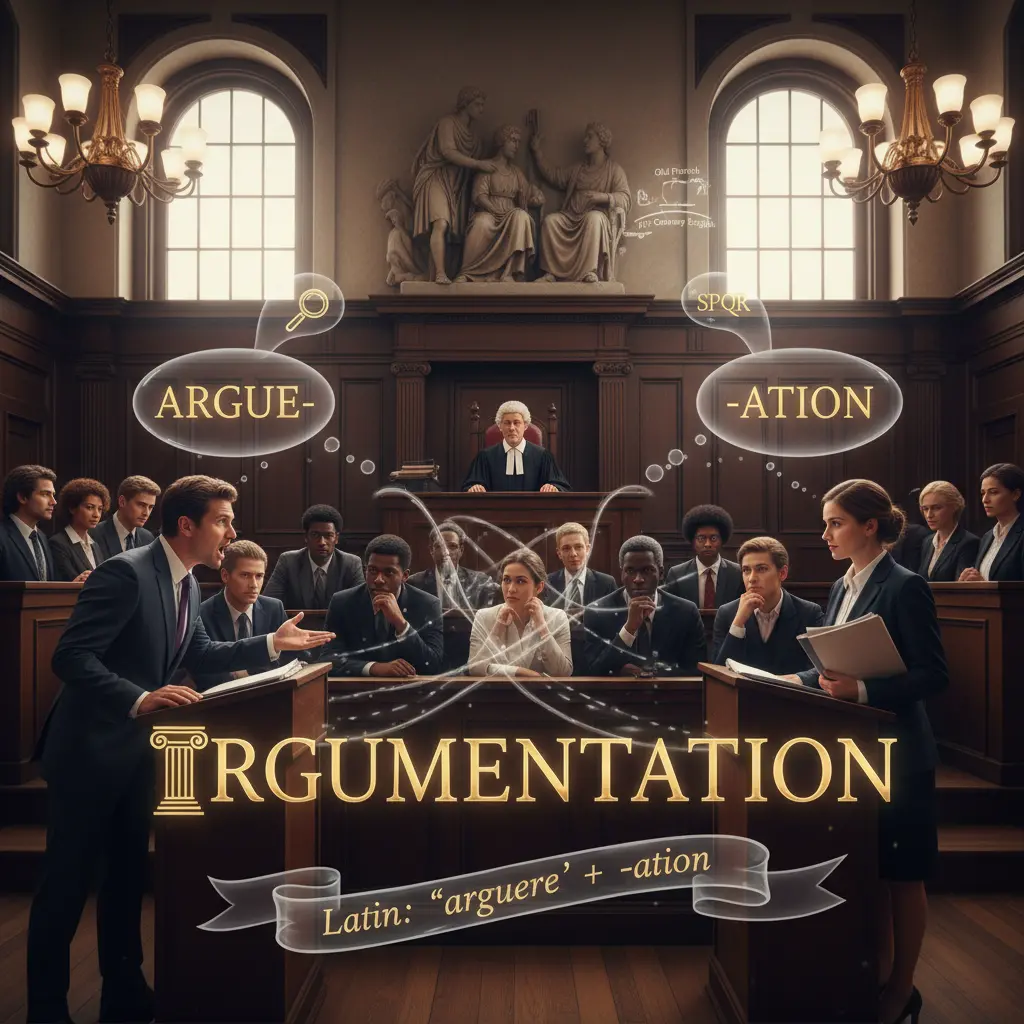
Example sentences are the start of understanding. Don't rush to memorize. First feel how the word works in a sentence.
The word is composed of 'argument-' (from Latin 'arguere' meaning 'to prove, make clear') + '-ation' (a suffix forming nouns). It originated in Latin, passed through Old French, and became established in English around the 16th century. Imagine a courtroom where lawyers passionately present their cases, employing reasoning and evidence to persuade the jury, which vividly illustrates the essence of argumentation.
Note 1: These definitions and etymologies are not standard dictionary definitions, but extended explanations provided to help with memorization and understanding of the actual application of words. Through this background information, we strive to make words more vivid and easier to understand, and help you remember their meanings in real life.
Note 2: LexiTalk designs the learning flow around the linguistics principle of “Comprehensible Input.” When learners encounter material that is slightly above their level but still understandable from context, the brain naturally absorbs the language. That’s why we keep every word inside authentic contexts, using examples and associations to help you understand it and use it flexibly.
Read the FAQ explanation of Comprehensible InputArgumentation is the careful, purposeful process of presenting reasons designed to support a claim or position. It combines clear claims, supporting evidence, logical connections, and acknowledged counterarguments to persuade an audience. Good argumentation does more than simply list opinions; it organizes ideas, cites credible sources, explains how evidence supports each claim, and anticipates objections. It also distinguishes between rhetoric and reasoning, aiming to demonstrate why a conclusion follows from the premises. Learners often confuse argumentation with arguing; the focus should be on structure, justification, and fair consideration of alternative viewpoints.
In English, argumentation is often framed as a formal structure of claim, evidence, and reasoning. Learners may overemphasize persuasive flair or rely on rhetorical devices rather than clear evidence and logical connections.
What is the definition of 'argumentation'?
Which sentence uses 'argumentation' correctly?
Which word is most similar to 'argumentation'?
What is the opposite of 'argumentation'?
Can you think of a real-life situation where reasoning is important?
Download LexiTalk app for personalized learning experience
Download AppCookies
We use cookies for essential site functions, analytics, and ads. You can accept, reject, or manage preferences. Privacy Policy