
as - Master This Word
Master this word with our 5-step learning method – Learn English in English
Train English Through Brain Routes, Not Translation.
This page helps you stop memorizing isolated translations and start understanding a word through its shared mental image, native-style thinking, and practical training steps.
Master this word with our 5-step learning method – Learn English in English
Example sentences are the start of understanding. Don't rush to memorize. First feel how the word works in a sentence.
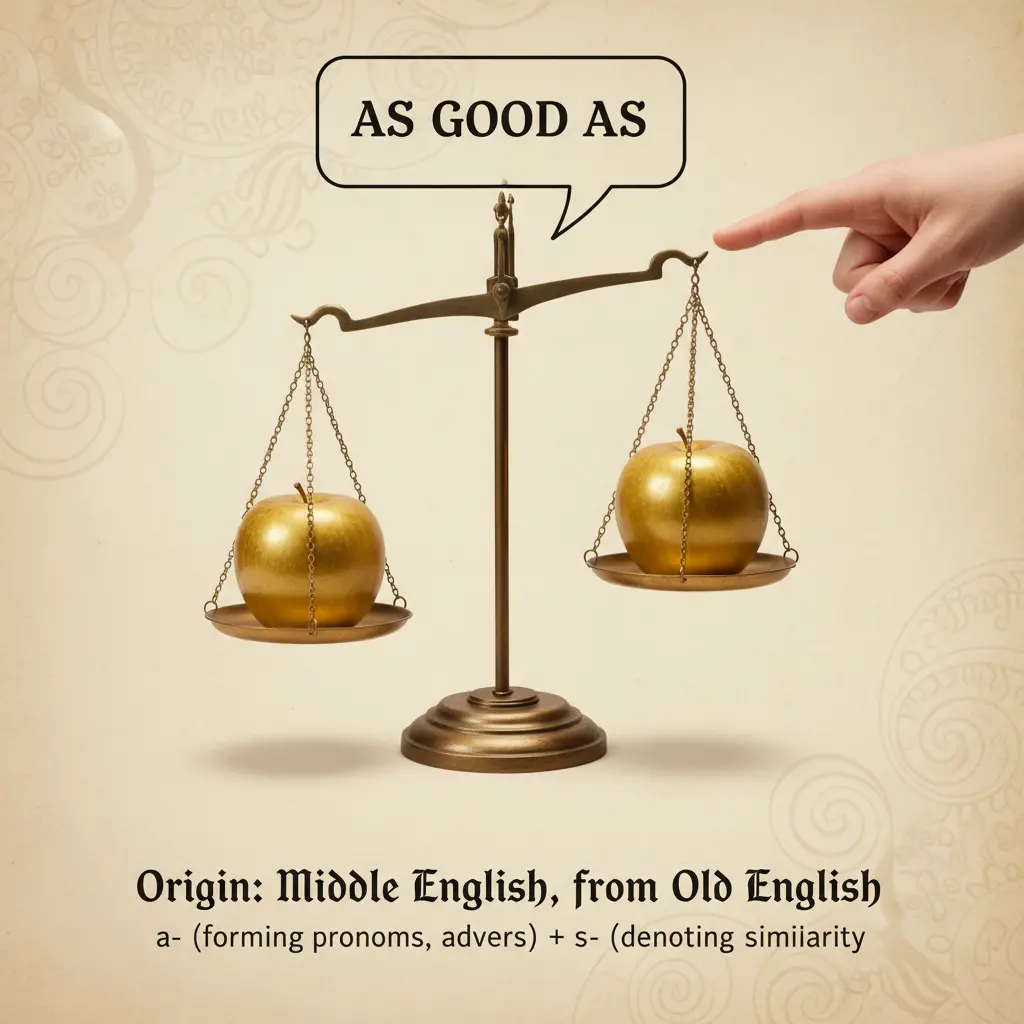
a- (forming pronouns, adverbs) + s- (denoting similarity); Origin: Middle English, from Old English. Memory image: Picture someone comparing two items, saying 'as good as' with both items visually represented.
Note 1: These definitions and etymologies are not standard dictionary definitions, but extended explanations provided to help with memorization and understanding of the actual application of words. Through this background information, we strive to make words more vivid and easier to understand, and help you remember their meanings in real life.
Note 2: LexiTalk designs the learning flow around the linguistics principle of “Comprehensible Input.” When learners encounter material that is slightly above their level but still understandable from context, the brain naturally absorbs the language. That’s why we keep every word inside authentic contexts, using examples and associations to help you understand it and use it flexibly.
Read the FAQ explanation of Comprehensible InputI set a mug on the desk and slide another beside it, watching the edges line up. As I shift closer, I feel the pull of balance and the need to adjust. I keep my hand steady, turn my wrist a fraction, and hold the position until the two cups feel the same in my palm. Later, in everyday talk, we use 'as' to link two ideas—doing something in the same way, or while one thing happens at the same time as another.
As is a small but versatile word that helps connect ideas in three broad ways: it can introduce a comparison, as in as tall as or as quickly as, to express equality of degree; it can mean in the same way as, or similarly to, with phrases like as you can see or as is true for many others; and it can signal time, meaning during the time that, as in As I was leaving. It also appears in fixed phrases like as well and in conditional-like uses such as as if. Learners often stumble over the different positions of as in sentences and may confuse its time sense with reason (because). Mastery comes from practicing the three core senses separately and noticing how context determines meaning.
Explain to an English speaker learning about as: emphasize its triple role (comparison, sameness, time) and how context decides which sense is active.
What is the meaning of the word 'as'?
How is the word 'as' commonly used in sentences?
Which word is similar to 'as'?
What is the opposite of 'as'?
In what real-life context would you hear or use the word 'as'?
Download LexiTalk app for personalized learning experience
Download AppCookies
We use cookies for essential site functions, analytics, and ads. You can accept, reject, or manage preferences. Privacy Policy