
assimilation - Master This Word
Master this word with our 5-step learning method – Learn English in English
Train English Through Brain Routes, Not Translation.
This page helps you stop memorizing isolated translations and start understanding a word through its shared mental image, native-style thinking, and practical training steps.
Master this word with our 5-step learning method – Learn English in English
Example sentences are the start of understanding. Don't rush to memorize. First feel how the word works in a sentence.
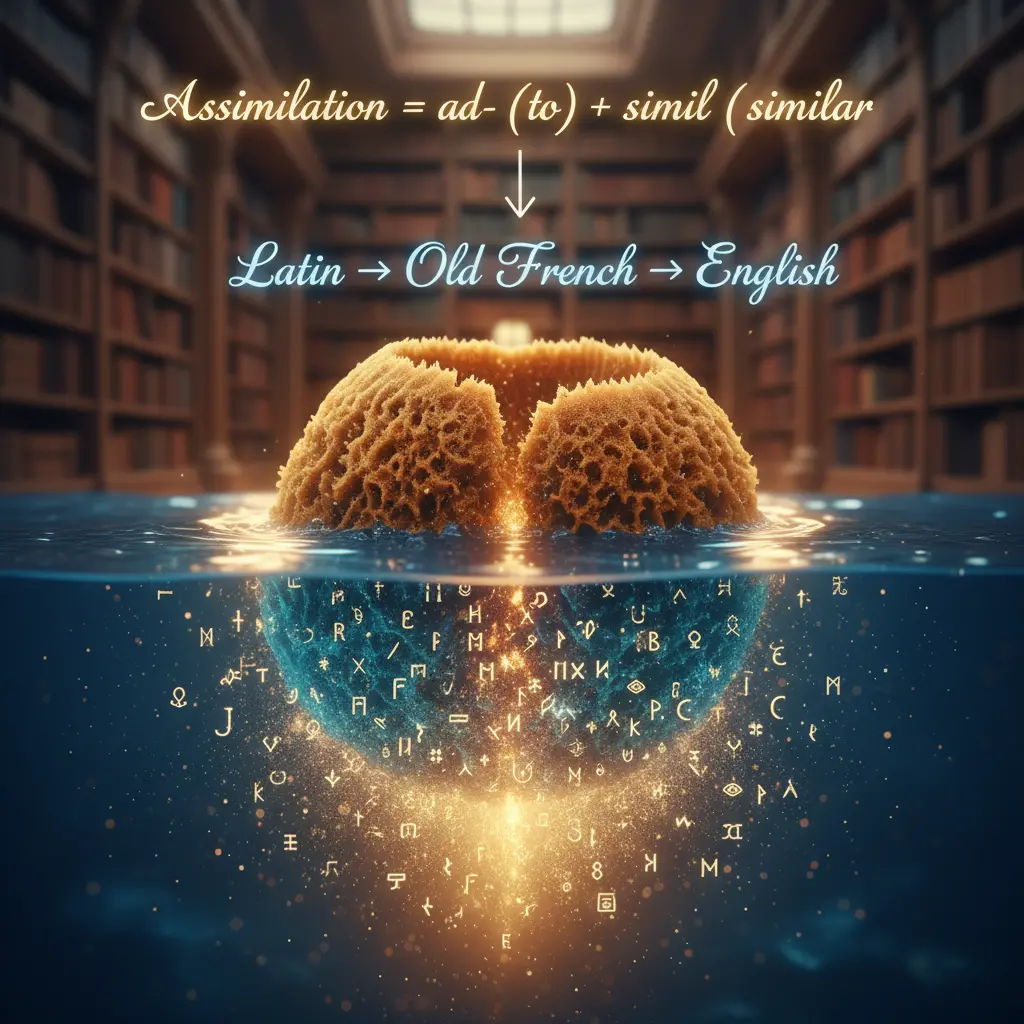
Assimilation = ad- (to) + simil (similar); Latin → Old French → English. Imagine a sponge soaking up water, becoming just like it, illustrating how cultures or ideas merge and adapt.
Note 1: These definitions and etymologies are not standard dictionary definitions, but extended explanations provided to help with memorization and understanding of the actual application of words. Through this background information, we strive to make words more vivid and easier to understand, and help you remember their meanings in real life.
Note 2: LexiTalk designs the learning flow around the linguistics principle of “Comprehensible Input.” When learners encounter material that is slightly above their level but still understandable from context, the brain naturally absorbs the language. That’s why we keep every word inside authentic contexts, using examples and associations to help you understand it and use it flexibly.
Read the FAQ explanation of Comprehensible InputAssimilation can describe how a new idea or culture is absorbed into an existing system, gradually becoming similar or indistinguishable. It covers social and cognitive processes: a minority community adopting the dominant language, customs, and institutions; a company integrating a foreign technology; or a learner incorporating new information into prior knowledge. In culture, assimilation is often contrasted with pluralism or multiculturalism; it can be voluntary or imposed. When ideas are assimilated, patterns, norms, and vocabularies merge, sometimes smoothing communication but also risking loss of distinct identities. The metaphor of a sponge soaking up water illustrates how differences fade as similarity increases, while the original material may still influence the whole.
Describe to an English speaker that assimilation is often seen as gradual blending over time, whereas some languages and cultures emphasize clear boundaries and identity. Learners may worry that any mixing erases difference, so explain the nuance and provide context.
What is the meaning of 'assimilation'?
Which of the following sentences uses 'assimilation' correctly?
What is a synonym for 'assimilation'?
What is an antonym for 'assimilation'?
How does 'assimilation' apply in real-world situations?
Download LexiTalk app for personalized learning experience
Download AppCookies
We use cookies for essential site functions, analytics, and ads. You can accept, reject, or manage preferences. Privacy Policy