beauty - Master This Word
Master this word with our 5-step learning method – Learn English in English
Train English Through Brain Routes, Not Translation.
This page helps you stop memorizing isolated translations and start understanding a word through its shared mental image, native-style thinking, and practical training steps.
Master this word with our 5-step learning method – Learn English in English
Example sentences are the start of understanding. Don't rush to memorize. First feel how the word works in a sentence.
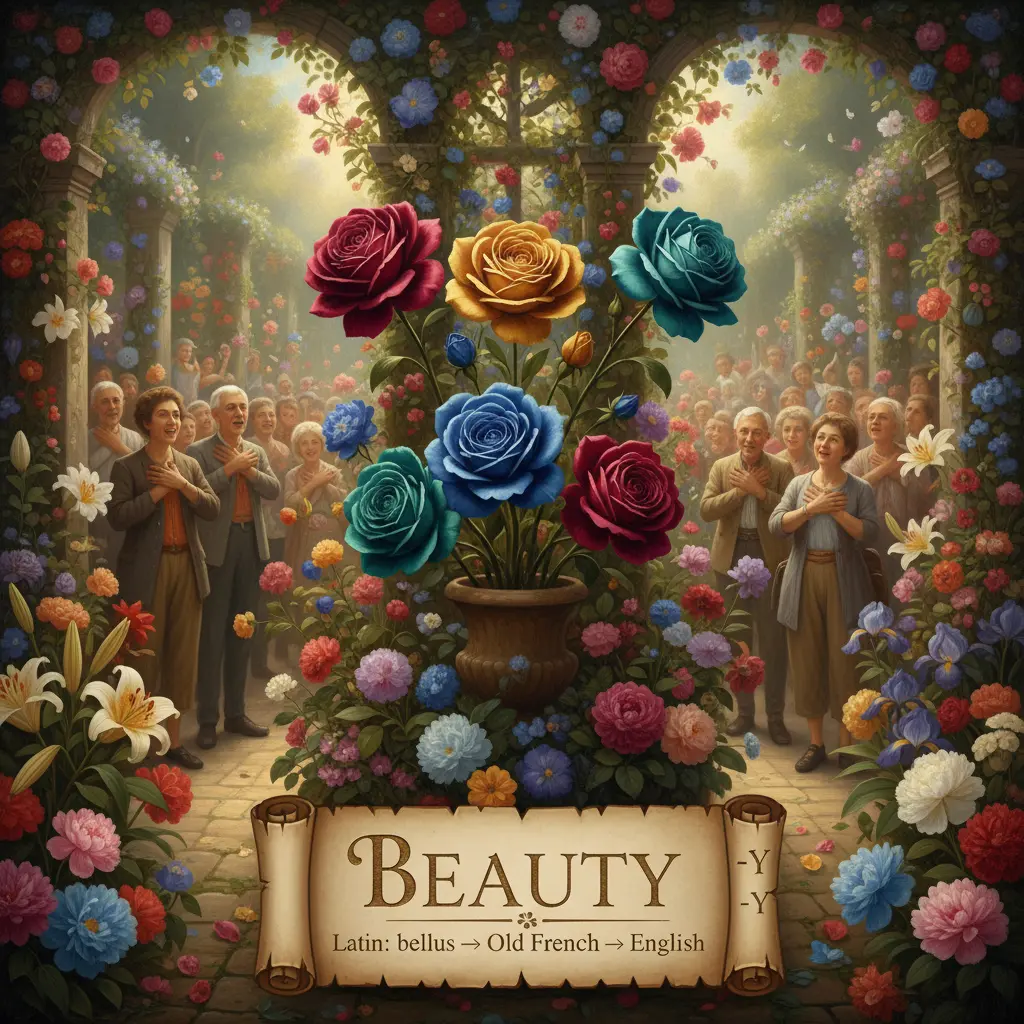
Root: beaut- (from Latin 'bellus' meaning 'pretty') + -y (a suffix forming nouns). Historical origin: Latin → Old French → English. Memory image: Imagine a beautiful flower blooming abundantly in a garden, its vibrant colors captivating everyone around.
Note 1: These definitions and etymologies are not standard dictionary definitions, but extended explanations provided to help with memorization and understanding of the actual application of words. Through this background information, we strive to make words more vivid and easier to understand, and help you remember their meanings in real life.
Note 2: LexiTalk designs the learning flow around the linguistics principle of “Comprehensible Input.” When learners encounter material that is slightly above their level but still understandable from context, the brain naturally absorbs the language. That’s why we keep every word inside authentic contexts, using examples and associations to help you understand it and use it flexibly.
Read the FAQ explanation of Comprehensible InputI lean closer to a painting, then I adjust my view as light shifts across the surface. My breath slows, my eyes hold carefully, and the scene seems to begin to change in my chest. The movement of color and form makes a quiet decision to keep looking, to notice how the whole feels right without words. In that moment, beauty no longer sits as a label but as a sense that grows when I stay attentive and let myself feel it.
Beauty refers to a quality that makes someone or something aesthetically appealing. In English, beauty can describe physical attractiveness, a pleasing combination of qualities that please the senses, or something that evokes admiration in general. It is both a tangible trait (a beautiful person) and a more abstract sense (the beauty of a landscape, music, or ideas). The word can be used as a countable noun, as in 'a beauty,' though more often we speak of beauty in a collective, uncountable sense. Beauty is also culturally relative: different cultures may value different features, and personal taste shapes judgments. Phrases like 'the beauty is in the eye of the beholder' highlight subjectivity.
English uses beauty for both appearances and abstract appeal; learners often mix up beauty as a trait with 'beautiful' as an adjective, and may assume beauty equals youth or a universal standard.
What does the word 'beauty' mean?
In which of the following sentences is 'beauty' used correctly?
Which word is similar to 'beauty'?
What is the opposite of 'beauty'?
How would you describe 'beauty' in a real-life context?
Download LexiTalk app for personalized learning experience
Download AppCookies
We use cookies for essential site functions, analytics, and ads. You can accept, reject, or manage preferences. Privacy Policy