behavioral - Master This Word
Master this word with our 5-step learning method – Learn English in English
Train English Through Brain Routes, Not Translation.
This page helps you stop memorizing isolated translations and start understanding a word through its shared mental image, native-style thinking, and practical training steps.
Master this word with our 5-step learning method – Learn English in English
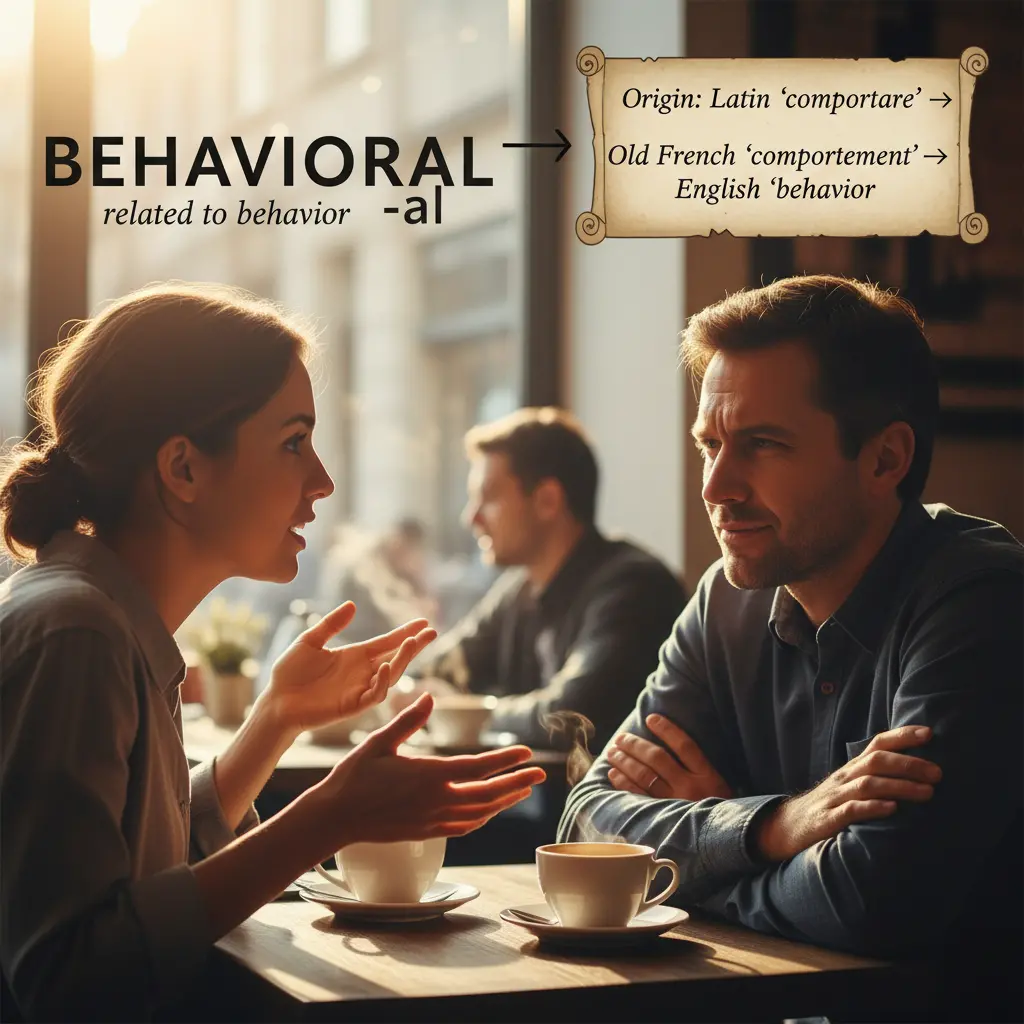
Example sentences are the start of understanding. Don't rush to memorize. First feel how the word works in a sentence.
behavioral: behavior (root) + -al (suffix) = related to behavior; Origin: Latin 'comportare' (to bear together) → Old French 'comportement' → English 'behavior'; Imagine a person listening carefully to another and adjusting their actions accordingly, showing their understanding of social behavior.
Note 1: These definitions and etymologies are not standard dictionary definitions, but extended explanations provided to help with memorization and understanding of the actual application of words. Through this background information, we strive to make words more vivid and easier to understand, and help you remember their meanings in real life.
Note 2: LexiTalk designs the learning flow around the linguistics principle of “Comprehensible Input.” When learners encounter material that is slightly above their level but still understandable from context, the brain naturally absorbs the language. That’s why we keep every word inside authentic contexts, using examples and associations to help you understand it and use it flexibly.
Read the FAQ explanation of Comprehensible InputFirst I reach for a switch and move my fingers to turn it on. The light shifts and the room feels different, and I adjust my stance to stay steady. I notice whether my face relaxes or tightens, a quick read of my own behavior in the moment. That tiny scene shows how behavioral conduct unfolds in everyday actions and how I shape what comes next.
Behavioral describes anything related to actions, conduct, and the way a person behaves in response to situations. It is often contrasted with cognitive or physiological aspects, and it appears in fields like behavioral psychology, behavioral science, and behavioral analysis. The suffix -al marks it as an adjective derived from behavior, and you will see phrases such as behavioral changes, behavioral traits, and behavioral patterns. In everyday speech, people might refer to a behavioral issue, a behavioral study, or a behavioral approach to training. When you use the word, keep in mind its emphasis on observable actions rather than thoughts alone.
In English, 'behavioral' is often used to emphasize observable actions and patterns, while some learners try to map it too narrowly to personality or 'good/bad' judgments. Focus on contexts like psychology, education, and behavioral studies to avoid overgeneralizing.
What is the meaning of 'behavioral'?
In which of the following sentences is 'behavioral' used correctly?
Which word is a synonym of 'behavioral'?
Which word is an antonym of 'behavioral'?
How would you apply the concept of 'behavioral' in a real-life context?
Download LexiTalk app for personalized learning experience
Download AppCookies
We use cookies for essential site functions, analytics, and ads. You can accept, reject, or manage preferences. Privacy Policy