biases - Master This Word
Master this word with our 5-step learning method – Learn English in English
Train English Through Brain Routes, Not Translation.
This page helps you stop memorizing isolated translations and start understanding a word through its shared mental image, native-style thinking, and practical training steps.
Master this word with our 5-step learning method – Learn English in English
Example sentences are the start of understanding. Don't rush to memorize. First feel how the word works in a sentence.
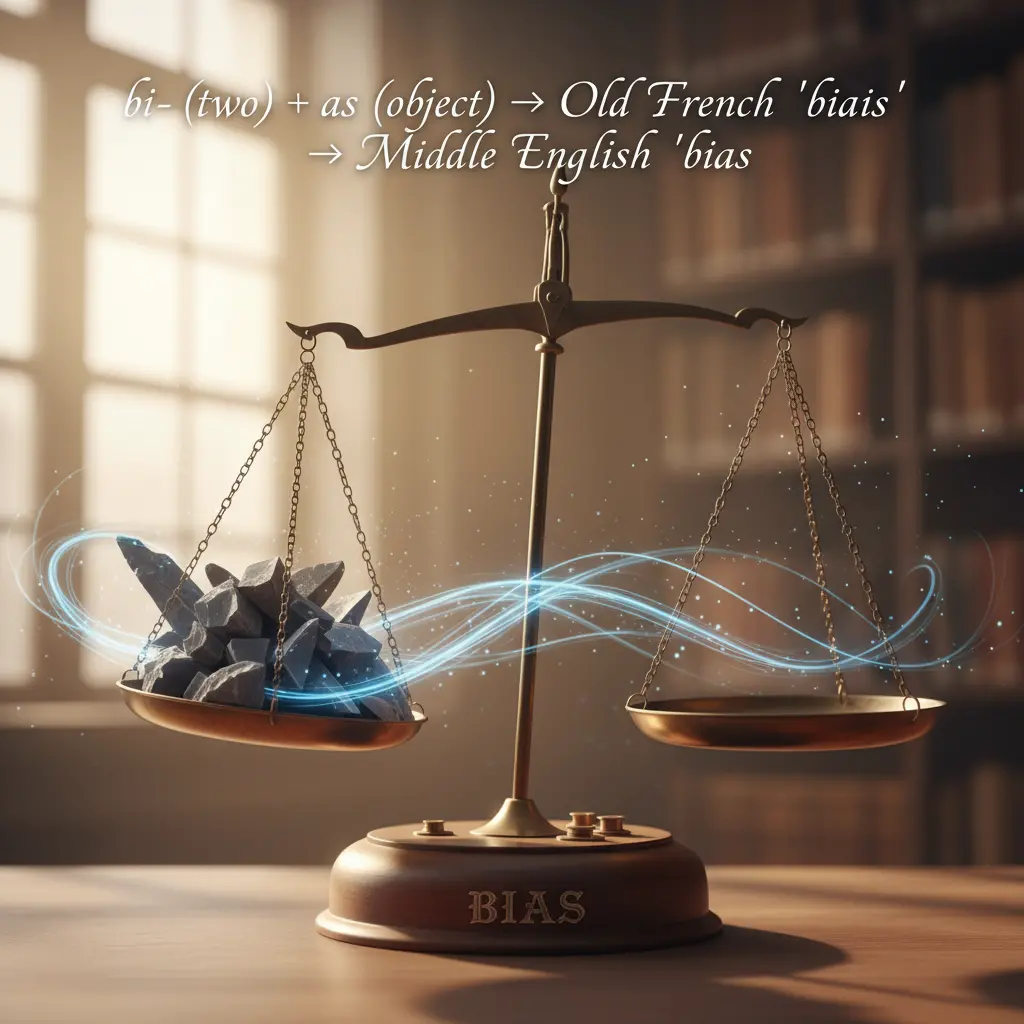
bias = bi- (two) + as (object) → Old French 'biais' → Middle English 'bias'. Imagine seeing a set of scales tipping unevenly with one side weighed down, symbolizing how bias can distort fairness.
Note 1: These definitions and etymologies are not standard dictionary definitions, but extended explanations provided to help with memorization and understanding of the actual application of words. Through this background information, we strive to make words more vivid and easier to understand, and help you remember their meanings in real life.
Note 2: LexiTalk designs the learning flow around the linguistics principle of “Comprehensible Input.” When learners encounter material that is slightly above their level but still understandable from context, the brain naturally absorbs the language. That’s why we keep every word inside authentic contexts, using examples and associations to help you understand it and use it flexibly.
Read the FAQ explanation of Comprehensible InputI move my attention like a knob I turn, watching thoughts slide toward one option. I settle on that path and hold back other ideas, letting the choice pull focus forward. The effort feels small but real, a push and pull between options, and I adjust as new clues come in. That tipping moment—bias in action—shapes what I notice next.
Bias is a tendency to favor one thing over another, and it can shape how we think, judge, and act, sometimes without our awareness. In everyday speech, bias often refers to personal preferences that tilt decisions, while in statistics it means a systematic error that distorts results. People can display bias in evaluating people, reports, or choices, and institutions may have bias in policy or procedures. Distinguishing bias from prejudice or stereotype helps learners use the word accurately. As a verb, bias means to influence unfairly, such as an editor biasing coverage; as a noun, it can describe the inclination itself.
In English, bias is often discussed as a cognitive tilt or a measurable error, with clear distinctions from prejudice or discrimination. Learners may mix up biased judgment with outright hostility, or confuse bias in statistics with personal prejudice.
What does the word 'biases' mean?
Identify the correct usage of the word 'biases' in a sentence.
Which word is most similar to 'biases'?
What is the opposite of 'biases'?
Can you think of a real-life context where biases might play a role?
Download LexiTalk app for personalized learning experience
Download AppCookies
We use cookies for essential site functions, analytics, and ads. You can accept, reject, or manage preferences. Privacy Policy