capability - Master This Word
Master this word with our 5-step learning method – Learn English in English
Train English Through Brain Routes, Not Translation.
This page helps you stop memorizing isolated translations and start understanding a word through its shared mental image, native-style thinking, and practical training steps.
Master this word with our 5-step learning method – Learn English in English
Example sentences are the start of understanding. Don't rush to memorize. First feel how the word works in a sentence.
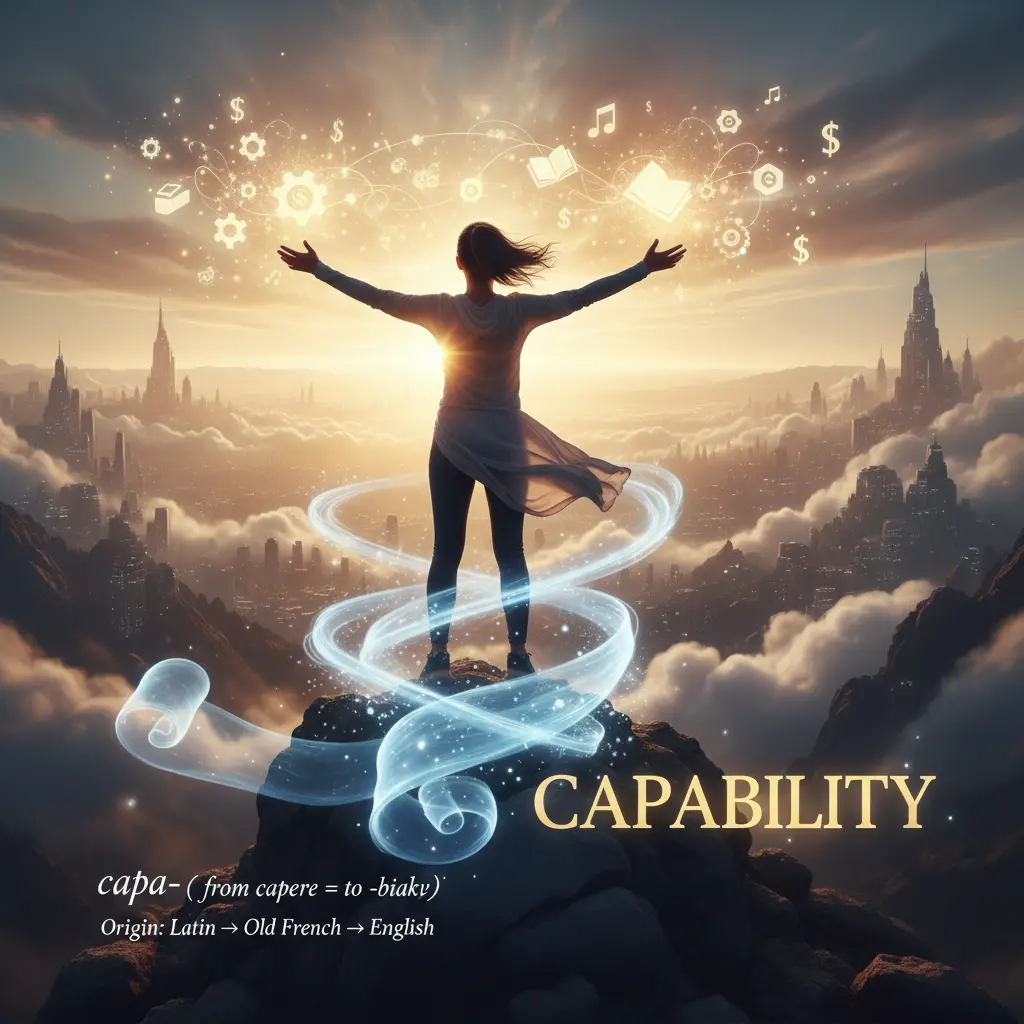
capability = capa- (from capere = to take) + -bility (suffix indicating ability). Origin: Latin → Old French → English. Imagine a person stretching out their hands to 'take' opportunities, symbolizing their capability to achieve anything.
Note 1: These definitions and etymologies are not standard dictionary definitions, but extended explanations provided to help with memorization and understanding of the actual application of words. Through this background information, we strive to make words more vivid and easier to understand, and help you remember their meanings in real life.
Note 2: LexiTalk designs the learning flow around the linguistics principle of “Comprehensible Input.” When learners encounter material that is slightly above their level but still understandable from context, the brain naturally absorbs the language. That’s why we keep every word inside authentic contexts, using examples and associations to help you understand it and use it flexibly.
Read the FAQ explanation of Comprehensible InputI place my hand on the keyboard, press a key, and watch the screen respond. I move the mouse, shift my stance, and change the pace as the code runs. I adjust my grip, hold steady, and keep nudging until the result appears. That small moment of control reveals capability—not a label, but the sense that I can steer the outcome in real tasks.
Capability refers to the power or capacity to do something, including both a person’s developed skills and a system’s possible functions. It sits between ability and potential: it can describe a mastered competence, the features that enable a device or software to work, or the untapped opportunities a person might develop in the future. When you say someone has the capability to learn quickly, you emphasize not just one skill but a range of abilities coming together. Learners should note that capability is often more formal or technical than simply saying you can do something; it also highlights possible, not yet realized talent.
Meta note: English treats capability as a broad, sometimes formal notion that covers skills, features, and potential; learners should distinguish it from ability (skill) and capacity (size/volume) and avoid overgeneralizing to everyday talk.
What is the meaning of the word 'capability'?
How is the word 'capability' used in a sentence?
Which word is similar to 'capability'?
What is the opposite of 'capability'?
In what real-life context would you hear the word 'capability'?
English Learning Listening Content
Listen NowDownload LexiTalk app for personalized learning experience
Download AppCookies
We use cookies for essential site functions, analytics, and ads. You can accept, reject, or manage preferences. Privacy Policy