
cartilage - Master This Word
Master this word with our 5-step learning method – Learn English in English
Train English Through Brain Routes, Not Translation.
This page helps you stop memorizing isolated translations and start understanding a word through its shared mental image, native-style thinking, and practical training steps.
Master this word with our 5-step learning method – Learn English in English
Example sentences are the start of understanding. Don't rush to memorize. First feel how the word works in a sentence.
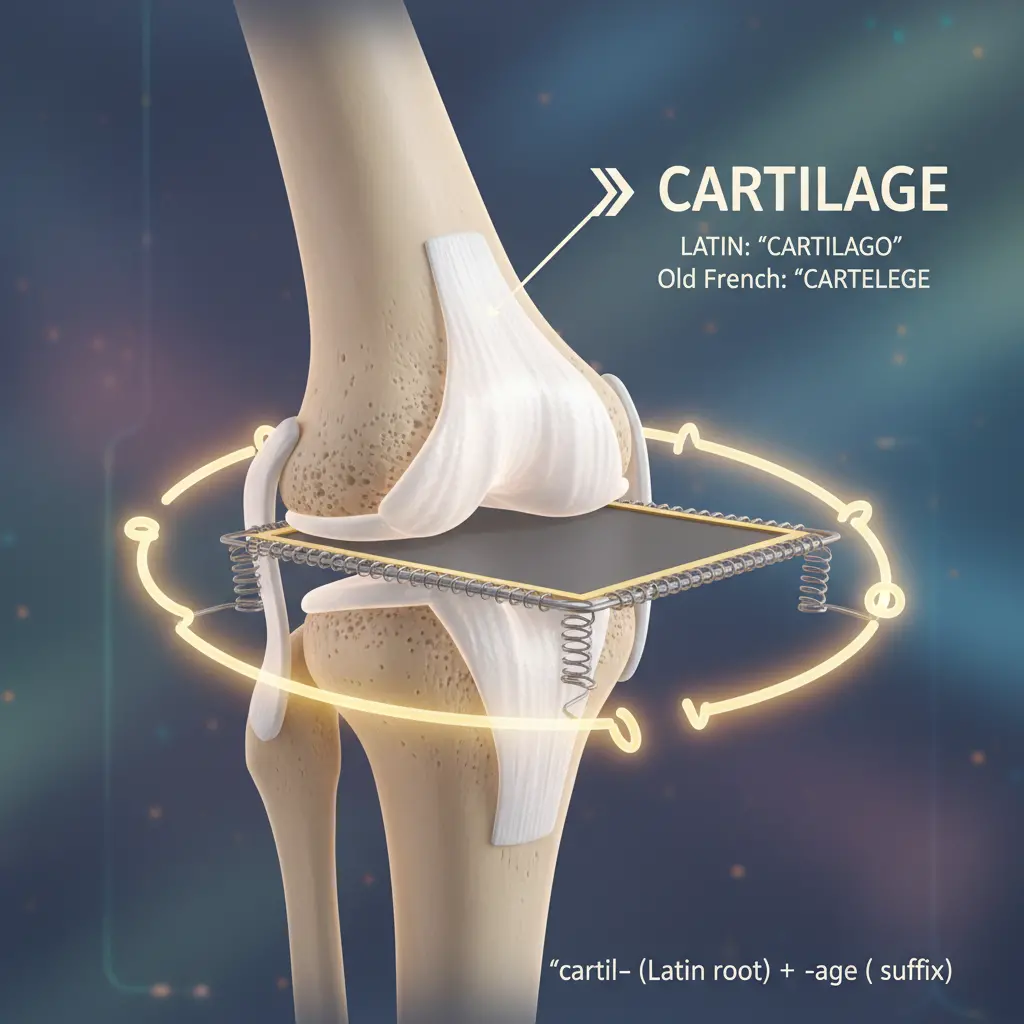
Root decomposition: 'cartil-' (Latin) + suffix '-age'. Historical origin: from Latin 'cartilago', to Old French 'cartelege', then to English. Memory image: visualize a flexible, rubbery material that cushions your joints, like the soft, bouncy feeling of a trampoline under your feet.
Note 1: These definitions and etymologies are not standard dictionary definitions, but extended explanations provided to help with memorization and understanding of the actual application of words. Through this background information, we strive to make words more vivid and easier to understand, and help you remember their meanings in real life.
Note 2: LexiTalk designs the learning flow around the linguistics principle of “Comprehensible Input.” When learners encounter material that is slightly above their level but still understandable from context, the brain naturally absorbs the language. That’s why we keep every word inside authentic contexts, using examples and associations to help you understand it and use it flexibly.
Read the FAQ explanation of Comprehensible InputCartilage is a flexible connective tissue found in joints, the tip of the nose, and the outer ears. It cushions bones where they meet, helping joints move smoothly, and it shapes the nose and ears. Unlike bone, cartilage has little or no blood supply, so injuries heal slowly. The word comes from Latin cartilago, with the suffix -age indicating a material or state, and it entered English via Old French. A memorable image is a soft, rubbery cushion that absorbs impact, like a trampoline under your feet. In everyday language we speak of cartilage damage, cartilage repair, and joint health, especially for athletes and older adults.
Explain to an English speaker: cartilage is a tissue not bone; learners often mix it up with cartridge or treat it as a bone-like substance. Emphasize its cushioning role and typical uncountable use.
What is the meaning of the word 'cartilage'?
Which sentence uses the word 'cartilage' correctly?
Which word is most similar to 'cartilage'?
What is the opposite of 'cartilage'?
Can you give an example of a real-life scenario where cartilage is important?
Download LexiTalk app for personalized learning experience
Download AppCookies
We use cookies for essential site functions, analytics, and ads. You can accept, reject, or manage preferences. Privacy Policy