census - Master This Word
Master this word with our 5-step learning method – Learn English in English
Train English Through Brain Routes, Not Translation.
This page helps you stop memorizing isolated translations and start understanding a word through its shared mental image, native-style thinking, and practical training steps.
Master this word with our 5-step learning method – Learn English in English
Example sentences are the start of understanding. Don't rush to memorize. First feel how the word works in a sentence.
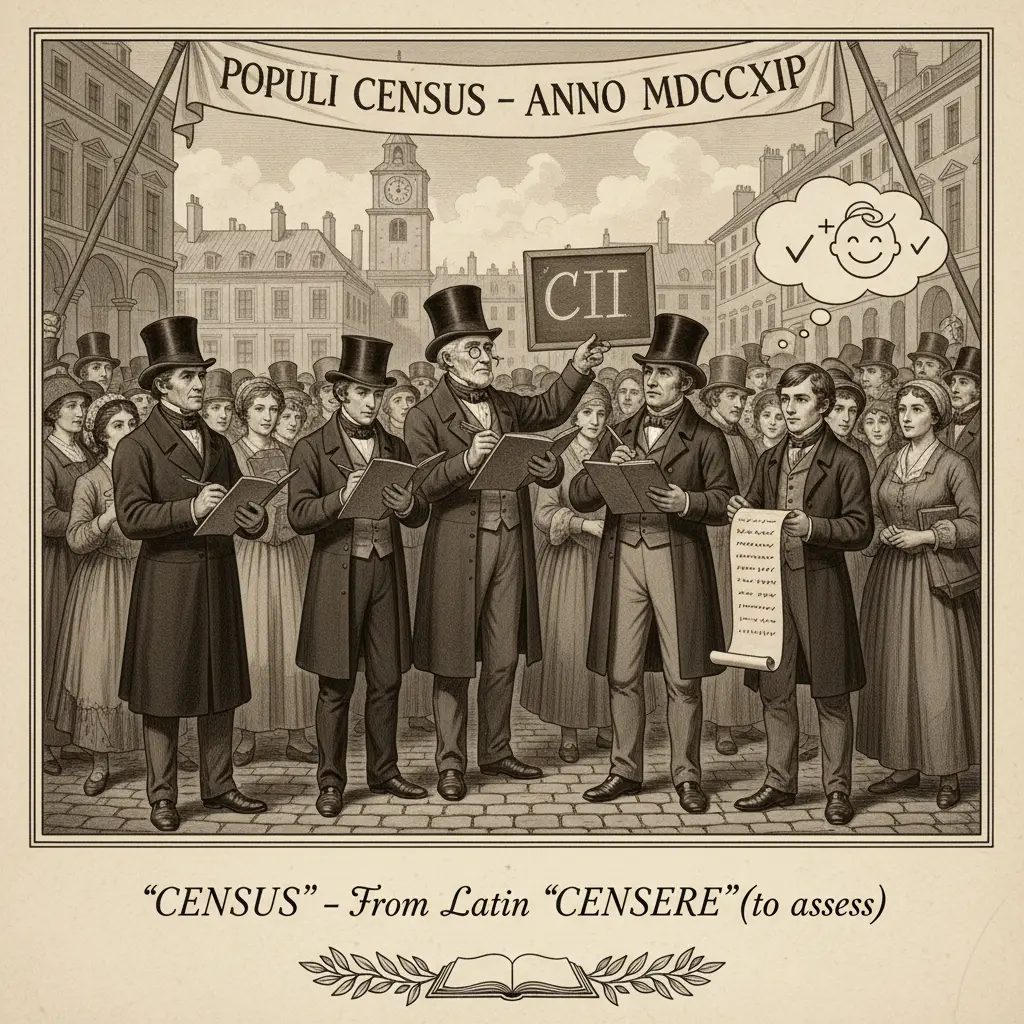
Root decomposition: 'cens-' (from Latin 'censere' meaning 'to assess') + 'us' (noun suffix). Historical origin: Latin 'census' → Old French 'cens' → English 'census'. Memory image: Imagine a group of officials counting people in a crowd, each tick marking a head in their tally.
Note 1: These definitions and etymologies are not standard dictionary definitions, but extended explanations provided to help with memorization and understanding of the actual application of words. Through this background information, we strive to make words more vivid and easier to understand, and help you remember their meanings in real life.
Note 2: LexiTalk designs the learning flow around the linguistics principle of “Comprehensible Input.” When learners encounter material that is slightly above their level but still understandable from context, the brain naturally absorbs the language. That’s why we keep every word inside authentic contexts, using examples and associations to help you understand it and use it flexibly.
Read the FAQ explanation of Comprehensible InputA census is an official count of a population, often conducted by government agencies at regular intervals. It gathers basic information such as age, gender, and housing, and may include questions on education, employment, and household composition. The purpose is to provide data to plan services, allocate resources, and inform policy. The term comes from Latin census, meaning an assessment. In many countries a decennial census is typical, though some nations conduct more frequent surveys. People sometimes confuse a census with a survey or poll; a census aims to count every person, not just a sample. In everyday language you might say a census is taken or conducted.
English tends to separate census (official count) from survey/poll (sampling). Learners often mix the two, and may assume a census is always yearly or that personal data are publicly released.
What is the meaning of the word 'census'?
In which of the following sentences is the word 'census' used correctly?
Which of the following is an antonym of 'census'?
In what real-life context would you expect to hear the word 'census'?
Reflect on the importance of conducting a census. Why is it necessary?
Download LexiTalk app for personalized learning experience
Download AppCookies
We use cookies for essential site functions, analytics, and ads. You can accept, reject, or manage preferences. Privacy Policy