cleared - Master This Word
Master this word with our 5-step learning method – Learn English in English
Train English Through Brain Routes, Not Translation.
This page helps you stop memorizing isolated translations and start understanding a word through its shared mental image, native-style thinking, and practical training steps.
Master this word with our 5-step learning method – Learn English in English
Example sentences are the start of understanding. Don't rush to memorize. First feel how the word works in a sentence.
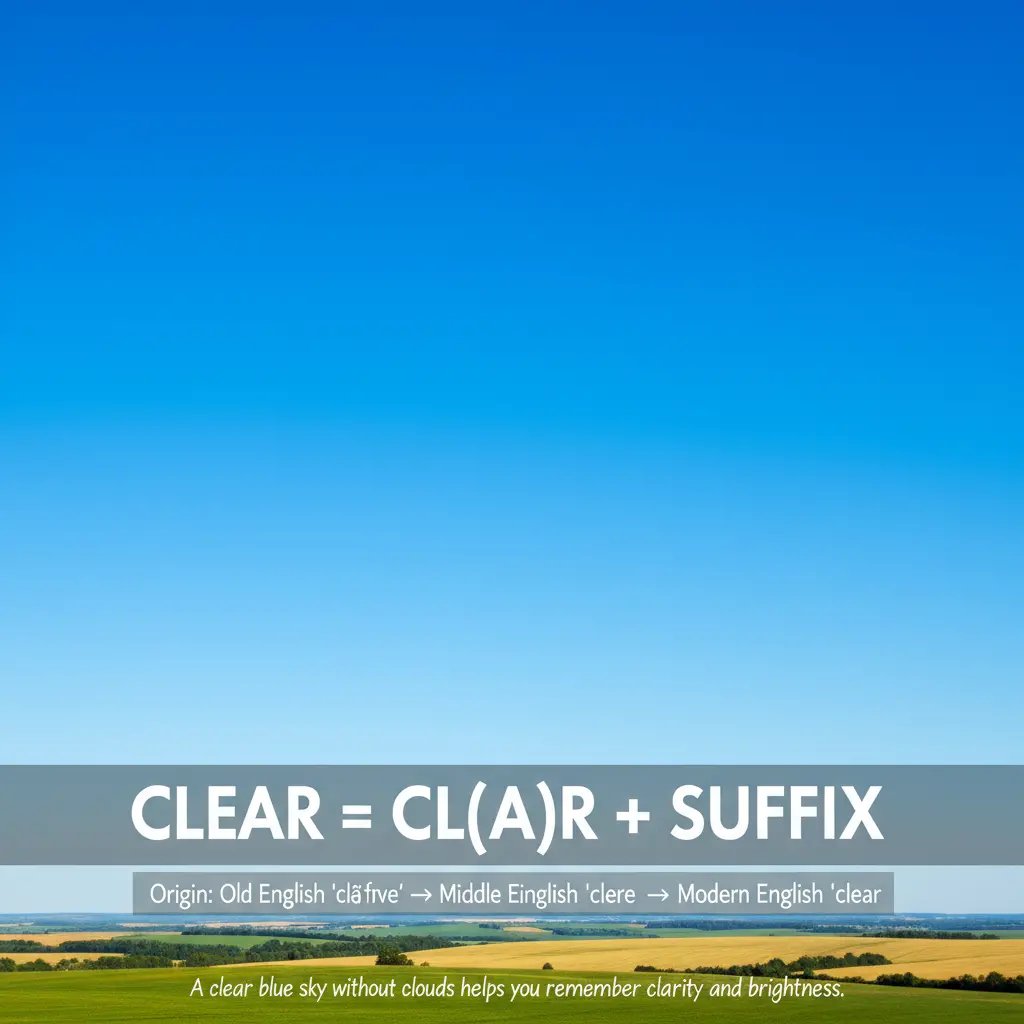
clear = cle(a)r + suffix; Origin: Old English 'clæfre' → Middle English 'clere' → Modern English 'clear'. Imagine a clear blue sky without clouds—this helps you remember clarity and brightness.
Note 1: These definitions and etymologies are not standard dictionary definitions, but extended explanations provided to help with memorization and understanding of the actual application of words. Through this background information, we strive to make words more vivid and easier to understand, and help you remember their meanings in real life.
Note 2: LexiTalk designs the learning flow around the linguistics principle of “Comprehensible Input.” When learners encounter material that is slightly above their level but still understandable from context, the brain naturally absorbs the language. That’s why we keep every word inside authentic contexts, using examples and associations to help you understand it and use it flexibly.
Read the FAQ explanation of Comprehensible InputFirst I move the blind cord and push the slats a fraction, and the room brightens as the air shifts. The view begins to clear, edges sharpening and shadows loosening, and my mind follows the change with a slow breath. I adjust my grip, keep the rhythm steady, and see how easy it feels to interpret what is ahead. When the space opens up, I realize clear is not a rule but a moment of space made by my own slight turn and steady hands.
Clear is a versatile word with several related ideas. As an adjective it describes something free from darkness, cloudiness, or obstructions, such as a clear sky, a clear view, or clear water. It can also mean easy to perceive, understand, or interpret, as in a clear explanation, a clear message, or a clear distinction. As a verb, to clear means to remove obstacles, clutter, or debris, or to make space by clearing a surface or a path. Learners often mix the senses, thinking that clear only concerns brightness or that it always means simple, but in English it also covers transparency, accuracy, and the act of clearing or resolving a problem.
Explain to an English speaker: English often uses clear for both visible light and mental clarity, but learners should recognize distinct collocations and the verb sense related to removing obstacles or making space.
Download LexiTalk app for personalized learning experience
Download AppCookies
We use cookies for essential site functions, analytics, and ads. You can accept, reject, or manage preferences. Privacy Policy