
coercive - Master This Word
Master this word with our 5-step learning method – Learn English in English
Train English Through Brain Routes, Not Translation.
This page helps you stop memorizing isolated translations and start understanding a word through its shared mental image, native-style thinking, and practical training steps.
Master this word with our 5-step learning method – Learn English in English
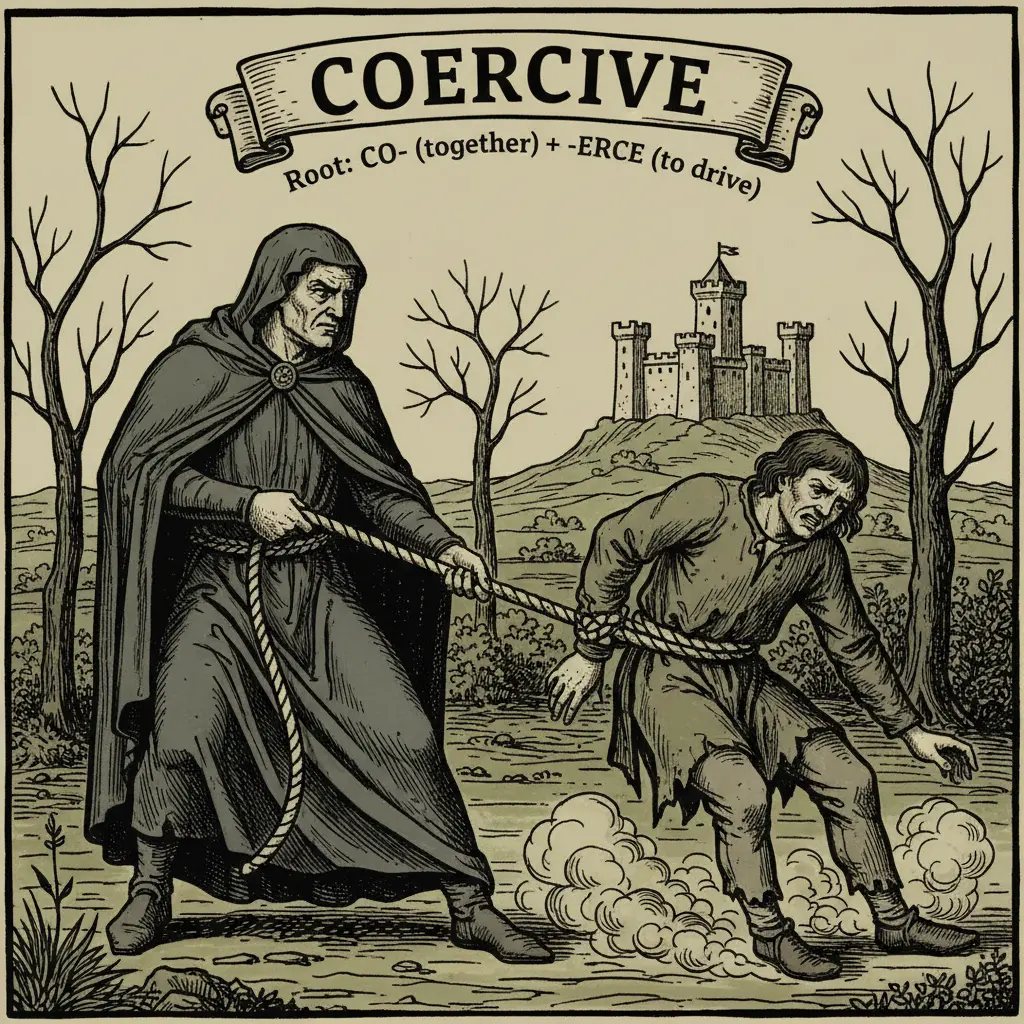
Example sentences are the start of understanding. Don't rush to memorize. First feel how the word works in a sentence.
Root: co- (together) + -erce (to drive). Historical origin: From Latin 'coercere' → Old French 'coercif' → English 'coercive'. Memory image: Imagine a person holding a rope tied to someone else, implying they are being 'pulled' into action against their will.
Note 1: These definitions and etymologies are not standard dictionary definitions, but extended explanations provided to help with memorization and understanding of the actual application of words. Through this background information, we strive to make words more vivid and easier to understand, and help you remember their meanings in real life.
Note 2: LexiTalk designs the learning flow around the linguistics principle of “Comprehensible Input.” When learners encounter material that is slightly above their level but still understandable from context, the brain naturally absorbs the language. That’s why we keep every word inside authentic contexts, using examples and associations to help you understand it and use it flexibly.
Read the FAQ explanation of Comprehensible InputCoercive describes actions or tactics designed to compel someone to act through force, threats, or intimidation rather than by their free choice. It can apply to formal contexts like law enforcement or negotiation, as well as informal settings such as relationships or workplaces where power imbalances push a person to comply. The term signals that autonomy has been overridden, often leaving the affected person feeling pressured, trapped, or obligated even if they do not want to consent. In discussions of rights, consent, and human dignity, coercive methods are highlighted as unacceptable and harmful, underscoring why boundaries and autonomy matter in social dealings.
In English, coercive emphasizes force or threats that override a person’s will, often with moral or legal weight. Learners tend to mix it up with 'forceful' or 'persuasive' without recognizing the coercive element is about power and control, not just effort or determination.
What does the word 'coercive' mean?
Choose the sentence that uses 'coercive' correctly.
Which word is most similar to 'coercive'?
What is the opposite of 'coercive'?
Can you think of a real-life scenario where someone used manipulation to achieve a goal?
Download LexiTalk app for personalized learning experience
Download AppCookies
We use cookies for essential site functions, analytics, and ads. You can accept, reject, or manage preferences. Privacy Policy