
compulsory - Master This Word
Master this word with our 5-step learning method – Learn English in English
Train English Through Brain Routes, Not Translation.
This page helps you stop memorizing isolated translations and start understanding a word through its shared mental image, native-style thinking, and practical training steps.
Master this word with our 5-step learning method – Learn English in English
Example sentences are the start of understanding. Don't rush to memorize. First feel how the word works in a sentence.
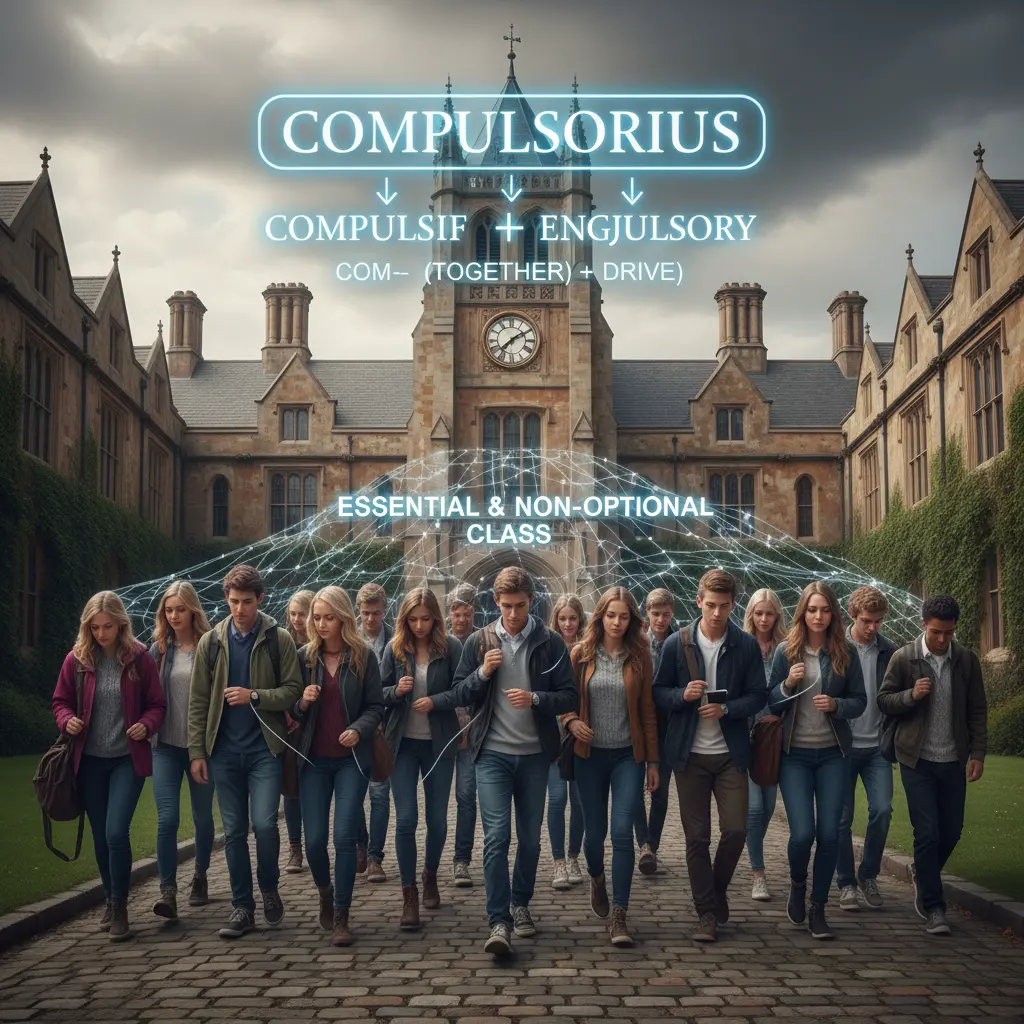
Root decomposition: 'com-' (together) + 'puls' (drive). Historical origin: Latin 'compulsorius', from 'compellere' → Old French 'compulsif' → English. Memory image: Imagine a group of students compelled (driven together) to attend a class they cannot skip, illustrating the essential, non-optional nature of 'compulsory'.
Note 1: These definitions and etymologies are not standard dictionary definitions, but extended explanations provided to help with memorization and understanding of the actual application of words. Through this background information, we strive to make words more vivid and easier to understand, and help you remember their meanings in real life.
Note 2: LexiTalk designs the learning flow around the linguistics principle of “Comprehensible Input.” When learners encounter material that is slightly above their level but still understandable from context, the brain naturally absorbs the language. That’s why we keep every word inside authentic contexts, using examples and associations to help you understand it and use it flexibly.
Read the FAQ explanation of Comprehensible InputI push open the gym door and pull the strap of my backpack tighter as the coach points to the lineup. A floor line makes me move in step with the others, and a posted note says the helmet rule is compulsory. The weight of the rule sits on my shoulders; I adjust my stance, hold my breath, and keep moving even when I’d rather slow down. That push, that turn of obligation, becomes a habit I carry into every morning drill.
Compulsory means something that you must do because it is required by law or by a rule. It is stronger than optional or recommended, implying an obligation backed by an authority. In everyday English you often see phrases like compulsory education, compulsory attendance, or compulsory military service. The word often contrasts with voluntary or discretionary actions. Some contexts also use obligatory or mandatory, but compulsory is most common when the rule comes from a formal authority. Learners should note that compulsory focuses on external obligation, not a personal choice, and it is typically associated with age-based or situation-based requirements.
For English learners, compulsory often feels more formal or official than simply saying something is 'required'. Some languages prefer a direct translation that uses a word for 'duty' or 'obligation', which can shift the nuance toward personal responsibility rather than external rules.
What is the definition of the word 'compulsory'?
Which sentence uses the word 'compulsory' correctly?
Which word is most similar to 'compulsory'?
What is the opposite of 'compulsory'?
Can you think of a real-life context where something is mandatory?
Download LexiTalk app for personalized learning experience
Download AppCookies
We use cookies for essential site functions, analytics, and ads. You can accept, reject, or manage preferences. Privacy Policy