
concise - Master This Word
Master this word with our 5-step learning method – Learn English in English
Train English Through Brain Routes, Not Translation.
This page helps you stop memorizing isolated translations and start understanding a word through its shared mental image, native-style thinking, and practical training steps.
Master this word with our 5-step learning method – Learn English in English
Example sentences are the start of understanding. Don't rush to memorize. First feel how the word works in a sentence.
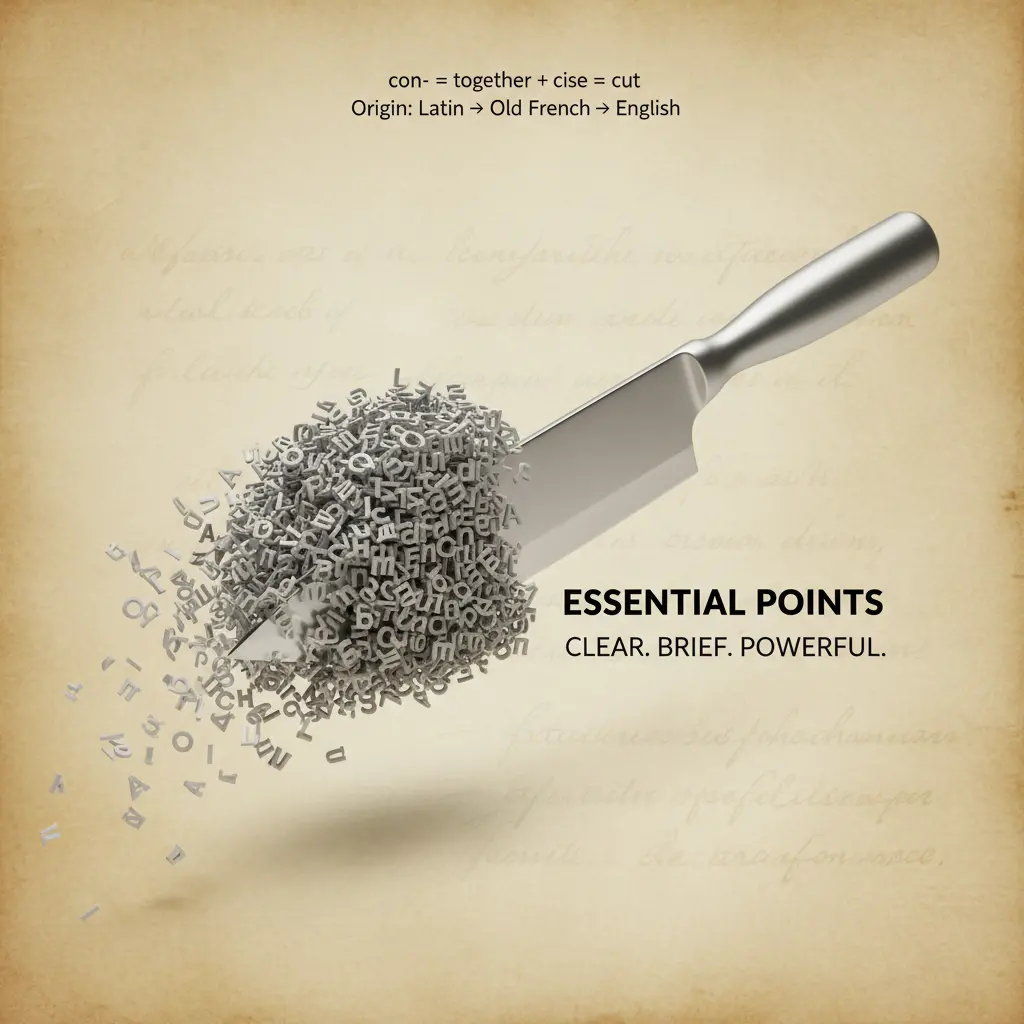
con- = together + cise = cut. Historical origin: Latin → Old French → English. Imagine a knife cutting through unnecessary words, leaving only the essential.
Note 1: These definitions and etymologies are not standard dictionary definitions, but extended explanations provided to help with memorization and understanding of the actual application of words. Through this background information, we strive to make words more vivid and easier to understand, and help you remember their meanings in real life.
Note 2: LexiTalk designs the learning flow around the linguistics principle of “Comprehensible Input.” When learners encounter material that is slightly above their level but still understandable from context, the brain naturally absorbs the language. That’s why we keep every word inside authentic contexts, using examples and associations to help you understand it and use it flexibly.
Read the FAQ explanation of Comprehensible InputConcise means expressing much in few words; not rambling, not overly compressed to the point of confusion. In English, concise writing relies on tight structure, strong verbs, precise nouns, and careful omission of filler. The goal is to convey the essential idea clearly and quickly, whether in business emails, abstracts, or journalistic summaries. Learners often confuse concise with merely short; concision is about relevance and flow, not censorship of nuance. Achieving it involves trimming redundancy, replacing long phrases with single verbs, and keeping sentences focused on one idea. Its etymology comes from con- together and cise cut, tracing a lineage from Latin through Old French into English.
British or American English speakers often prize brisk, direct expression; conciseness is seen as professional and respectful of the reader’s time.
What is the meaning of the word 'concise'?
Which of the following sentences uses 'concise' correctly?
What is a synonym for 'concise'?
What is an antonym for 'concise'?
How is being 'concise' important in professional communication?
Download LexiTalk app for personalized learning experience
Download AppCookies
We use cookies for essential site functions, analytics, and ads. You can accept, reject, or manage preferences. Privacy Policy