concrete - Master This Word
Master this word with our 5-step learning method – Learn English in English
Train English Through Brain Routes, Not Translation.
This page helps you stop memorizing isolated translations and start understanding a word through its shared mental image, native-style thinking, and practical training steps.
Master this word with our 5-step learning method – Learn English in English
Example sentences are the start of understanding. Don't rush to memorize. First feel how the word works in a sentence.
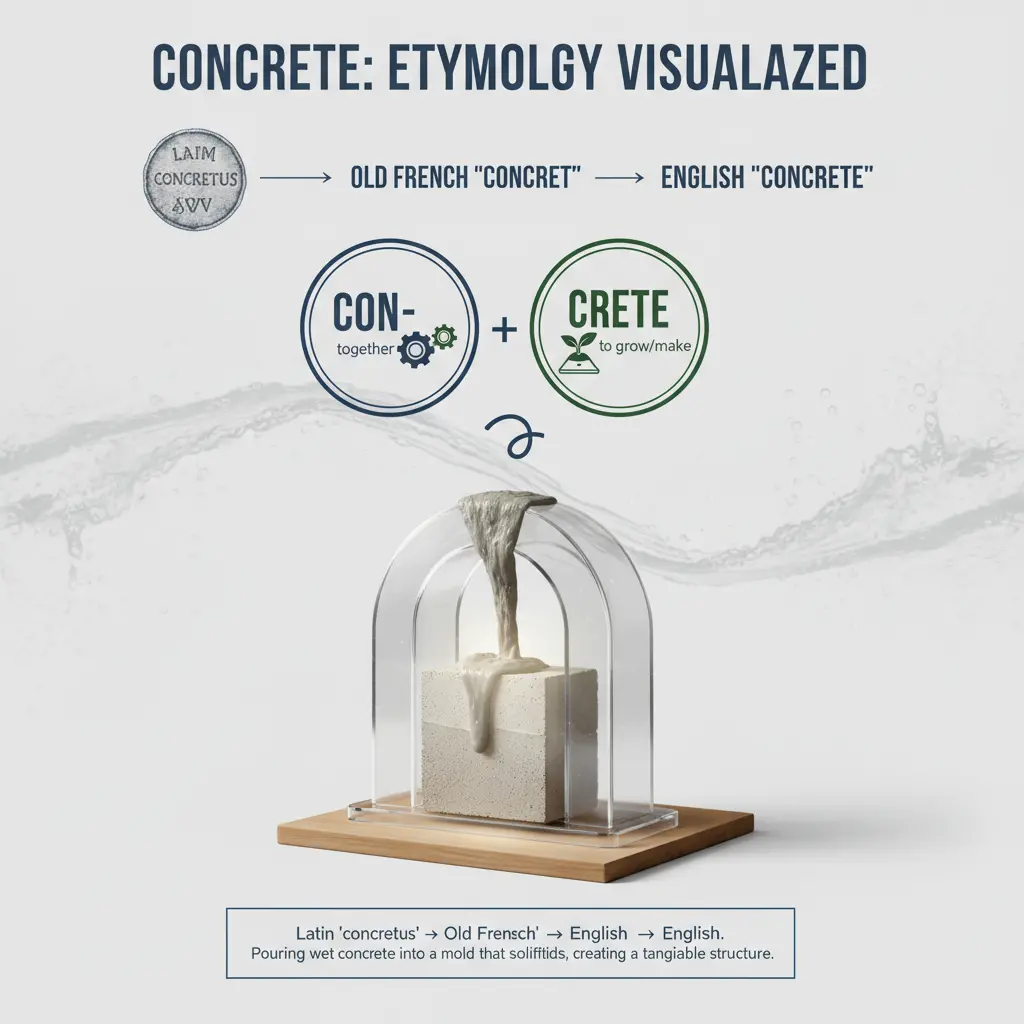
Concrete: con- = together + crete = to grow/make. Origin: Latin 'concretus' → Old French 'concret' → English. Imagine pouring wet concrete into a mold that solidifies, creating a tangible structure.
Note 1: These definitions and etymologies are not standard dictionary definitions, but extended explanations provided to help with memorization and understanding of the actual application of words. Through this background information, we strive to make words more vivid and easier to understand, and help you remember their meanings in real life.
Note 2: LexiTalk designs the learning flow around the linguistics principle of “Comprehensible Input.” When learners encounter material that is slightly above their level but still understandable from context, the brain naturally absorbs the language. That’s why we keep every word inside authentic contexts, using examples and associations to help you understand it and use it flexibly.
Read the FAQ explanation of Comprehensible InputI press my fingers to a cold, hard slab of concrete and feel it answer with a steady, unyielding weight. I shift my grip, push and pull, and watch how the surface holds as I adjust my stance for the task ahead. The room seems to tighten around the block, and I ride that solid presence until I know where to keep it. When I set it in place, the scene settles—not a word about meaning, just the feel of something real under my hands.
Concrete is a word that often puzzles learners because it has two related yet distinct senses. As a noun it names the building material made from cement, gravel, and water, which you can pour, mold, and see as a solid structure. As an adjective it describes something solid, real, and tangible rather than abstract or theoretical. In everyday English you can say concrete evidence, concrete plans, or concrete examples to make a point clearer. The word also appears in phrases like concrete jungle or concrete reality, emphasizing nonabstract realities. Pronunciation typically stresses the first syllable, with minor regional vowel differences between British and American English.
Explain to an English speaker (meta, keep short)
What is the meaning of the word 'concrete'?
In which sentence is 'concrete' used correctly?
Which word is similar to 'concrete'?
Which word is the opposite of 'concrete'?
In what situation would you encounter 'concrete'?
Download LexiTalk app for personalized learning experience
Download AppCookies
We use cookies for essential site functions, analytics, and ads. You can accept, reject, or manage preferences. Privacy Policy