conflicts - Master This Word
Master this word with our 5-step learning method – Learn English in English
Train English Through Brain Routes, Not Translation.
This page helps you stop memorizing isolated translations and start understanding a word through its shared mental image, native-style thinking, and practical training steps.
Master this word with our 5-step learning method – Learn English in English
Example sentences are the start of understanding. Don't rush to memorize. First feel how the word works in a sentence.
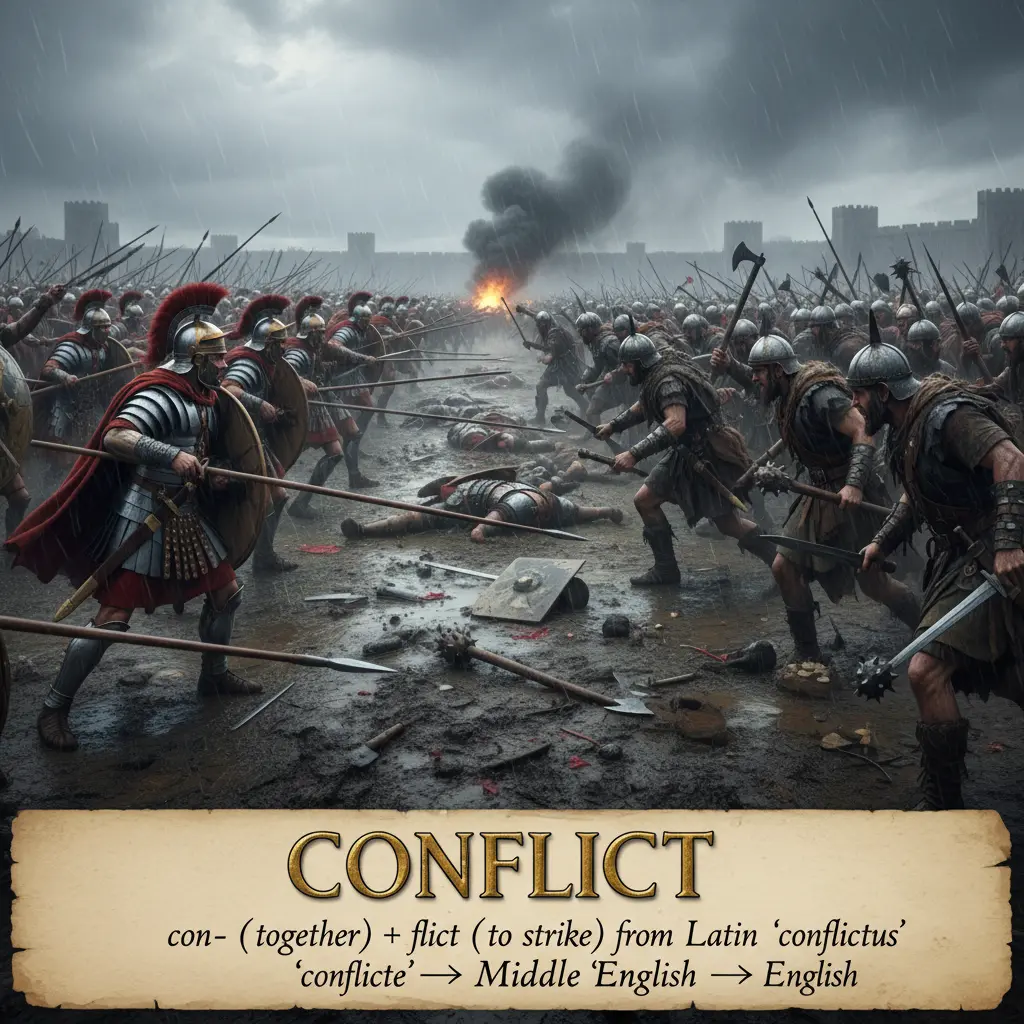
conflict = con- (together) + flict (to strike) from Latin 'conflictus' → Middle English 'conflicte' → English. Imagine two armies striking together in battle, creating clash and chaos.
Note 1: These definitions and etymologies are not standard dictionary definitions, but extended explanations provided to help with memorization and understanding of the actual application of words. Through this background information, we strive to make words more vivid and easier to understand, and help you remember their meanings in real life.
Note 2: LexiTalk designs the learning flow around the linguistics principle of “Comprehensible Input.” When learners encounter material that is slightly above their level but still understandable from context, the brain naturally absorbs the language. That’s why we keep every word inside authentic contexts, using examples and associations to help you understand it and use it flexibly.
Read the FAQ explanation of Comprehensible InputHands on the desk, I push the page enough to tip it toward me. Two thoughts tug at me from opposite sides, and I keep shifting my weight to hear them both. I adjust my grip and turn toward the option that feels steadier. That small push-and-pull inside me becomes a choice I make, a learned routine that helps me move forward.
Conflict refers to a serious disagreement or clash, and it can also describe a struggle between opposing forces. In everyday English, we talk about personal conflicts, political conflicts, or conflicts in plans that create friction and require negotiation. The noun emphasizes the tension, while the verb form 'to conflict' means to be in opposition or in disagreement with something or someone. The concept can be constructive when it leads to debate and resolution, or destructive when it escalates into violence or stalemate. Learners should note collocations such as 'conflict with', 'in conflict with', and 'conflict of interest'. Etymology hints at clash and combat, which helps remember the sense of collision and incompatibility.
Explain to an English speaker (meta, keep short)
What does the word 'conflicts' mean?
Identify the correct usage of 'conflicts' in a sentence.
Which word is most similar to 'conflicts'?
What is the opposite of 'conflicts'?
Can you think of a real-life scenario that illustrates 'conflicts'?
Download LexiTalk app for personalized learning experience
Download AppCookies
We use cookies for essential site functions, analytics, and ads. You can accept, reject, or manage preferences. Privacy Policy