cycle - Master This Word
Master this word with our 5-step learning method – Learn English in English
Train English Through Brain Routes, Not Translation.
This page helps you stop memorizing isolated translations and start understanding a word through its shared mental image, native-style thinking, and practical training steps.
Master this word with our 5-step learning method – Learn English in English
Example sentences are the start of understanding. Don't rush to memorize. First feel how the word works in a sentence.
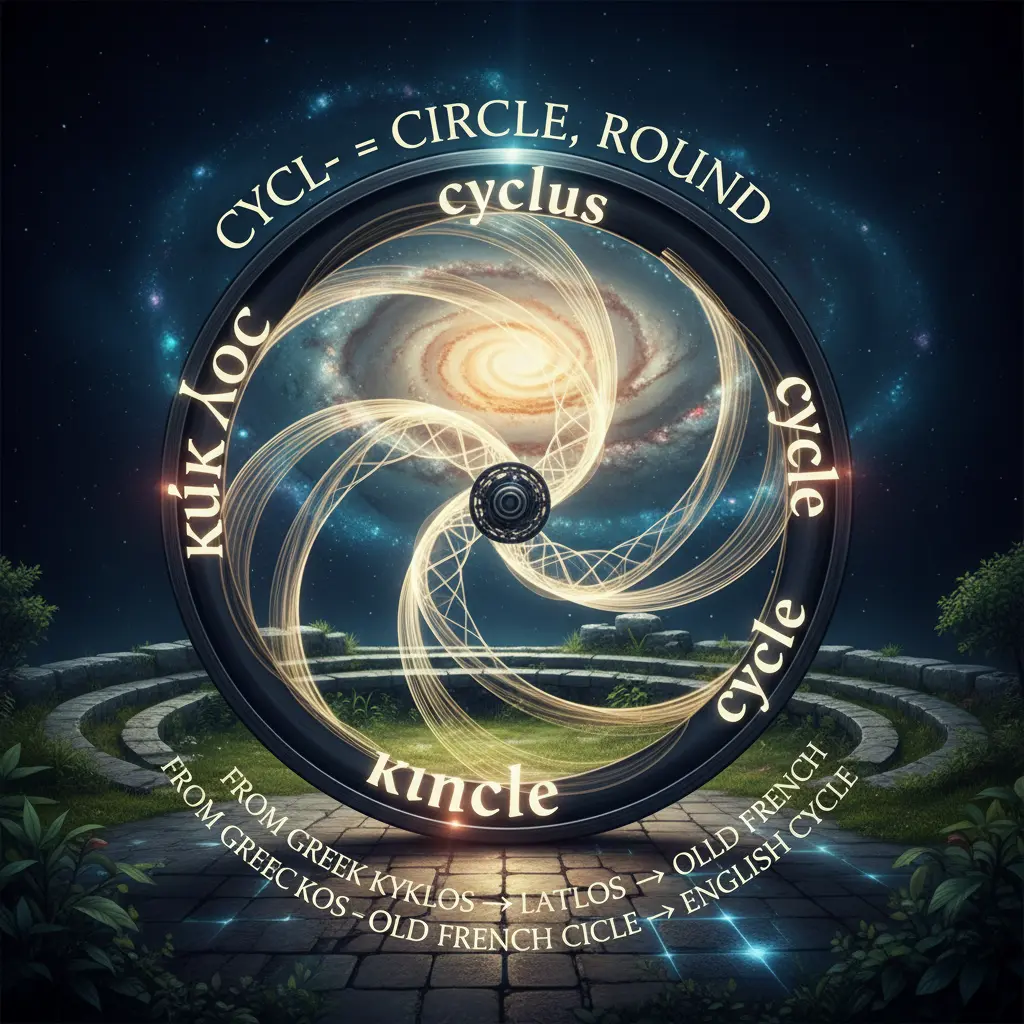
cycl- = circle, round; from Greek kyklos → Latin cyclus → Old French cicle → English cycle. Visualize a wheel turning around, symbolizing the continuous nature of cycles.
Note 1: These definitions and etymologies are not standard dictionary definitions, but extended explanations provided to help with memorization and understanding of the actual application of words. Through this background information, we strive to make words more vivid and easier to understand, and help you remember their meanings in real life.
Note 2: LexiTalk designs the learning flow around the linguistics principle of “Comprehensible Input.” When learners encounter material that is slightly above their level but still understandable from context, the brain naturally absorbs the language. That’s why we keep every word inside authentic contexts, using examples and associations to help you understand it and use it flexibly.
Read the FAQ explanation of Comprehensible InputI start by gently turning the pedals with my feet, letting my body settle into a steady rhythm. I move along a short stretch, my hands adjusting the handlebars and my weight shifting with each turn. The cadence nudges my mind into a familiar loop, pulling attention back to the road and the effort in my legs. Cycle stops being a word and becomes the flow I feel in time and action.
Cycle can describe a repeating sequence or a complete loop, such as the cycle of the seasons or a project cycle that passes through planning, execution, and review. It also refers to the act of riding a bicycle, when used as a verb phrase like to cycle to work. In everyday English you will hear about life cycles, production cycles, and recycling cycles. The word carries a sense of regularity, rhythm, and continuity, rather than a perfect geometric circle. Remember that cycle derives from the idea of turning, like a wheel. Learners often confuse cycle with circle; cycle often emphasizes repetition or stages, not just a round shape.
Cycle in English often emphasizes repetition, stages, and a process flow, not just a geometric shape; learners may confuse it with circle or round when discussing objects or shapes.
What is the meaning of the word 'cycle'?
In which of the following sentences is 'cycle' used correctly?
Which word is similar to 'cycle'?
Which word is the opposite of 'cycle'?
In what real-life context would you encounter the word 'cycle'?
Download LexiTalk app for personalized learning experience
Download AppCookies
We use cookies for essential site functions, analytics, and ads. You can accept, reject, or manage preferences. Privacy Policy