
death - Master This Word
Master this word with our 5-step learning method – Learn English in English
Train English Through Brain Routes, Not Translation.
This page helps you stop memorizing isolated translations and start understanding a word through its shared mental image, native-style thinking, and practical training steps.
Master this word with our 5-step learning method – Learn English in English
Example sentences are the start of understanding. Don't rush to memorize. First feel how the word works in a sentence.
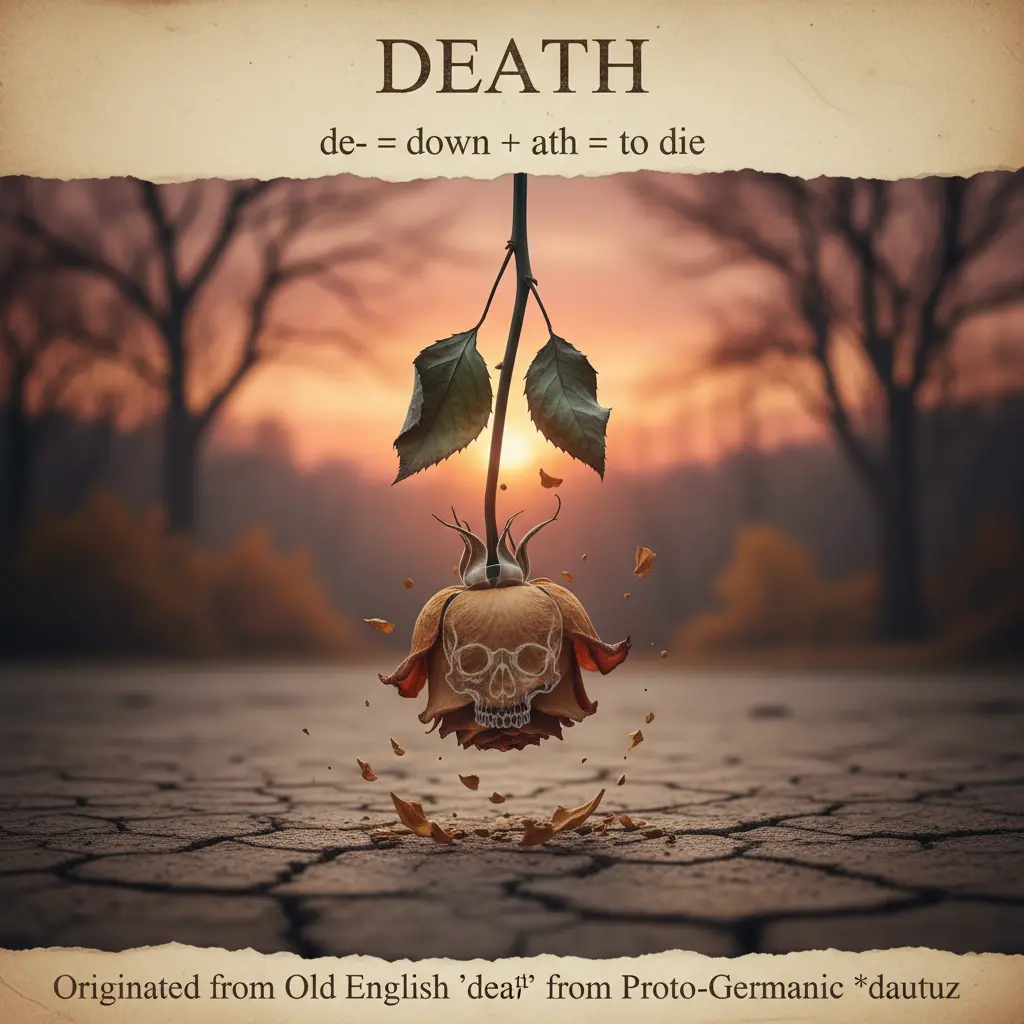
de- = down + ath = to die; Originated from Old English 'deaþ' from Proto-Germanic *dauþuz; Imagine a wilted flower falling down, symbolizing the end of life.
Note 1: These definitions and etymologies are not standard dictionary definitions, but extended explanations provided to help with memorization and understanding of the actual application of words. Through this background information, we strive to make words more vivid and easier to understand, and help you remember their meanings in real life.
Note 2: LexiTalk designs the learning flow around the linguistics principle of “Comprehensible Input.” When learners encounter material that is slightly above their level but still understandable from context, the brain naturally absorbs the language. That’s why we keep every word inside authentic contexts, using examples and associations to help you understand it and use it flexibly.
Read the FAQ explanation of Comprehensible InputI hold my breath, push open the door, and move into a quiet room. The light shifts on the walls as I set my pace and watch the space change. I turn away from the noise and adjust my steps, keeping a steady rhythm. Letting the scene settle, I feel an edge arrive—death as a boundary I recognize through this careful action.
Death is the permanent end of a living being, marking the cessation of the body's biological functions. It is commonly understood as the moment when life stops and a person no longer experiences consciousness, breathing, or heartbeat. In everyday use, death appears in phrases like death toll and in expressions about mortality, such as plans made for afterlife or messages about loss. Culturally, death carries varied emotional weight: some traditions emphasize mourning and remembrance, others focus on acceptance or spiritual beliefs about what comes next. The concept also fuels creative language and idioms, from gallows humor to poetry about endings. The etymology links to decay and downfall, an image of stillness following vitality.
Explain to an English speaker: death is a concrete biological end; learners may confuse it with 'dying' or with 'death' as a metaphor—practice with phrases like near death vs death toll.
What does the word 'death' mean?
Which sentence uses the word 'death' correctly?
Which word is most similar to 'death'?
What is the opposite of 'death'?
Can you give an example of a real-life scenario of 'death'?
Download LexiTalk app for personalized learning experience
Download AppCookies
We use cookies for essential site functions, analytics, and ads. You can accept, reject, or manage preferences. Privacy Policy