deductible - Master This Word
Master this word with our 5-step learning method – Learn English in English
Train English Through Brain Routes, Not Translation.
This page helps you stop memorizing isolated translations and start understanding a word through its shared mental image, native-style thinking, and practical training steps.
Master this word with our 5-step learning method – Learn English in English
Example sentences are the start of understanding. Don't rush to memorize. First feel how the word works in a sentence.
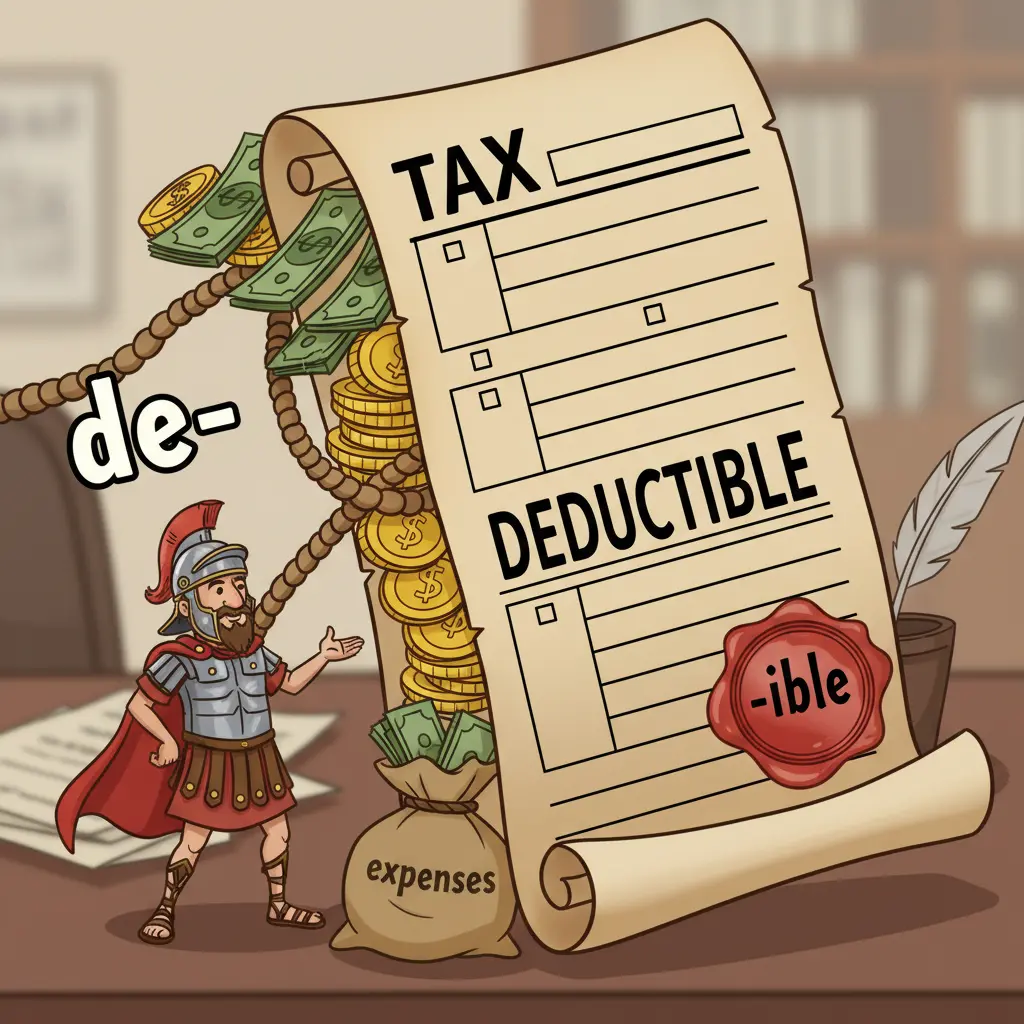
a) Root decomposition: de- (prefix meaning down/away) + duc- (lead) + -tible (able to be). b) Historical origin: from Latin deducere, via Old French déduire/deduire, into English as deductible. c) Memory image: imagine a tax form with a rope labeled de- pulling money away as a guide named duc leads coins down, sealed by a stamp -ible signifying deductible.
Note 1: These definitions and etymologies are not standard dictionary definitions, but extended explanations provided to help with memorization and understanding of the actual application of words. Through this background information, we strive to make words more vivid and easier to understand, and help you remember their meanings in real life.
Note 2: LexiTalk designs the learning flow around the linguistics principle of “Comprehensible Input.” When learners encounter material that is slightly above their level but still understandable from context, the brain naturally absorbs the language. That’s why we keep every word inside authentic contexts, using examples and associations to help you understand it and use it flexibly.
Read the FAQ explanation of Comprehensible InputDeductible is a noun referring to the amount you pay out of pocket before your insurance coverage begins. In health or auto policies you choose a deductible; the higher the deductible, the lower the monthly premium, but you pay more if you file a claim. In taxation, a deductible is an expense you can subtract from your gross income to reduce taxable income (tax-deductible). In everyday finance, a deductible can be any cost that can be subtracted as an expense for accounting or budgeting. Understanding your deductible helps compare insurance plans and plan finances accordingly.
English speakers often distinguish clear between the insurance usage (out-of-pocket amount) and tax usage (expense that lowers tax). Learners frequently confuse the two or mix up spelling and hyphenation (tax-deductible vs deductible).
Which of the following best defines the word 'deductible'?
Which sentence uses 'deductible' correctly?
Which word or phrase is most similar in meaning to 'deductible'?
Which word or phrase is the best antonym for 'deductible'?
Which scenario would correctly call for the use of the word 'deductible' when describing the costs?
Download LexiTalk app for personalized learning experience
Download AppCookies
We use cookies for essential site functions, analytics, and ads. You can accept, reject, or manage preferences. Privacy Policy