designed - Master This Word
Master this word with our 5-step learning method – Learn English in English
Train English Through Brain Routes, Not Translation.
This page helps you stop memorizing isolated translations and start understanding a word through its shared mental image, native-style thinking, and practical training steps.
Master this word with our 5-step learning method – Learn English in English
Example sentences are the start of understanding. Don't rush to memorize. First feel how the word works in a sentence.
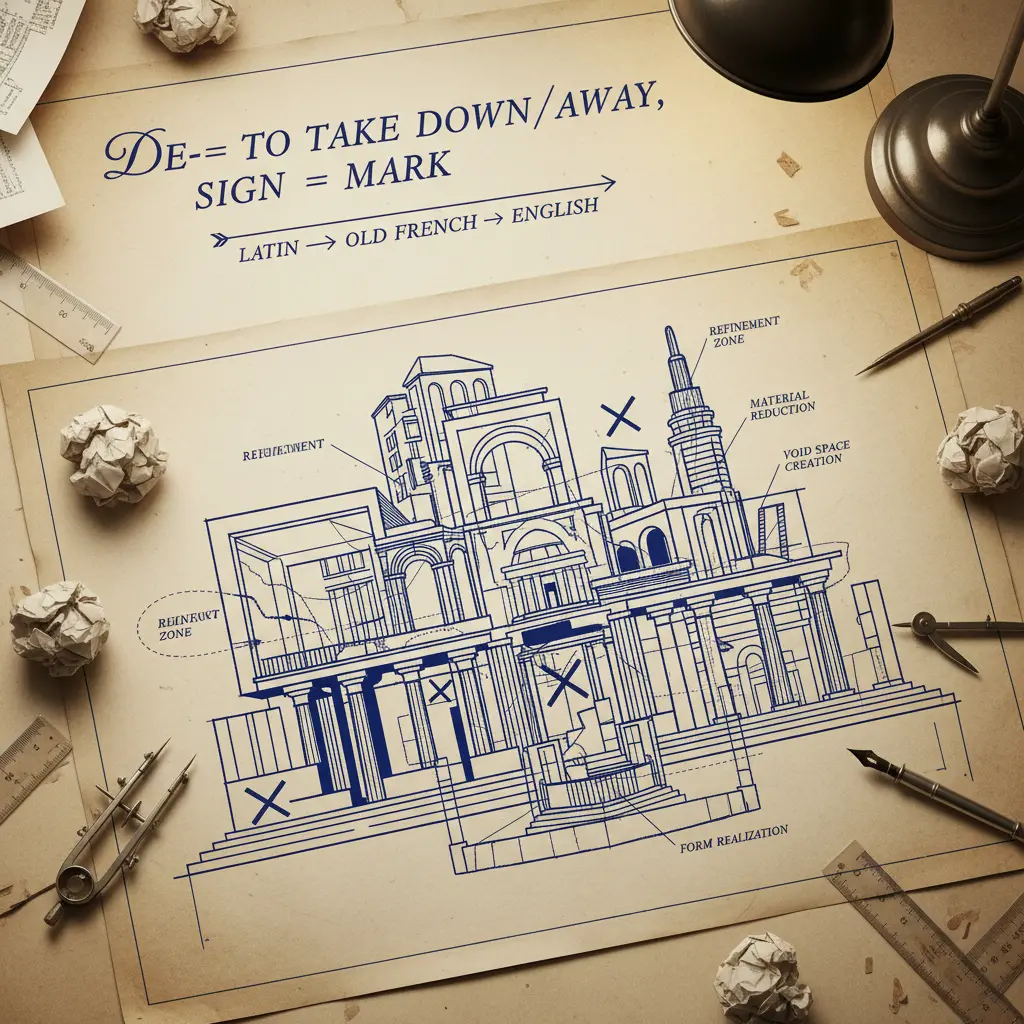
de- = to take down/away, sign = mark; Latin → Old French → English. Imagine creating a blueprint on paper, marking out spaces and shapes to realize a building or art piece.
Note 1: These definitions and etymologies are not standard dictionary definitions, but extended explanations provided to help with memorization and understanding of the actual application of words. Through this background information, we strive to make words more vivid and easier to understand, and help you remember their meanings in real life.
Note 2: LexiTalk designs the learning flow around the linguistics principle of “Comprehensible Input.” When learners encounter material that is slightly above their level but still understandable from context, the brain naturally absorbs the language. That’s why we keep every word inside authentic contexts, using examples and associations to help you understand it and use it flexibly.
Read the FAQ explanation of Comprehensible InputI grip a pencil and move it across a blank page. I shift lines, adjust the spacing, and feel a tiny push against the edge of the page. I place shapes and hold the moment, turning ideas into a practical layout. As I keep nudging and testing, the design takes on a feel of how it will look and work.
Design is the act of planning or drawing something to show how it will look and work. As a noun, it can refer to a plan, a drawing, a pattern, or a distinctive style or decoration. As a verb, design means to create a plan or drawing for a product, building, or graphic, often with attention to function, aesthetics, and constraints. In everyday English, we talk about design teams, design concepts, and the design of user interfaces. Learners sometimes mix up design with 'create' or 'invent,' or assume every verb form uses 'design' as a direct object. Also, design can imply deliberate intention (to design something to achieve a goal) rather than simple guessing.
Explain to an English speaker (meta, keep short) — English treats design as both plan and appearance, with athletic noun/verb flexibility; common mistakes include confusing design with making or inventing, and over-relying on literal translations.
What is the definition of the word designed?
Which sentence uses the word designed correctly?
Which word is most similar to designed?
What is the opposite of designed?
Can you think of a real-life scenario where something was designed?
Technology & Social Media
Listen NowDownload LexiTalk app for personalized learning experience
Download AppCookies
We use cookies for essential site functions, analytics, and ads. You can accept, reject, or manage preferences. Privacy Policy