differently - Master This Word
Master this word with our 5-step learning method – Learn English in English
Train English Through Brain Routes, Not Translation.
This page helps you stop memorizing isolated translations and start understanding a word through its shared mental image, native-style thinking, and practical training steps.
Master this word with our 5-step learning method – Learn English in English
Example sentences are the start of understanding. Don't rush to memorize. First feel how the word works in a sentence.
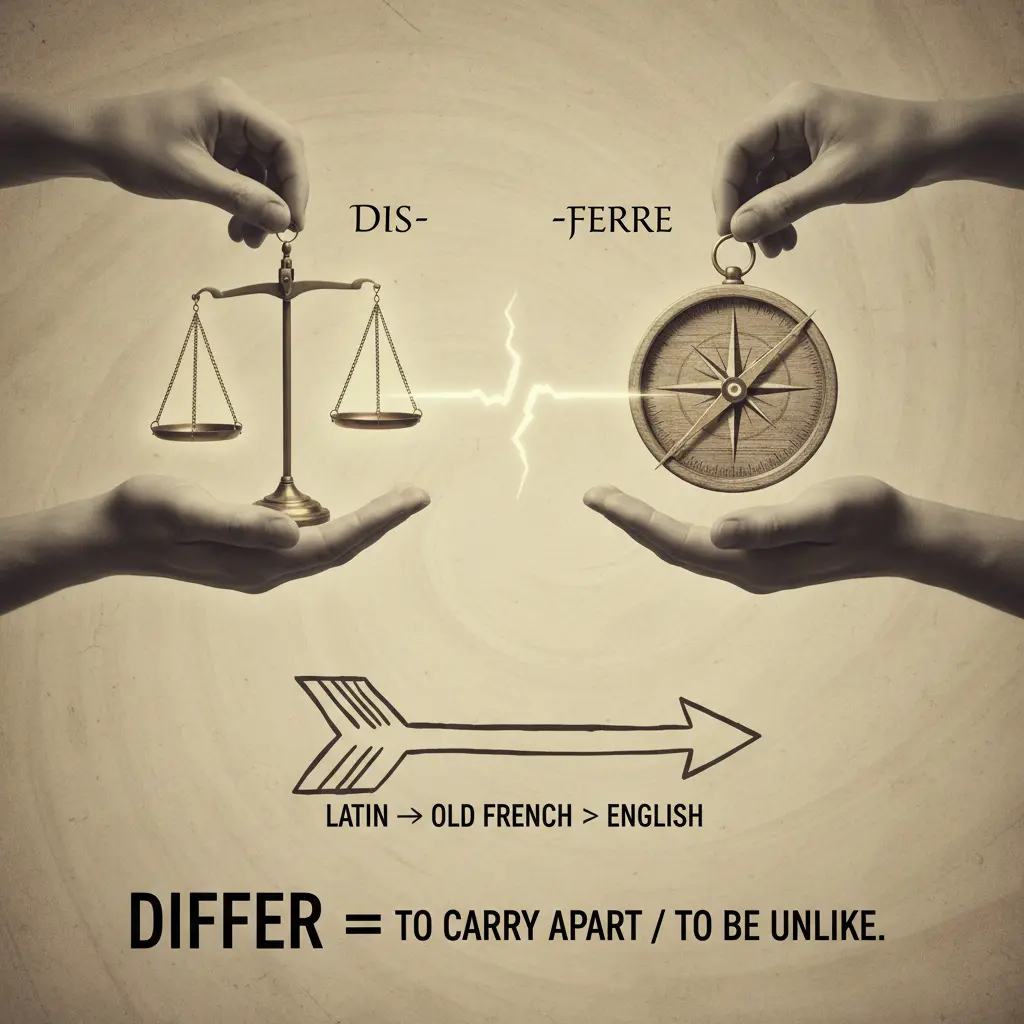
Root decomposition: dis- = not, ferre = to carry. Historical origin: Latin → Old French → English. Memory image: Imagine two carrying hands, one with a different object, emphasizing the distinction.
Note 1: These definitions and etymologies are not standard dictionary definitions, but extended explanations provided to help with memorization and understanding of the actual application of words. Through this background information, we strive to make words more vivid and easier to understand, and help you remember their meanings in real life.
Note 2: LexiTalk designs the learning flow around the linguistics principle of “Comprehensible Input.” When learners encounter material that is slightly above their level but still understandable from context, the brain naturally absorbs the language. That’s why we keep every word inside authentic contexts, using examples and associations to help you understand it and use it flexibly.
Read the FAQ explanation of Comprehensible InputI reach out, place my palm on two things, and push one a little to test the space. A quick shift between them shows they aren’t the same, and I feel the difference opening up. I adjust my gaze, turn to what makes each one stand apart, and keep the idea in mind as I compare more. The moment you notice it, you know different means not the same, even when the things share a surface.
Different describes not being the same as something else, signaling contrast or variety rather than similarity. In English it pairs naturally with two nouns or ideas to show a distinction, most commonly with from, as in different from. The word comes from Latin dis- meaning not and ferre meaning to carry, moving through Old French into English. Learners often say different than, or treat different as a stronger degree than necessary. Remember that different emphasizes distinction, while diverse or varied highlight many kinds within a group. Using different with the right preposition and context helps you express precise contrasts, not just any difference.
Explain to an English speaker (meta, keep short)
What is the meaning of the word 'differently'?
In which of the following sentences is 'differently' used correctly?
Which word is similar to 'differently'?
What is the opposite of 'differently'?
How can you approach a problem differently in everyday life?
Download LexiTalk app for personalized learning experience
Download AppCookies
We use cookies for essential site functions, analytics, and ads. You can accept, reject, or manage preferences. Privacy Policy