
digressive - Master This Word
Master this word with our 5-step learning method – Learn English in English
Train English Through Brain Routes, Not Translation.
This page helps you stop memorizing isolated translations and start understanding a word through its shared mental image, native-style thinking, and practical training steps.
Master this word with our 5-step learning method – Learn English in English
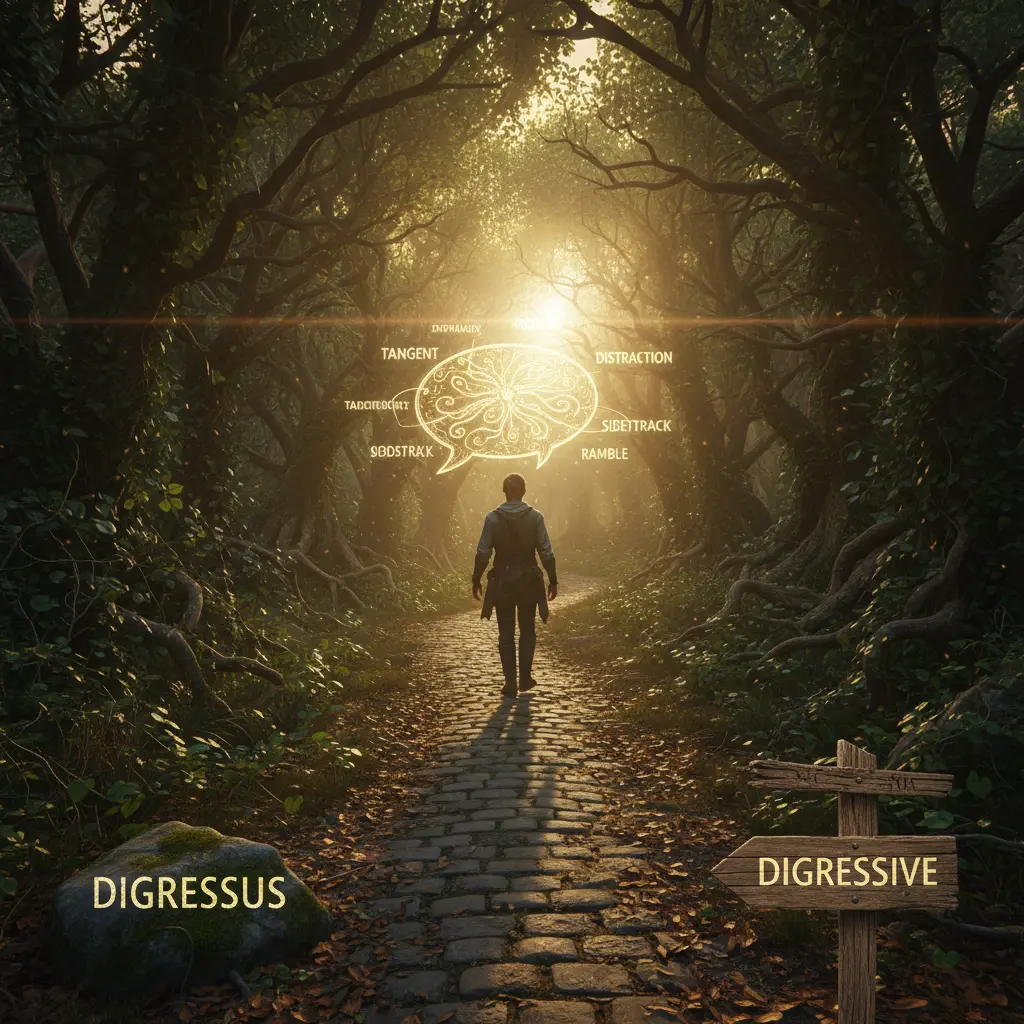
Example sentences are the start of understanding. Don't rush to memorize. First feel how the word works in a sentence.
Root decomposition: 'di-' (apart) + 'gress' (to step) + 'ive' (adjective suffix). Historical origin: Latin 'digressus' → Old French 'digressif' → English 'digressive'. Memory image: Picture someone stepping off a path into the woods—each step leads them further away from their destination, just like a digressive conversation strays from the main topic.
Note 1: These definitions and etymologies are not standard dictionary definitions, but extended explanations provided to help with memorization and understanding of the actual application of words. Through this background information, we strive to make words more vivid and easier to understand, and help you remember their meanings in real life.
Note 2: LexiTalk designs the learning flow around the linguistics principle of “Comprehensible Input.” When learners encounter material that is slightly above their level but still understandable from context, the brain naturally absorbs the language. That’s why we keep every word inside authentic contexts, using examples and associations to help you understand it and use it flexibly.
Read the FAQ explanation of Comprehensible InputDigressive describes speech or writing that strays from the main topic by introducing related but tangential details, anecdotes, or side issues. It can be deliberate, aiming to illustrate a point with context, or unintentional, leading to a rambling effect. In formal writing, a digressive aside can frustrate readers who want concise argument, while in literary or descriptive prose it can create texture or mood. The term emphasizes that the speaker’s or author’s focus is temporarily diverted. When you see digressive passages, check whether they illuminate the main claim or merely delay it; too much digression risks diluting clarity and impact.
In English, digressive is a stylistic label that often hints at rambling but can be a deliberate rhetorical choice; learners may assume all digressions are bad or that it only applies to speech.
What does the word 'digressive' mean?
Which sentence uses 'digressive' correctly?
Which word is most similar to 'digressive'?
What is the opposite of 'digressive'?
Can you think of a real-life situation where discussions might become digressive?
Download LexiTalk app for personalized learning experience
Download AppCookies
We use cookies for essential site functions, analytics, and ads. You can accept, reject, or manage preferences. Privacy Policy