
disc - Master This Word
Master this word with our 5-step learning method – Learn English in English
Train English Through Brain Routes, Not Translation.
This page helps you stop memorizing isolated translations and start understanding a word through its shared mental image, native-style thinking, and practical training steps.
Master this word with our 5-step learning method – Learn English in English
Example sentences are the start of understanding. Don't rush to memorize. First feel how the word works in a sentence.
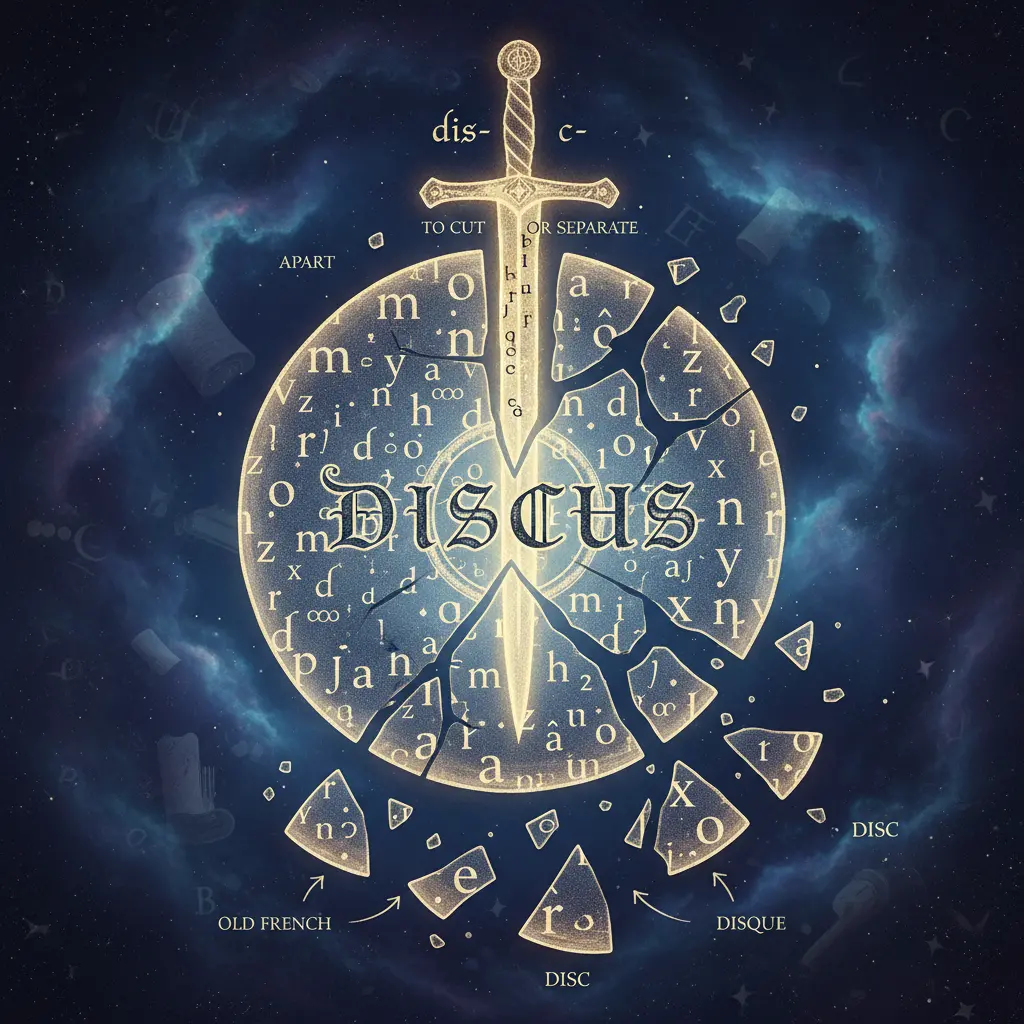
Root decomposition: dis- = apart, c- = to cut or separate. Historical origin: Latin 'discus' → Old French 'disque' → English. Memory image: Imagine a disc being cut into pieces, representing separation and division.
Note 1: These definitions and etymologies are not standard dictionary definitions, but extended explanations provided to help with memorization and understanding of the actual application of words. Through this background information, we strive to make words more vivid and easier to understand, and help you remember their meanings in real life.
Note 2: LexiTalk designs the learning flow around the linguistics principle of “Comprehensible Input.” When learners encounter material that is slightly above their level but still understandable from context, the brain naturally absorbs the language. That’s why we keep every word inside authentic contexts, using examples and associations to help you understand it and use it flexibly.
Read the FAQ explanation of Comprehensible InputFirst I pick up a disc and press it into my palm, the edge cool and precise. I move my wrist, tilt it a little, and give it a light spin as it turns through the air. I adjust my stance to catch or throw it, feeling the momentum push and pull against my grip. When it settles on the table or sails toward a target, the word becomes a shade of the moment—round, flat, and familiar.
A disc is a flat, thin, circular object that can describe several things. In everyday talk it might be a round plate, a coaster, or a small circular token. In sports, a disc refers to a flying disc used in games like ultimate Frisbee or disc golf. In computing and media, disc is an older spelling for data storage media such as a compact disc (CD) or a hard disc, and in British English you will see disc where Americans say disk. The etymology traces to Latin discus, via Old French disque, with a sense of splitting or separating carried by the root dis- and c- to cut. A handy memory image is a circle imagined as being cut apart, emphasizing division and unity at once.
English speakers often separate disc/ disk by context but also notice spelling differences between British and American usage. Learners should pay attention to which meaning is intended and which spelling is preferred in technical writing versus casual talk.
What is the meaning of the word 'disc'?
Which of the following is an example of using 'disc' in a sentence?
What is an opposite word for 'disc'?
In what real-life context would you find a 'disc'?
Can you think of a situation where you might encounter a 'disc'?
Download LexiTalk app for personalized learning experience
Download AppCookies
We use cookies for essential site functions, analytics, and ads. You can accept, reject, or manage preferences. Privacy Policy