
displace - Master This Word
Master this word with our 5-step learning method – Learn English in English
Train English Through Brain Routes, Not Translation.
This page helps you stop memorizing isolated translations and start understanding a word through its shared mental image, native-style thinking, and practical training steps.
Master this word with our 5-step learning method – Learn English in English
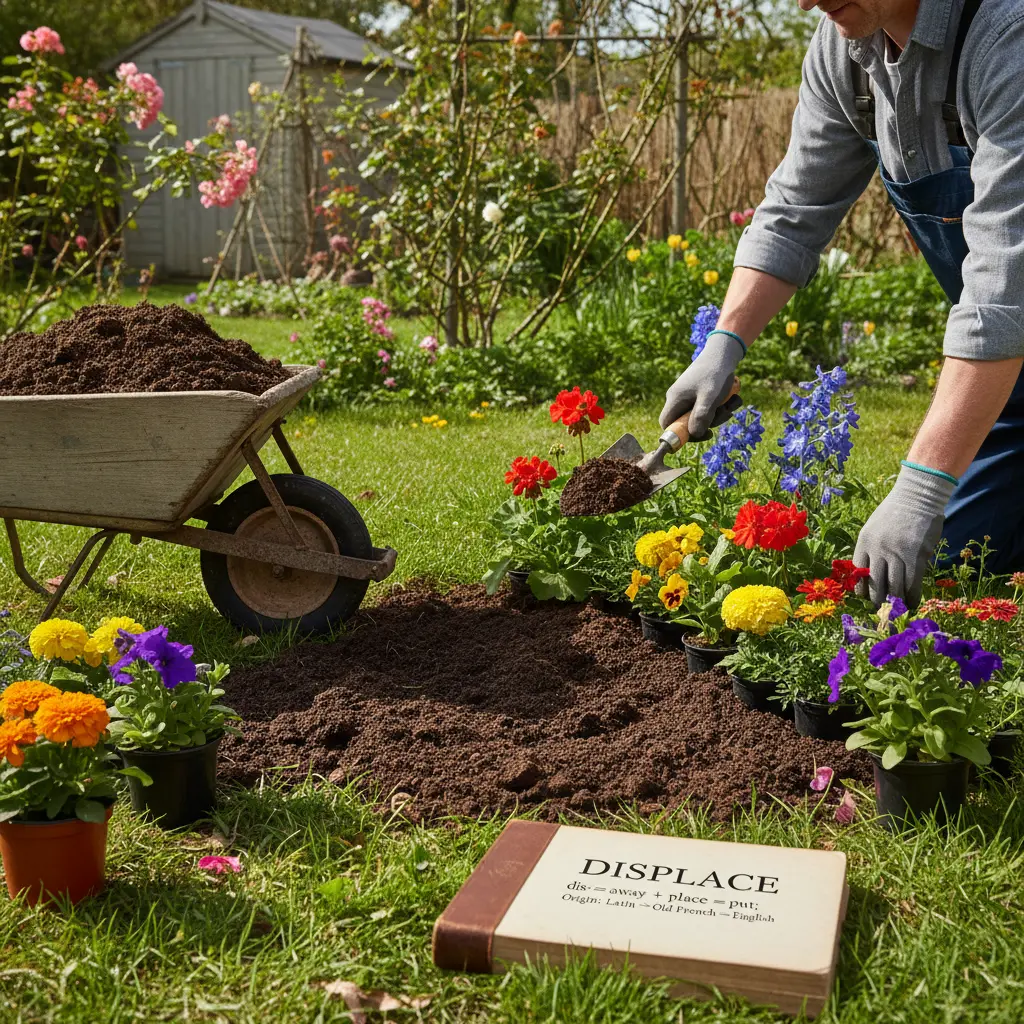
Example sentences are the start of understanding. Don't rush to memorize. First feel how the word works in a sentence.
dis- = away + place = put; Origin: Latin → Old French → English. Imagine a person displacing dirt from a garden, removing it from its spot, replacing it with flowers.
Note 1: These definitions and etymologies are not standard dictionary definitions, but extended explanations provided to help with memorization and understanding of the actual application of words. Through this background information, we strive to make words more vivid and easier to understand, and help you remember their meanings in real life.
Note 2: LexiTalk designs the learning flow around the linguistics principle of “Comprehensible Input.” When learners encounter material that is slightly above their level but still understandable from context, the brain naturally absorbs the language. That’s why we keep every word inside authentic contexts, using examples and associations to help you understand it and use it flexibly.
Read the FAQ explanation of Comprehensible InputI grab the chair and move it a foot to the side, feeling the space open up. I push the table a bit, then pull the rug to smooth the line between floor and edge. The sofa settles, and the old corner loosens its grip as things shift around. When a new lamp is placed in the vacated spot, the room makes room for something else to displace the familiar rhythm.
Displace means to move something from its usual place, or to remove someone from where they live or work, or to take the place of something by substituting it. It emphasizes separation from the original position and often implies some disruption. You can displace furniture, mud, or people, and you can be displaced by a newer model, a policy, or a natural event. The verb is transitive and typically follows a direct object: you displace X with Y, or X is displaced by Y. Distinctions from move (any movement) and remove (take away entirely) help learners choose the right nuance in different contexts.
Displace in English often carries a formal, policy or physical disruption nuance; learners may overgeneralize to simply moving objects, or confuse it with replace. In many cultures, displacement is tied to housing rights, land use, or social impact, so learners benefit from associating the term with context and agency (who causes the displacement).
What does 'displace' mean?
In which sentence is 'displace' used correctly?
What is a synonym for 'displace'?
What is an antonym for 'displace'?
How is the term 'displace' used in real life?
Download LexiTalk app for personalized learning experience
Download AppCookies
We use cookies for essential site functions, analytics, and ads. You can accept, reject, or manage preferences. Privacy Policy