disruption - Master This Word
Master this word with our 5-step learning method – Learn English in English
Train English Through Brain Routes, Not Translation.
This page helps you stop memorizing isolated translations and start understanding a word through its shared mental image, native-style thinking, and practical training steps.
Master this word with our 5-step learning method – Learn English in English
Example sentences are the start of understanding. Don't rush to memorize. First feel how the word works in a sentence.
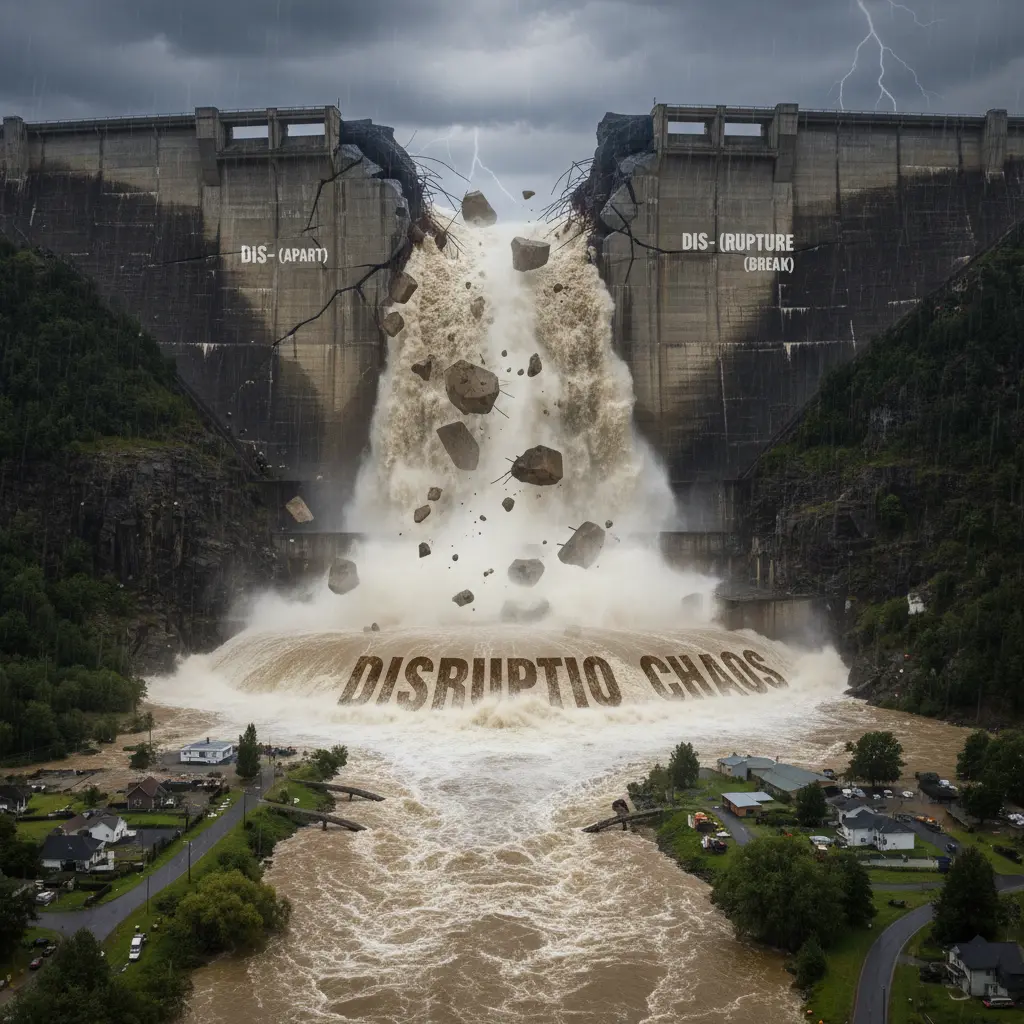
disruption = dis- (apart) + rupture (break). Originating from Latin 'disruptio' through Old French to English. Visualize a dam that suddenly breaks, causing water to flood everything in its path, representing interruption and chaos.
Note 1: These definitions and etymologies are not standard dictionary definitions, but extended explanations provided to help with memorization and understanding of the actual application of words. Through this background information, we strive to make words more vivid and easier to understand, and help you remember their meanings in real life.
Note 2: LexiTalk designs the learning flow around the linguistics principle of “Comprehensible Input.” When learners encounter material that is slightly above their level but still understandable from context, the brain naturally absorbs the language. That’s why we keep every word inside authentic contexts, using examples and associations to help you understand it and use it flexibly.
Read the FAQ explanation of Comprehensible InputFirst I reach for the kettle and set it on the burner, feeling the morning rhythm settle into place. Then the power blinks and the scene shifts, a small disruption in the flow. I pause, push through the flicker, and adjust my grip on the mug to keep the steam steady. I regroup the steps and change the pace, learning how to steer when the flow breaks.
Disruption is a noun describing an interruption or disturbance in a process, system, or routine. It can be a temporary pause that slows work, a break in continuity that reroutes activity, or a major change that unsettles people and creates confusion. In business, technology, and everyday life, disruption often carries a sense of upheaval that requires adaptation, problem solving, and clear communication. It can be unintended, like a power outage, or intentional, like a radical innovation that redefines how people work and interact. Learning to use disruption correctly means recognizing when a situation interrupts status quo versus when it signals transformative change.
For English speakers, disruption often covers both a temporary interruption and a deeper, transformative change. Learners should note the nuance that disruption can be neutral or even positive in contexts like innovation, not just negative interruptions. Articles and prepositions (a disruption in, disruptions to, caused by) matter for natural phrasing.
What is the meaning of 'disruption'?
In which sentence is 'disruption' used correctly?
Which word is a synonym of 'disruption'?
What is the opposite meaning of 'disruption'?
How does 'disruption' apply in real-world situations?
Download LexiTalk app for personalized learning experience
Download AppCookies
We use cookies for essential site functions, analytics, and ads. You can accept, reject, or manage preferences. Privacy Policy