during - Master This Word
Master this word with our 5-step learning method – Learn English in English
Train English Through Brain Routes, Not Translation.
This page helps you stop memorizing isolated translations and start understanding a word through its shared mental image, native-style thinking, and practical training steps.
Master this word with our 5-step learning method – Learn English in English
Example sentences are the start of understanding. Don't rush to memorize. First feel how the word works in a sentence.
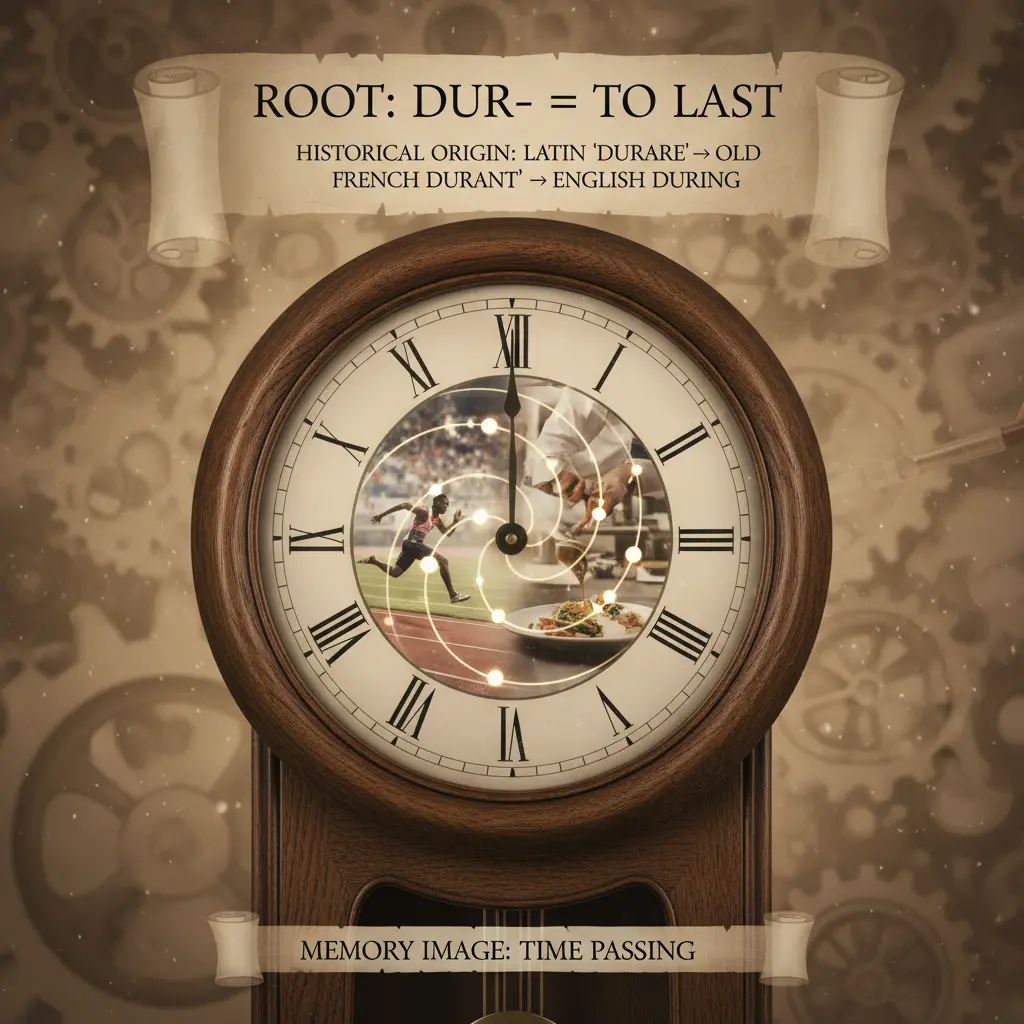
Root: dur- = to last; Historical origin: Latin 'durare' → Old French 'durant' → English 'during'; Memory image: Imagine a clock ticking while an event unfolds, symbolizing the duration of time passing.
Note 1: These definitions and etymologies are not standard dictionary definitions, but extended explanations provided to help with memorization and understanding of the actual application of words. Through this background information, we strive to make words more vivid and easier to understand, and help you remember their meanings in real life.
Note 2: LexiTalk designs the learning flow around the linguistics principle of “Comprehensible Input.” When learners encounter material that is slightly above their level but still understandable from context, the brain naturally absorbs the language. That’s why we keep every word inside authentic contexts, using examples and associations to help you understand it and use it flexibly.
Read the FAQ explanation of Comprehensible InputI set the camera on the tripod, pull the light into place, and take a steady breath. During the take, I adjust my posture, shift the camera a notch, and keep the frame's pace as the scene plays out. The hands move, the timer ticks, and I feel the effort of staying focused as the action runs its course. That moment teaches me to talk about time inside an event, as in during the shot or during the take.
During is used to refer to the entire period of a time or event, or to indicate something happens at a point within that period. It answers questions like 'for how long?' or 'at what point in the event?'. It normally comes before a noun phrase indicating the time, as in during the summer, during the meeting, during the night, or during surgery. It contrasts with for, which emphasizes duration, and with in or on, which may describe other relationships with time. Learners should notice collocations such as during the course of, during which, and during the event's progression. When reporting past events, during + noun helps convey the time frame clearly.
English learners often map during directly to a single point in time, but it also marks stretches of time inside an event; confusion with while or for is common, especially with ongoing actions.
What is the meaning of the word 'during'?
How is the word 'during' used in a sentence?
Which of the following is a similar word to 'during'?
What is the opposite of 'during'?
In what context would you use the word 'during'?
Download LexiTalk app for personalized learning experience
Download AppCookies
We use cookies for essential site functions, analytics, and ads. You can accept, reject, or manage preferences. Privacy Policy