economy - Master This Word
Master this word with our 5-step learning method – Learn English in English
Train English Through Brain Routes, Not Translation.
This page helps you stop memorizing isolated translations and start understanding a word through its shared mental image, native-style thinking, and practical training steps.
Master this word with our 5-step learning method – Learn English in English
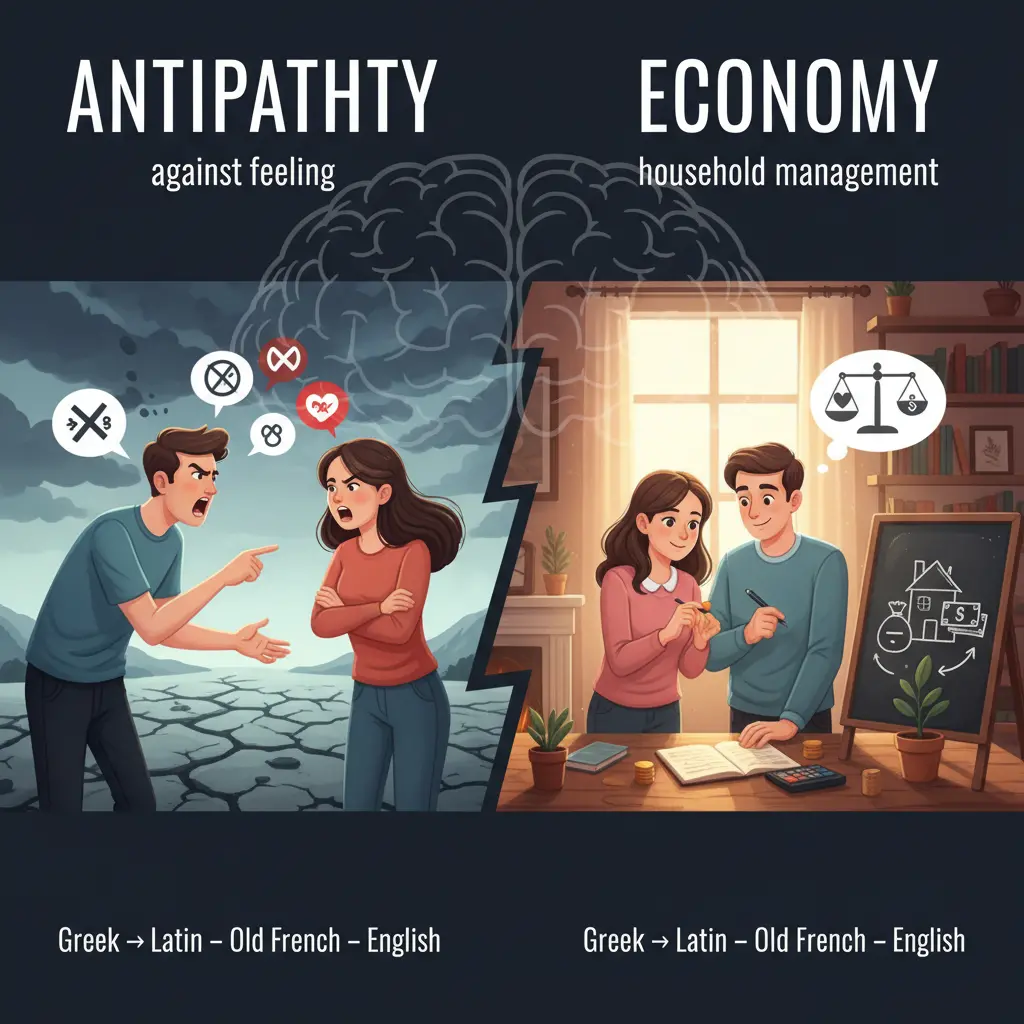
Example sentences are the start of understanding. Don't rush to memorize. First feel how the word works in a sentence.
Root: oiko- (house) + nomos (law) = household management. Historical origin: Greek → Latin → Old French → English. Memory image: Picture a family managing their household budget, balancing income and expenses to maintain a healthy home.
Note 1: These definitions and etymologies are not standard dictionary definitions, but extended explanations provided to help with memorization and understanding of the actual application of words. Through this background information, we strive to make words more vivid and easier to understand, and help you remember their meanings in real life.
Note 2: LexiTalk designs the learning flow around the linguistics principle of “Comprehensible Input.” When learners encounter material that is slightly above their level but still understandable from context, the brain naturally absorbs the language. That’s why we keep every word inside authentic contexts, using examples and associations to help you understand it and use it flexibly.
Read the FAQ explanation of Comprehensible InputHands on the table, I move a few coins across the surface, watching them settle and slide. I feel the push and pull of control as I adjust one coin and keep the others in place. The small act makes me sense how a bigger system keeps turning when people set priorities, hold back, or shift resources. In the end, the word economy lands in my head as a living rhythm that can change with every choice I make.
An economy is the way a society organizes production, distribution, and consumption of goods and services. It includes households, businesses, and government, and relies on resources, labor, and technology to create value. The term can refer to the system of resources management at a national scale, like how a country allocates budgets, sets trade rules, and measures success with indicators such as GDP. It also appears in phrases about careful management of limited resources, for example a household economy or a city economy. Learners should note the adjective 'economic' and 'economical' differ from the noun 'economy'.
For English learners, focus on economy as a broad system (not just money) and distinguish it from economics (the study) and economical (cost-saving).
What is the meaning of the word 'economy'?
In which of the following sentences is 'economy' used correctly?
Which of the following is a similar word to 'economy'?
What is the opposite of 'economy'?
How would you explain the concept of 'economy' in a real-life context?
Download LexiTalk app for personalized learning experience
Download AppCookies
We use cookies for essential site functions, analytics, and ads. You can accept, reject, or manage preferences. Privacy Policy