
equality - Master This Word
Master this word with our 5-step learning method – Learn English in English
Train English Through Brain Routes, Not Translation.
This page helps you stop memorizing isolated translations and start understanding a word through its shared mental image, native-style thinking, and practical training steps.
Master this word with our 5-step learning method – Learn English in English
Example sentences are the start of understanding. Don't rush to memorize. First feel how the word works in a sentence.
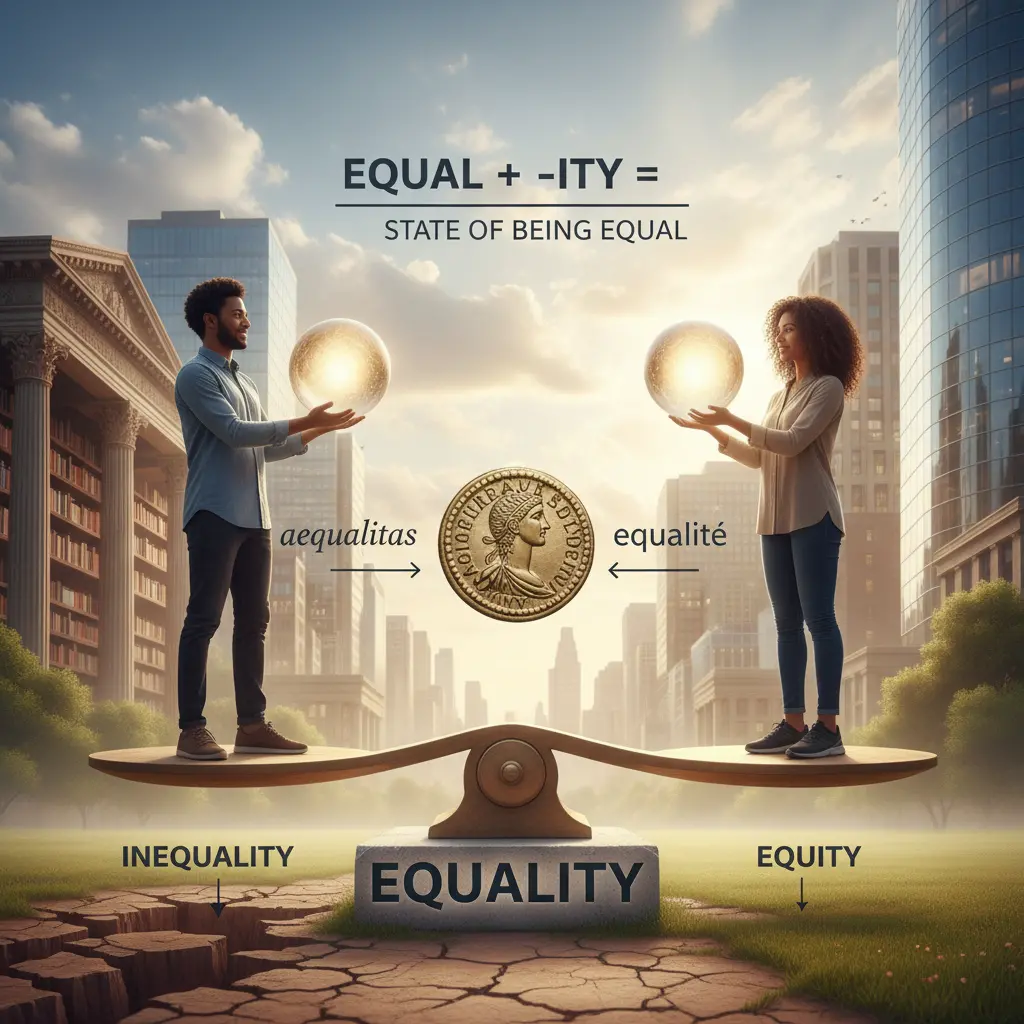
equal + -ity = state of being equal. From Latin 'aequalitas' → Old French 'equalité' → English. Imagine two people standing on equal ground, sharing the same opportunities like two sides of a balanced scale.
Note 1: These definitions and etymologies are not standard dictionary definitions, but extended explanations provided to help with memorization and understanding of the actual application of words. Through this background information, we strive to make words more vivid and easier to understand, and help you remember their meanings in real life.
Note 2: LexiTalk designs the learning flow around the linguistics principle of “Comprehensible Input.” When learners encounter material that is slightly above their level but still understandable from context, the brain naturally absorbs the language. That’s why we keep every word inside authentic contexts, using examples and associations to help you understand it and use it flexibly.
Read the FAQ explanation of Comprehensible InputI place two cups on the counter and push them until their rims align. Then I adjust the distance between them, keeping the same pressure and watching the line. It feels steady, like a tiny system that stays balanced as I work. That quiet equality arrives not by words but through the careful moves that keep everything even.
Equality is the state of being equal in status, rights, and opportunities. It is not merely sameness, but the principle that every person deserves fair treatment and protection under the law. In everyday speech, we talk about social equality, political equality, and mathematical equality (for example, 2+2=4) to describe different kinds of balance or parity. Learners often mix up equality with sameness or fairness, or assume it means everyone will have the exact same things rather than equal access to chances and protections. The concept underpins debates about education, employment, and justice, reminding us to remove barriers so that people can participate on a level playing field.
English speakers often separate equality of opportunity from equality of outcome; learners tend to assume equal outcomes are always intended or possible, and may misread laws as guaranteeing identical results rather than fair access.
What is the meaning of 'equality'?
Which sentence uses 'equality' correctly?
Which word is an antonym of 'equality'?
In what real-life context would 'equality' be a crucial concept?
Reflect on why 'equality' is important in society.
Download LexiTalk app for personalized learning experience
Download AppCookies
We use cookies for essential site functions, analytics, and ads. You can accept, reject, or manage preferences. Privacy Policy