
exorcise - Master This Word
Master this word with our 5-step learning method – Learn English in English
Train English Through Brain Routes, Not Translation.
This page helps you stop memorizing isolated translations and start understanding a word through its shared mental image, native-style thinking, and practical training steps.
Master this word with our 5-step learning method – Learn English in English
Example sentences are the start of understanding. Don't rush to memorize. First feel how the word works in a sentence.
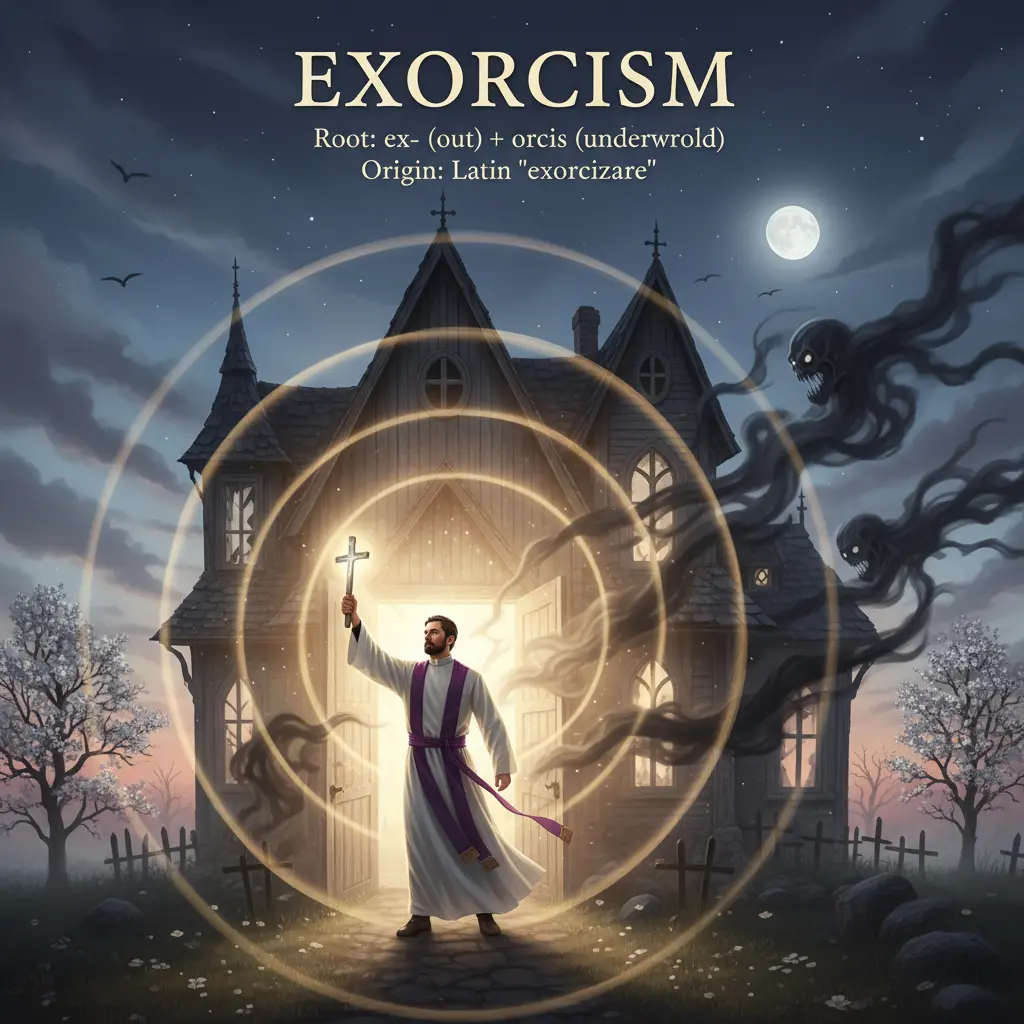
Root decomposition: 'ex-' (out of) + 'orcis' (of the underworld); Historical origin: Latin 'exorcizare' → Old French 'exorciser' → English; Memory image: Imagine a brave priest expelling dark shadows from a haunted house, bringing light and peace.
Note 1: These definitions and etymologies are not standard dictionary definitions, but extended explanations provided to help with memorization and understanding of the actual application of words. Through this background information, we strive to make words more vivid and easier to understand, and help you remember their meanings in real life.
Note 2: LexiTalk designs the learning flow around the linguistics principle of “Comprehensible Input.” When learners encounter material that is slightly above their level but still understandable from context, the brain naturally absorbs the language. That’s why we keep every word inside authentic contexts, using examples and associations to help you understand it and use it flexibly.
Read the FAQ explanation of Comprehensible InputExorcise means to drive out an evil spirit or negative influence through ritual or authority, and it can be used beyond the supernatural: to expel a harmful presence from a place, or to remove a persistent problem from a system or organization. In religious contexts, the ritual act is explicit, but in secular speech people might say you want to exorcise fear, guilt, or corruption from a workplace. The word emphasizes cleansing and final removal rather than mere improvement. Note the spelling with x-o-r-c-i-s-e, and that it is a verb that takes a direct object (exorcise a demon, exorcise the house).
Learners tend to view exorcise as a strictly religious act tied to dramatic rituals; in English it also carries metaphorical force, which can be hard for non-native speakers to gauge when to apply to non-supernatural problems.
What is the meaning of the word 'exorcise'?
Which sentence correctly uses the word 'exorcise'?
Which of the following is a synonym for 'exorcise'?
What is the opposite of the word 'exorcise'?
Can you give an example of a real-life scenario involving the concept of exorcism?
Download LexiTalk app for personalized learning experience
Download AppCookies
We use cookies for essential site functions, analytics, and ads. You can accept, reject, or manage preferences. Privacy Policy