felt - Master This Word
Master this word with our 5-step learning method – Learn English in English
Train English Through Brain Routes, Not Translation.
This page helps you stop memorizing isolated translations and start understanding a word through its shared mental image, native-style thinking, and practical training steps.
Master this word with our 5-step learning method – Learn English in English
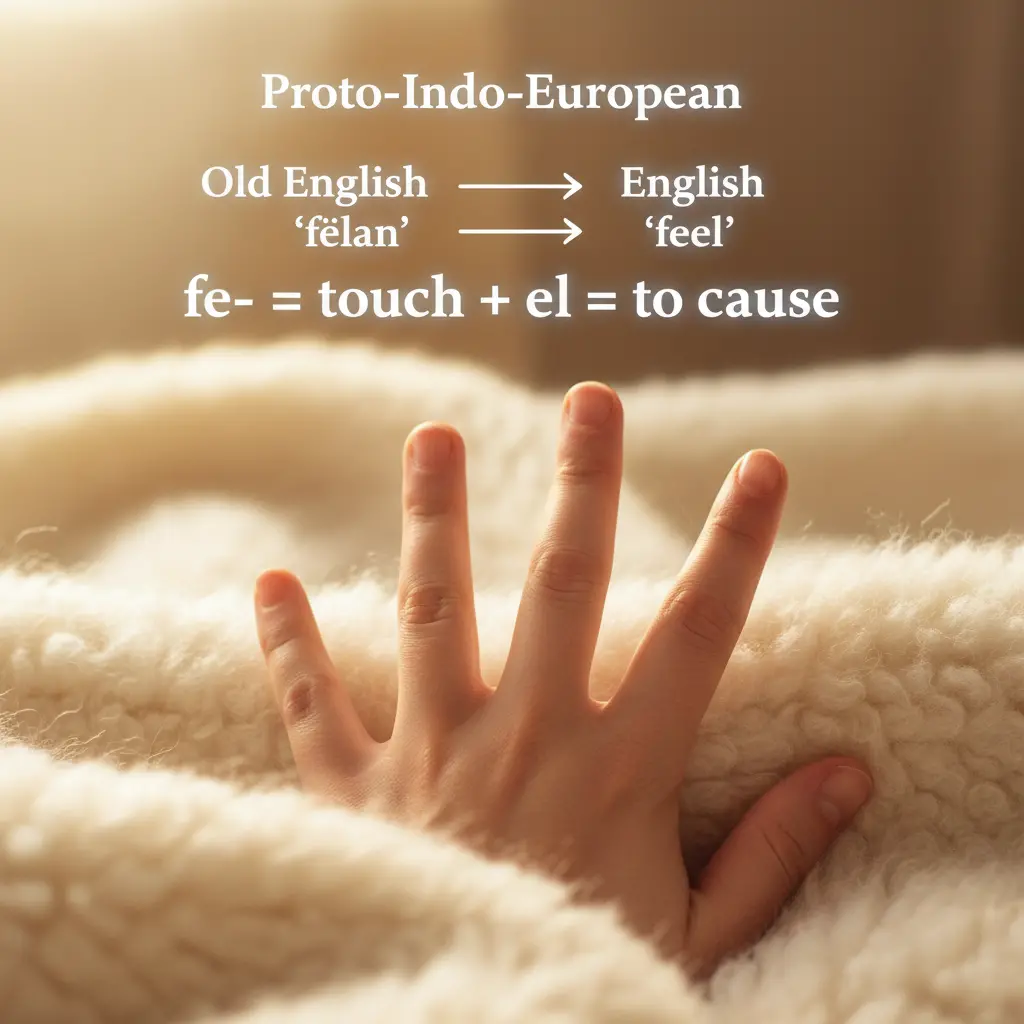
Example sentences are the start of understanding. Don't rush to memorize. First feel how the word works in a sentence.
fe- = touch + el = to cause. Origin: Proto-Indo-European → Old English 'fēlan' → English 'feel'. Imagine reaching out and gently touching a soft surface, sensing its texture.
Note 1: These definitions and etymologies are not standard dictionary definitions, but extended explanations provided to help with memorization and understanding of the actual application of words. Through this background information, we strive to make words more vivid and easier to understand, and help you remember their meanings in real life.
Note 2: LexiTalk designs the learning flow around the linguistics principle of “Comprehensible Input.” When learners encounter material that is slightly above their level but still understandable from context, the brain naturally absorbs the language. That’s why we keep every word inside authentic contexts, using examples and associations to help you understand it and use it flexibly.
Read the FAQ explanation of Comprehensible InputI place my hand flat on the desk and push gently, letting my fingers test the surface. As I move a little, the grain under my skin changes and the moment tightens into attention. I feel warmth and a slight tension that loosens as I adjust my grip to keep control. From this tiny cue I learn how to use touch in real tasks: decide whether to keep pressing, stop, or let the feeling guide my actions.
Feel is a versatile verb that spans three broad areas: perceiving through touch, experiencing emotions, and sensing physical or mental states. When you feel something, you are registering a sensation with your senses—texture, temperature, pressure, or pain. When you feel an emotion, you describe your inner experience, such as happiness, sadness, or anxiety. You can also talk about general sensations, like "I feel cold" or "I feel tired." English uses feel in many idioms and structures beyond concrete perception, for example 'feel like doing something,' 'feel for someone,' or 'feel that something is true.' Learners often confuse feel with touch when referring to objects, or confuse emotion with fact. Keep in mind feel emphasizes subjectivity and perception.
English often encodes both physical sensation and inner experience with feel, plus many idioms that shift meaning. Learners may default to a physical sense or confuse feel with think when giving opinions.
What is the definition of the word 'felt'?
Select the correctly used sentence containing the word 'felt'.
Which of the following words is a synonym of 'felt'?
What is an antonym of the word 'felt'?
Can you think of a real-life context where someone might have 'felt' a specific emotion?
Download LexiTalk app for personalized learning experience
Download AppCookies
We use cookies for essential site functions, analytics, and ads. You can accept, reject, or manage preferences. Privacy Policy