
flutter - Master This Word
Master this word with our 5-step learning method – Learn English in English
Train English Through Brain Routes, Not Translation.
This page helps you stop memorizing isolated translations and start understanding a word through its shared mental image, native-style thinking, and practical training steps.
Master this word with our 5-step learning method – Learn English in English
Example sentences are the start of understanding. Don't rush to memorize. First feel how the word works in a sentence.
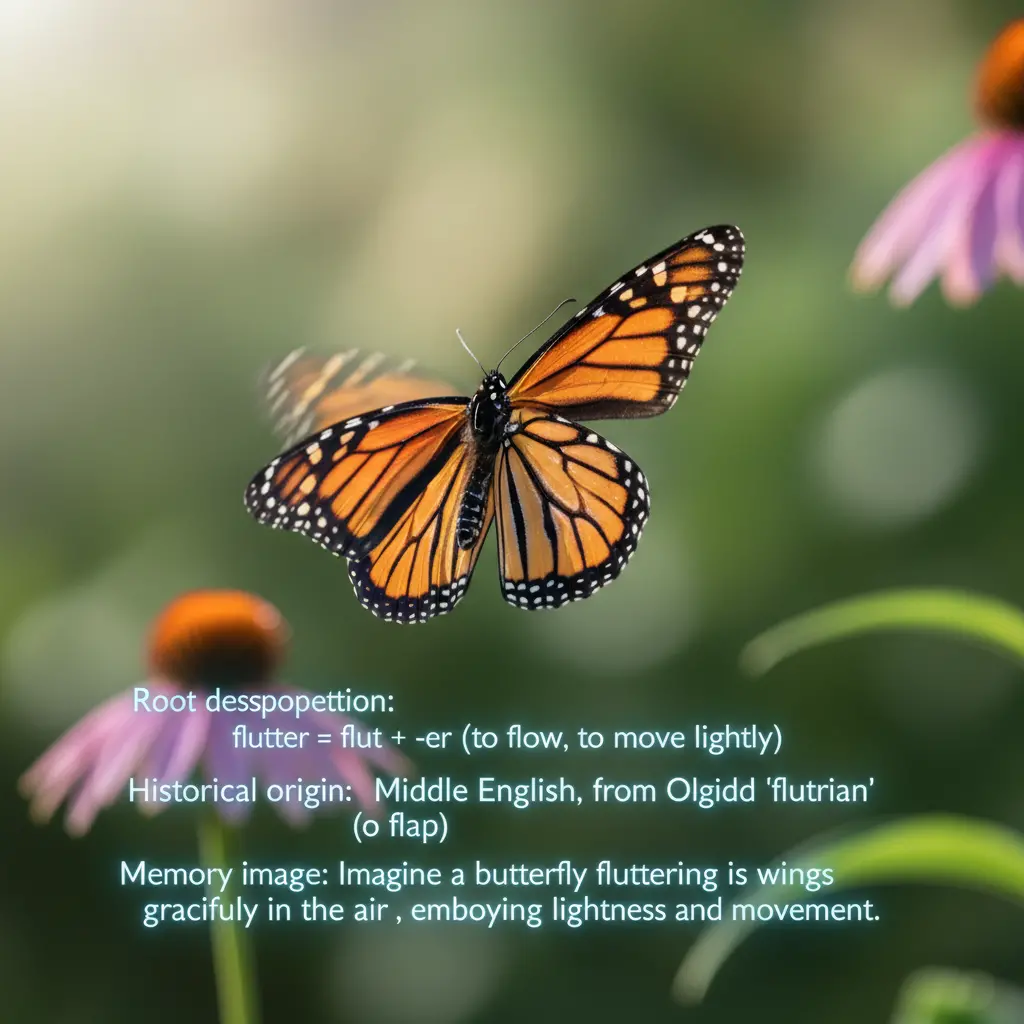
Root decomposition: flutter = flut + -er (to flow, to move lightly). Historical origin: Middle English, from Old English 'flutrian' (to flap). Memory image: Imagine a butterfly fluttering its wings gracefully in the air, embodying lightness and movement.
Note 1: These definitions and etymologies are not standard dictionary definitions, but extended explanations provided to help with memorization and understanding of the actual application of words. Through this background information, we strive to make words more vivid and easier to understand, and help you remember their meanings in real life.
Note 2: LexiTalk designs the learning flow around the linguistics principle of “Comprehensible Input.” When learners encounter material that is slightly above their level but still understandable from context, the brain naturally absorbs the language. That’s why we keep every word inside authentic contexts, using examples and associations to help you understand it and use it flexibly.
Read the FAQ explanation of Comprehensible InputFlutter means to move lightly and quickly in the air; to tremble or shake; or to agitate or fluster someone or something. It conveys small, brief motion rather than heavy or sustained movement. You can describe a bird or leaf fluttering, a flag in a breeze, or your heart fluttering with excitement or nerves. In everyday use, one might say the butterfly fluttered its wings, or I felt my heart flutter with anticipation. The verb forms are flutter, fluttering, fluttered. Etymology traces flutter to flut- 'to flow, move lightly' and it carries a sense of gentle, airy motion.
For English learners, flutter often centers on light motion or quick emotional responses. Some may overextend it to any movement or confuse it with flap, which implies heavier action. Remember: flutter emphasizes brief, airy motion and sometimes feelings that rise briefly, not a long process.
What is the meaning of 'flutter'?
In which sentence is 'flutter' used correctly?
Which word is a synonym of 'flutter'?
What is the opposite of 'flutter'?
In what real-life context might you observe a 'flutter'?
Download LexiTalk app for personalized learning experience
Download AppCookies
We use cookies for essential site functions, analytics, and ads. You can accept, reject, or manage preferences. Privacy Policy