fossils - Master This Word
Master this word with our 5-step learning method – Learn English in English
Train English Through Brain Routes, Not Translation.
This page helps you stop memorizing isolated translations and start understanding a word through its shared mental image, native-style thinking, and practical training steps.
Master this word with our 5-step learning method – Learn English in English
Example sentences are the start of understanding. Don't rush to memorize. First feel how the word works in a sentence.
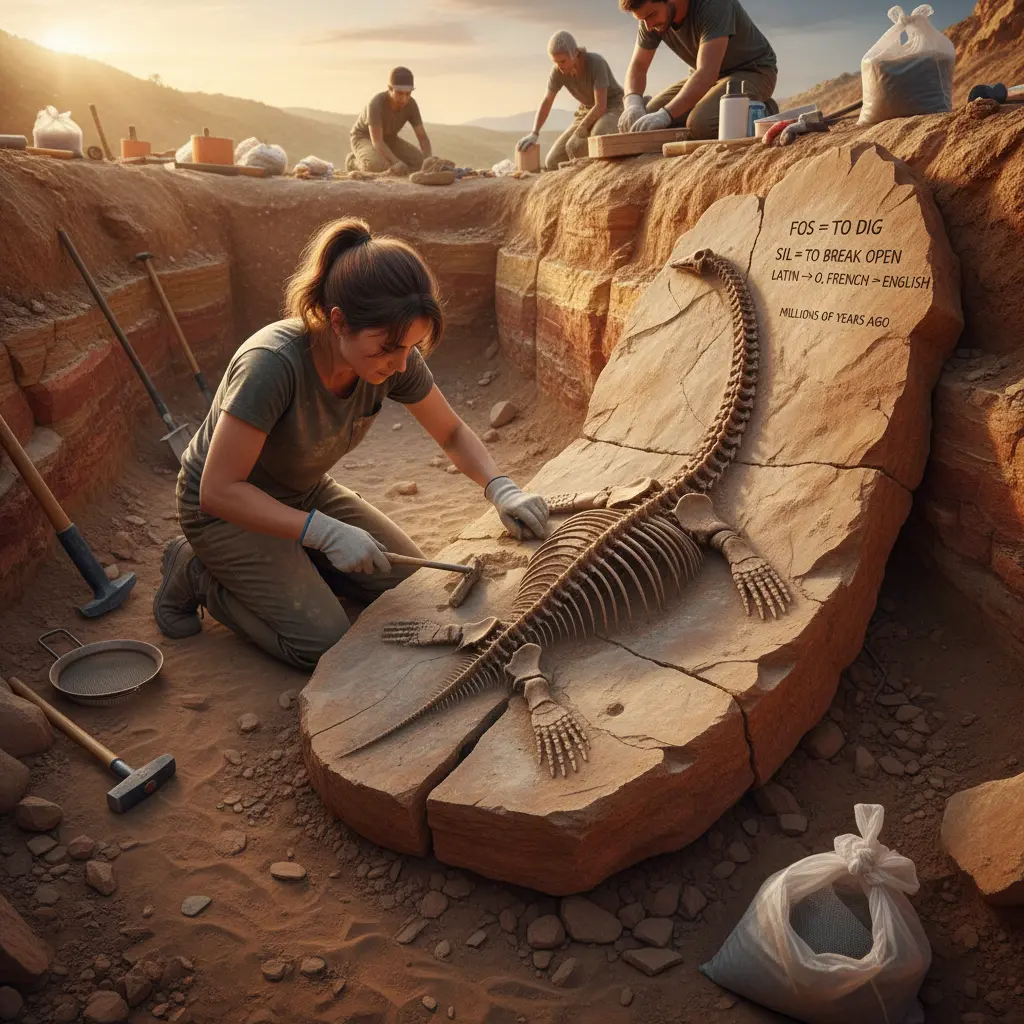
fossil = fos- (to dig) + -sil (to break open); Originates from Latin → Old French → English. Imagine an archaeologist digging into the earth and finding ancient remnants of life enclosed in rock, revealing stories from millions of years ago.
Note 1: These definitions and etymologies are not standard dictionary definitions, but extended explanations provided to help with memorization and understanding of the actual application of words. Through this background information, we strive to make words more vivid and easier to understand, and help you remember their meanings in real life.
Note 2: LexiTalk designs the learning flow around the linguistics principle of “Comprehensible Input.” When learners encounter material that is slightly above their level but still understandable from context, the brain naturally absorbs the language. That’s why we keep every word inside authentic contexts, using examples and associations to help you understand it and use it flexibly.
Read the FAQ explanation of Comprehensible InputI place my palm on the cool glass and move my fingers along the fossil's ridges. I tilt my wrist and turn the angle a little, feeling a push and pull as details come into focus. I adjust my grip, hold my breath, and let the moment settle. The simple act shows me that a fossil is a trace kept from life long ago, showing up when I look closely.
Fossil refers to the preserved remains or traces of ancient organisms, typically found in rocks. It can be bones, shells, imprints, or even organisms trapped in amber. Fossils let scientists reconstruct past ecosystems, climates, and evolutionary processes. The term also carries a metaphorical sense, describing a person or idea that seems stuck in the past or out of fashion. As a noun (plural fossils), it has related phrases like fossil record and fossil fuel; the verb form is fossilize. Understanding the distinctions helps learners switch between literal science contexts and figurative language without confusion.
In English, fossil has a clear science meaning and a broad metaphorical use. Learners often overgeneralize the metaphor, confuse fossilize with fossil, and stumble over phrases like fossil fuel and fossil record.
What is the definition of fossils?
Which of the following sentences uses the word 'fossils' correctly?
Which word is most similar to fossils?
What is the opposite of fossils?
Can you think of a real-life context where ancient remains are studied?
English Learning Listening Content
Listen NowDownload LexiTalk app for personalized learning experience
Download AppCookies
We use cookies for essential site functions, analytics, and ads. You can accept, reject, or manage preferences. Privacy Policy