geography - Master This Word
Master this word with our 5-step learning method – Learn English in English
Train English Through Brain Routes, Not Translation.
This page helps you stop memorizing isolated translations and start understanding a word through its shared mental image, native-style thinking, and practical training steps.
Master this word with our 5-step learning method – Learn English in English
Example sentences are the start of understanding. Don't rush to memorize. First feel how the word works in a sentence.
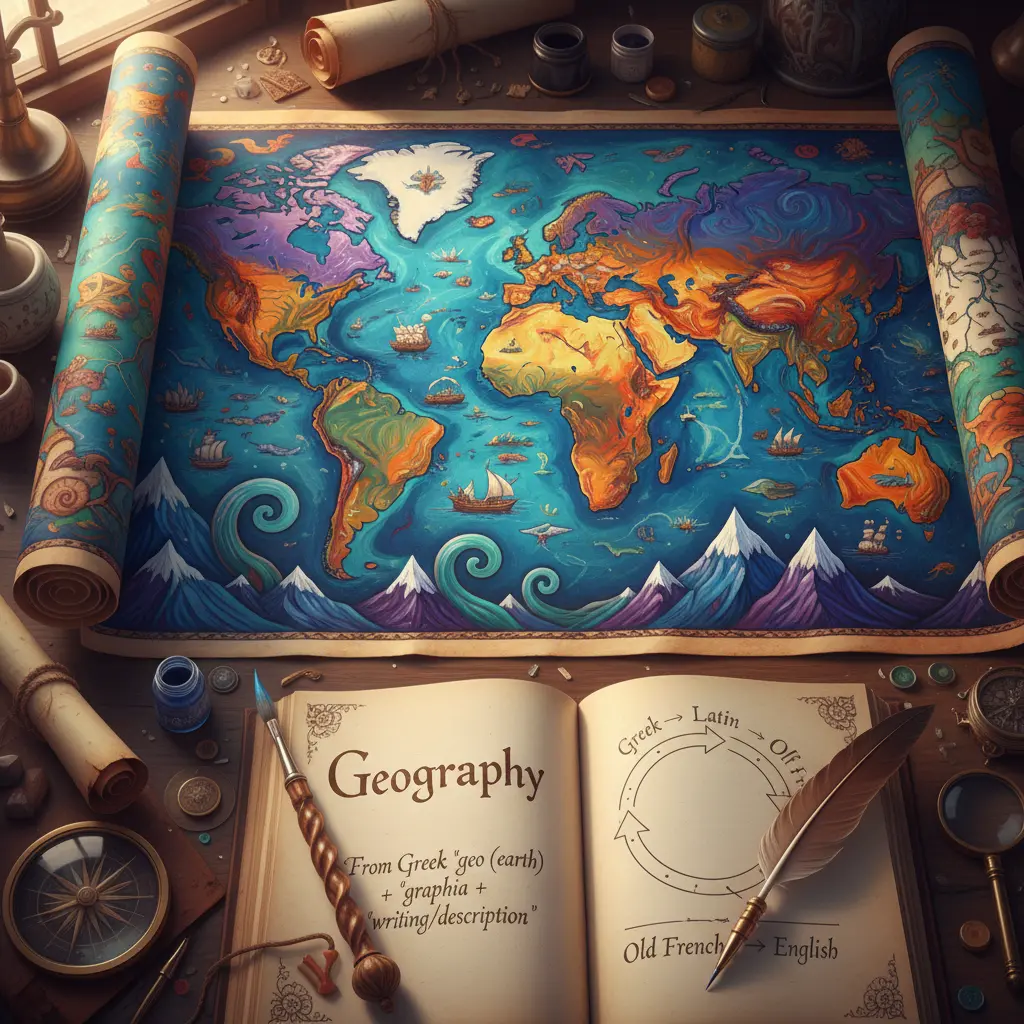
geo- = earth; -graphy = writing/description. Origin: Greek → Latin → Old French → English. Imagine a map being crafted with vibrant colors depicting mountains and rivers, telling the story of Earth's features.
Note 1: These definitions and etymologies are not standard dictionary definitions, but extended explanations provided to help with memorization and understanding of the actual application of words. Through this background information, we strive to make words more vivid and easier to understand, and help you remember their meanings in real life.
Note 2: LexiTalk designs the learning flow around the linguistics principle of “Comprehensible Input.” When learners encounter material that is slightly above their level but still understandable from context, the brain naturally absorbs the language. That’s why we keep every word inside authentic contexts, using examples and associations to help you understand it and use it flexibly.
Read the FAQ explanation of Comprehensible InputI sit with a map and move my finger along the shapes of land and water. I shift the page to follow a river's bend and set a pin on a busy coast town. The feel of that push and hold to keep the image steady grows as the coast seems to breathe under my touch. This sense carries into real use, guiding how we plan routes, where cities sit, and how people interact with the environment.
Geography is the study of the Earth's surfaces, features, and phenomena. It examines how landscapes are shaped by natural forces and how human activity interacts with those spaces. The word covers both physical geography, which looks at mountains, rivers, climates, and ecosystems, and human geography, which analyzes cities, borders, migrations, and cultural patterns. Geographers use maps, data, and fieldwork to describe where things are, why they are there, and how places connect with one another. By exploring scale—from local neighborhoods to global systems—geography helps explain issues like climate change, resource distribution, and urban planning. It is a bridge between the natural world and human society.
Geography in English often emphasizes both physical processes and human systems, using terms like physical geography and human geography to frame the subject; learners may overfocus on map skills and forget the explanatory role of spatial relationships.
What is the meaning of the word 'geography'?
In which sentence is 'geography' used correctly?
Which word is a synonym of 'geography'?
Which word is an antonym of 'geography'?
How is 'geography' relevant in real life?
Download LexiTalk app for personalized learning experience
Download AppCookies
We use cookies for essential site functions, analytics, and ads. You can accept, reject, or manage preferences. Privacy Policy