gradients - Master This Word
Master this word with our 5-step learning method – Learn English in English
Train English Through Brain Routes, Not Translation.
This page helps you stop memorizing isolated translations and start understanding a word through its shared mental image, native-style thinking, and practical training steps.
Master this word with our 5-step learning method – Learn English in English
Example sentences are the start of understanding. Don't rush to memorize. First feel how the word works in a sentence.
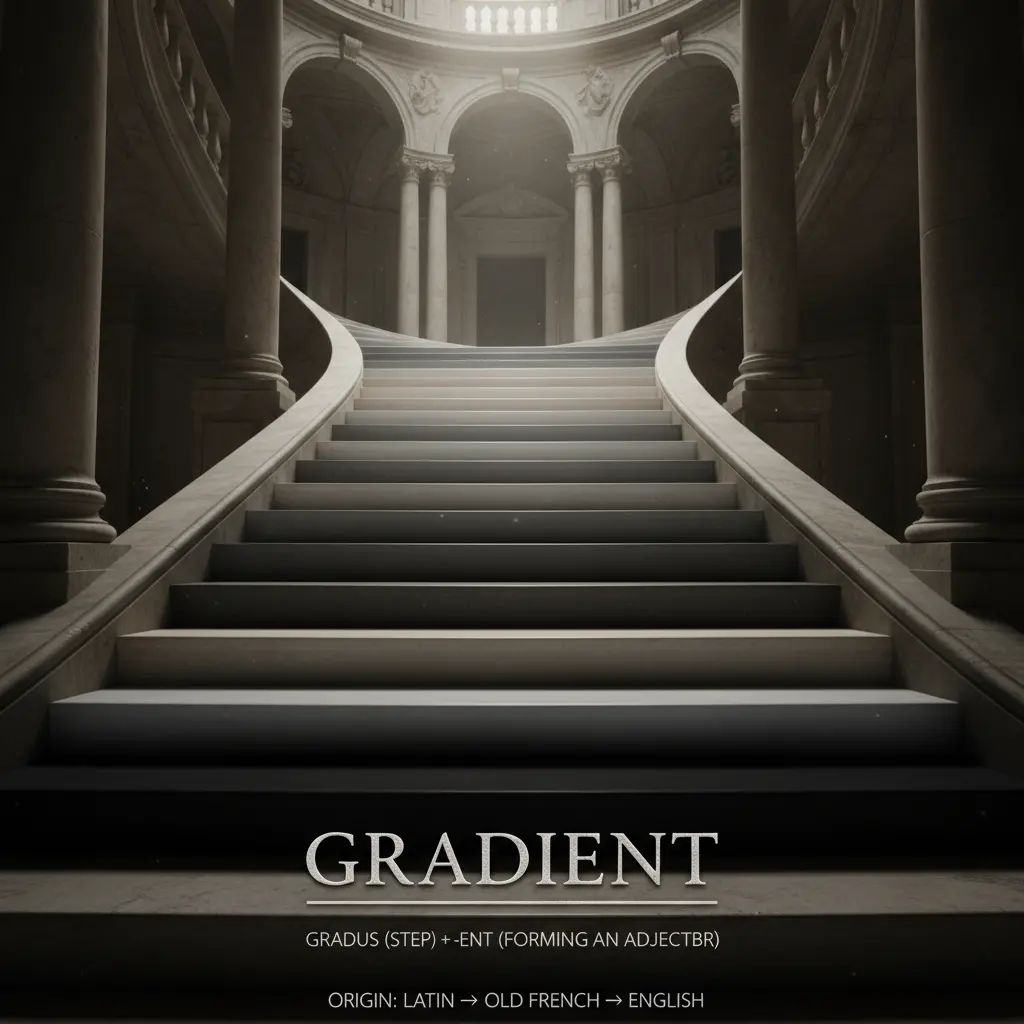
gradient = gradus (step) + -ent (forming an adjective). Origin: Latin → Old French → English. Picture a staircase where each step shifts in color from dark to light, illustrating a smooth transition.
Note 1: These definitions and etymologies are not standard dictionary definitions, but extended explanations provided to help with memorization and understanding of the actual application of words. Through this background information, we strive to make words more vivid and easier to understand, and help you remember their meanings in real life.
Note 2: LexiTalk designs the learning flow around the linguistics principle of “Comprehensible Input.” When learners encounter material that is slightly above their level but still understandable from context, the brain naturally absorbs the language. That’s why we keep every word inside authentic contexts, using examples and associations to help you understand it and use it flexibly.
Read the FAQ explanation of Comprehensible InputGradient is a noun with several related but distinct senses. In design, it refers to a gradual change in color or tone from one shade to another, creating a smooth transition. In everyday language and in basic geometry, gradient can also mean a slope or incline—the steepness of a hill, measured as a change in height over distance. In mathematics more broadly, gradient denotes the rate of change or variation of a quantity; for a single-variable function it is closely related to the derivative, while for multivariable functions it points in the direction of greatest increase. The idea evokes steps, color bands, and surfaces that shift gently from dark to light, hot to cool, or fast to slow.
English learners often trip over gradient’s multiple senses, especially when distinguishing color gradient from mathematical slope or rate of change. The phrase is common in design, geography, and calculus, so context is essential to choose the right meaning.
Download LexiTalk app for personalized learning experience
Download AppCookies
We use cookies for essential site functions, analytics, and ads. You can accept, reject, or manage preferences. Privacy Policy