greater - Master This Word
Master this word with our 5-step learning method – Learn English in English
Train English Through Brain Routes, Not Translation.
This page helps you stop memorizing isolated translations and start understanding a word through its shared mental image, native-style thinking, and practical training steps.
Master this word with our 5-step learning method – Learn English in English
Example sentences are the start of understanding. Don't rush to memorize. First feel how the word works in a sentence.
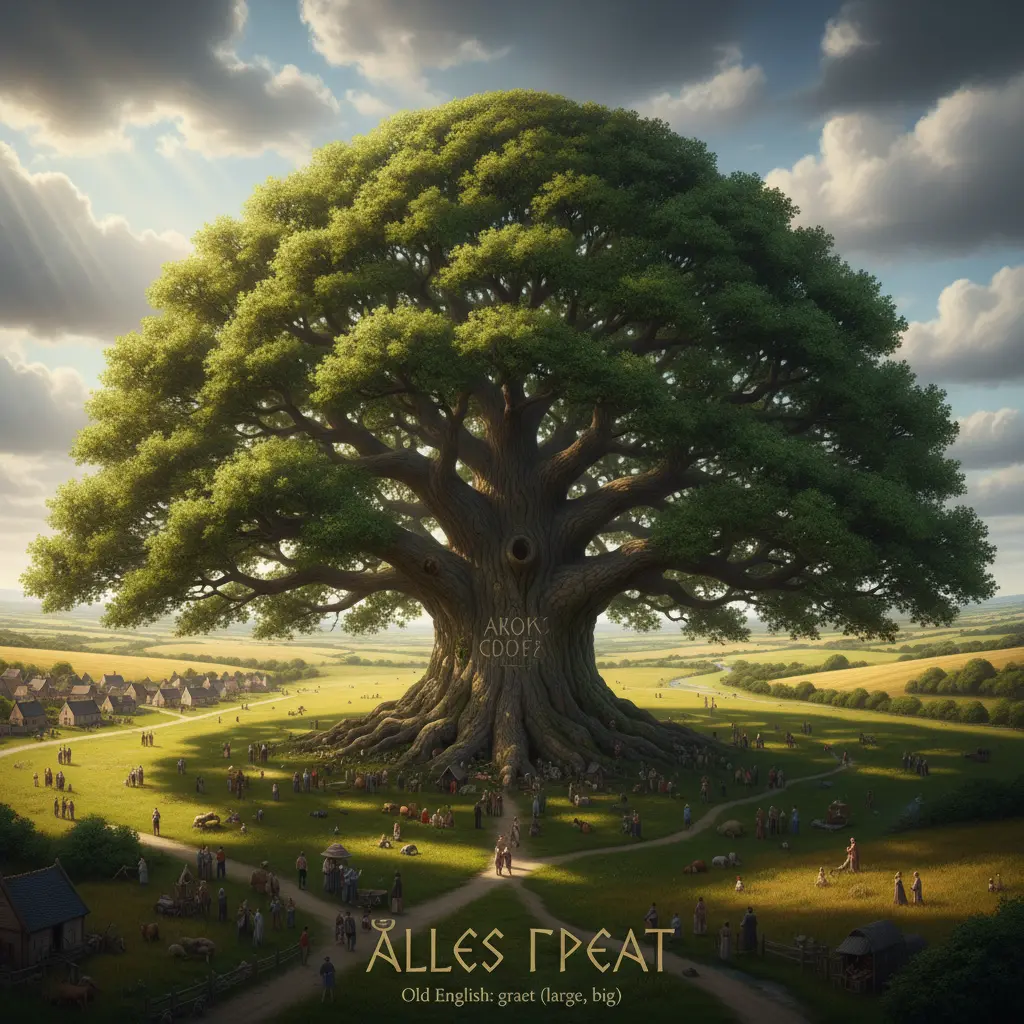
Great comes from the Old English "graet" meaning large or big. The root decomposes into "grea" (meaning full or large). Imagine a gigantic tree that provides shade to everything around it, symbolizing greatness.
Note 1: These definitions and etymologies are not standard dictionary definitions, but extended explanations provided to help with memorization and understanding of the actual application of words. Through this background information, we strive to make words more vivid and easier to understand, and help you remember their meanings in real life.
Note 2: LexiTalk designs the learning flow around the linguistics principle of “Comprehensible Input.” When learners encounter material that is slightly above their level but still understandable from context, the brain naturally absorbs the language. That’s why we keep every word inside authentic contexts, using examples and associations to help you understand it and use it flexibly.
Read the FAQ explanation of Comprehensible InputFirst I push the door open a crack and then turn the knob wider, watching the space move from dim to bright. I adjust my pace as the light shifts and the room feels more alive, and I hold steady to keep the rhythm. The effort makes the moment feel bigger, like the scene is about to change its mood from ordinary to great. By the time I step through, the whole moment sits solid and clear, and I know it’s great because I earned it with a simple push.
Great describes something that is far above the normal level in extent, amount, or intensity, and also denotes high quality or importance, or something impressive or excellent. It is versatile and common in everyday speech as well as in writing. You can use it before nouns (a great idea), before adjectives (great big), or to modify whole clauses (That was a great win). Learners should note that great can be informal and friendly, but in many situations it remains perfectly acceptable in semi-formal contexts; for formal writing, you might opt for excellent or outstanding. The Old English graet originally meant large or big, reinforcing the image of breadth or power.
Explain to an English speaker: Great is highly versatile and common in everyday praise, but learners sometimes over-sentimentalize it or misuse it when they want stronger synonyms like excellent or superb.
What does the word 'greater' mean?
Choose the correct sentence that uses 'greater' properly.
Which word is most similar to 'greater'?
What is the opposite of 'greater'?
Can you think of a real-life context where you would use the word 'greater'?
Download LexiTalk app for personalized learning experience
Download AppCookies
We use cookies for essential site functions, analytics, and ads. You can accept, reject, or manage preferences. Privacy Policy