greatly - Master This Word
Master this word with our 5-step learning method – Learn English in English
Train English Through Brain Routes, Not Translation.
This page helps you stop memorizing isolated translations and start understanding a word through its shared mental image, native-style thinking, and practical training steps.
Master this word with our 5-step learning method – Learn English in English
Example sentences are the start of understanding. Don't rush to memorize. First feel how the word works in a sentence.
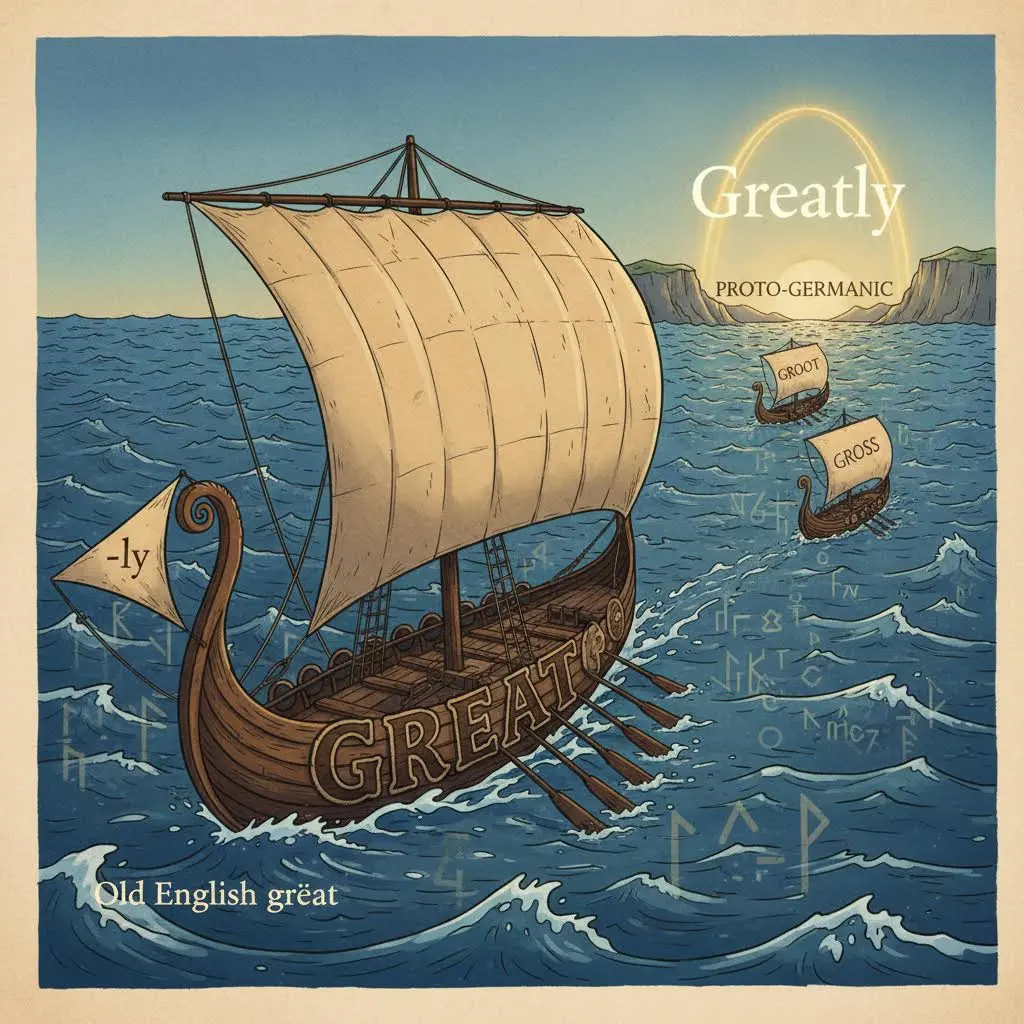
Root decomposition: great + suffix -ly forms the adverb greatly. Historical origin: great comes from Old English grēat, from Proto-Germanic *grautaz-, related to Dutch groot and German groß. Memory image: imagine a bold word GREAT with a tiny -ly sail attached, sailing across the sea to become greatly.
Note 1: These definitions and etymologies are not standard dictionary definitions, but extended explanations provided to help with memorization and understanding of the actual application of words. Through this background information, we strive to make words more vivid and easier to understand, and help you remember their meanings in real life.
Note 2: LexiTalk designs the learning flow around the linguistics principle of “Comprehensible Input.” When learners encounter material that is slightly above their level but still understandable from context, the brain naturally absorbs the language. That’s why we keep every word inside authentic contexts, using examples and associations to help you understand it and use it flexibly.
Read the FAQ explanation of Comprehensible InputMy hand moves to the window latch, I push and then turn, and the curtains pull back. Light floods in and the world changes greatly, the room suddenly bright and warm. I feel the effort in my arm, steadying as I adjust the balance of shade and glow. Later, in everyday talk, I use greatly to mark something that matters, the sense of emphasis sticking with me as I speak.
greatly means to a very large extent, with strong emphasis; to a significant degree. It often intensifies verbs, adjectives, or participles: greatly improved, greatly influenced, greatly appreciated. It usually comes before the word it modifies and signals a higher degree than simply very. In formal writing, greatly can convey measured emphasis, whereas everyday speech might use very much or a lot more naturally. It does not commonly modify nouns directly. The word is formed from great + -ly; its history traces to Old English grēat and Proto-Germanic roots. Use it to show substantial impact or growth, but avoid overusing it in casual sentences where a simpler alternative would suffice.
For English learners, greatly emphasizes scale or intensity and sits before the word it modifies; it often signals formality. Learners may misuse it with nouns or replace it with 'very' in all contexts, which can weaken nuance.
What is the meaning of 'greatly'?
In which sentence is 'greatly' used correctly?
Which is a synonym of 'greatly'?
What is the opposite of 'greatly'?
How would you use 'greatly' in a real-life scenario?
Download LexiTalk app for personalized learning experience
Download AppCookies
We use cookies for essential site functions, analytics, and ads. You can accept, reject, or manage preferences. Privacy Policy