
homeostasis - Master This Word
Master this word with our 5-step learning method – Learn English in English
Train English Through Brain Routes, Not Translation.
This page helps you stop memorizing isolated translations and start understanding a word through its shared mental image, native-style thinking, and practical training steps.
Master this word with our 5-step learning method – Learn English in English
Example sentences are the start of understanding. Don't rush to memorize. First feel how the word works in a sentence.
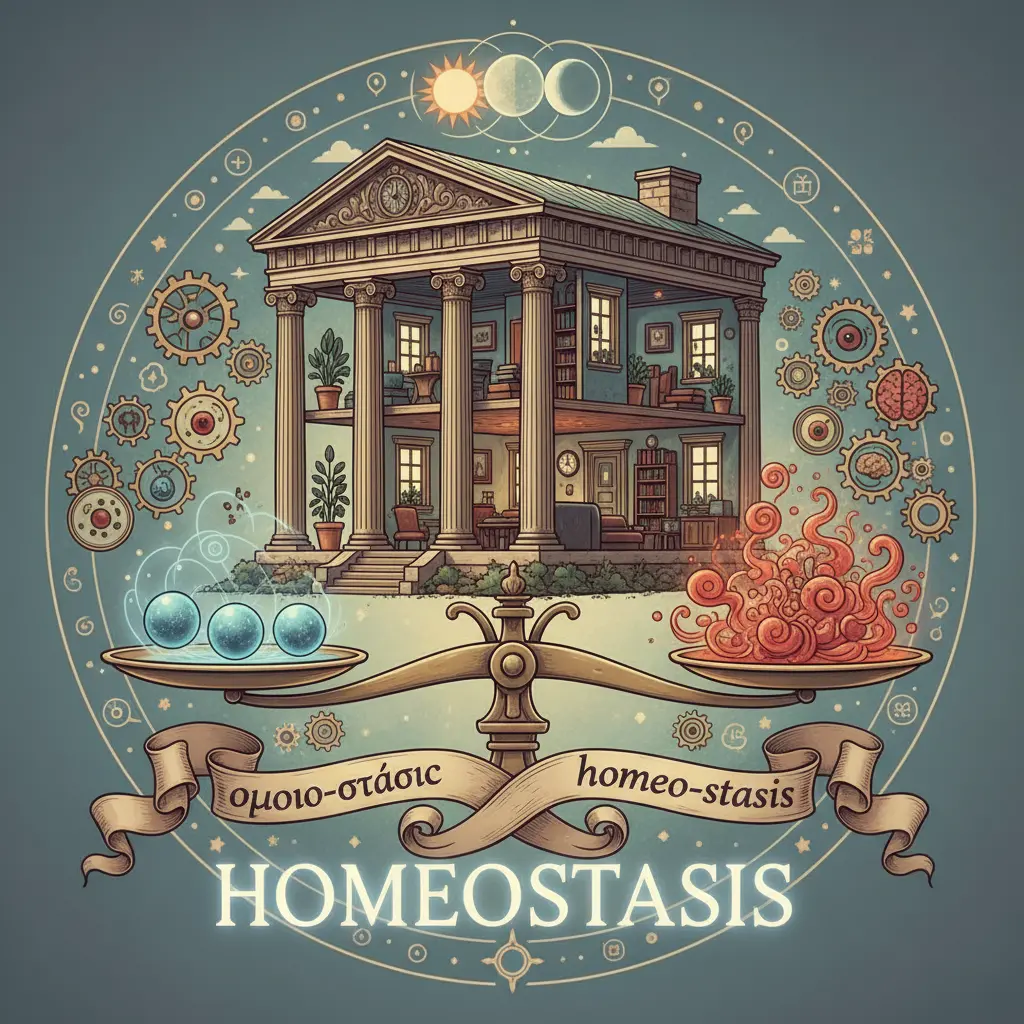
Root decomposition: 'homo-' (same) + 'stasis' (standing). Historical origin: Greek (homeo-stasis) → Latin → English. Memory image: Imagine a home where everything is perfectly organized and balanced—just like how organisms maintain internal equilibrium despite external changes.
Note 1: These definitions and etymologies are not standard dictionary definitions, but extended explanations provided to help with memorization and understanding of the actual application of words. Through this background information, we strive to make words more vivid and easier to understand, and help you remember their meanings in real life.
Note 2: LexiTalk designs the learning flow around the linguistics principle of “Comprehensible Input.” When learners encounter material that is slightly above their level but still understandable from context, the brain naturally absorbs the language. That’s why we keep every word inside authentic contexts, using examples and associations to help you understand it and use it flexibly.
Read the FAQ explanation of Comprehensible InputHomeostasis is the process by which living organisms maintain a stable internal environment despite external changes. It relies on sensory receptors, control centers, and effectors to monitor variables such as body temperature, pH, glucose levels, and fluid balance, and to adjust processes like sweating, respiration, urination, and hormone release to keep conditions within a narrow, functional range. This dynamic balancing act is ongoing and can involve rapid responses or slow, long-term adjustments. When homeostasis is disrupted, cells and organs may malfunction, health can deteriorate, and disease may result. Scientists describe the system in terms of set points, feedback loops, and coordinated signaling that keep the organism functioning smoothly.
For English speakers, think of homeostasis as a dynamic balancing act driven by feedback, targets, and signaling rather than a static fixed state. Learners often confuse it with simple 'stability' or with the idea of a single turning point. Emphasize that many variables are regulated together and that the term appears across physiology, medicine, and biology.
What is the definition of 'homeostasis'?
Which sentence correctly uses 'homeostasis'?
Which word is most similar to 'homeostasis'?
What is the opposite of 'homeostasis'?
Can you think of a real-life context where the concept of homeostasis is important?
Download LexiTalk app for personalized learning experience
Download AppCookies
We use cookies for essential site functions, analytics, and ads. You can accept, reject, or manage preferences. Privacy Policy