hour - Master This Word
Master this word with our 5-step learning method – Learn English in English
Train English Through Brain Routes, Not Translation.
This page helps you stop memorizing isolated translations and start understanding a word through its shared mental image, native-style thinking, and practical training steps.
Master this word with our 5-step learning method – Learn English in English
Example sentences are the start of understanding. Don't rush to memorize. First feel how the word works in a sentence.
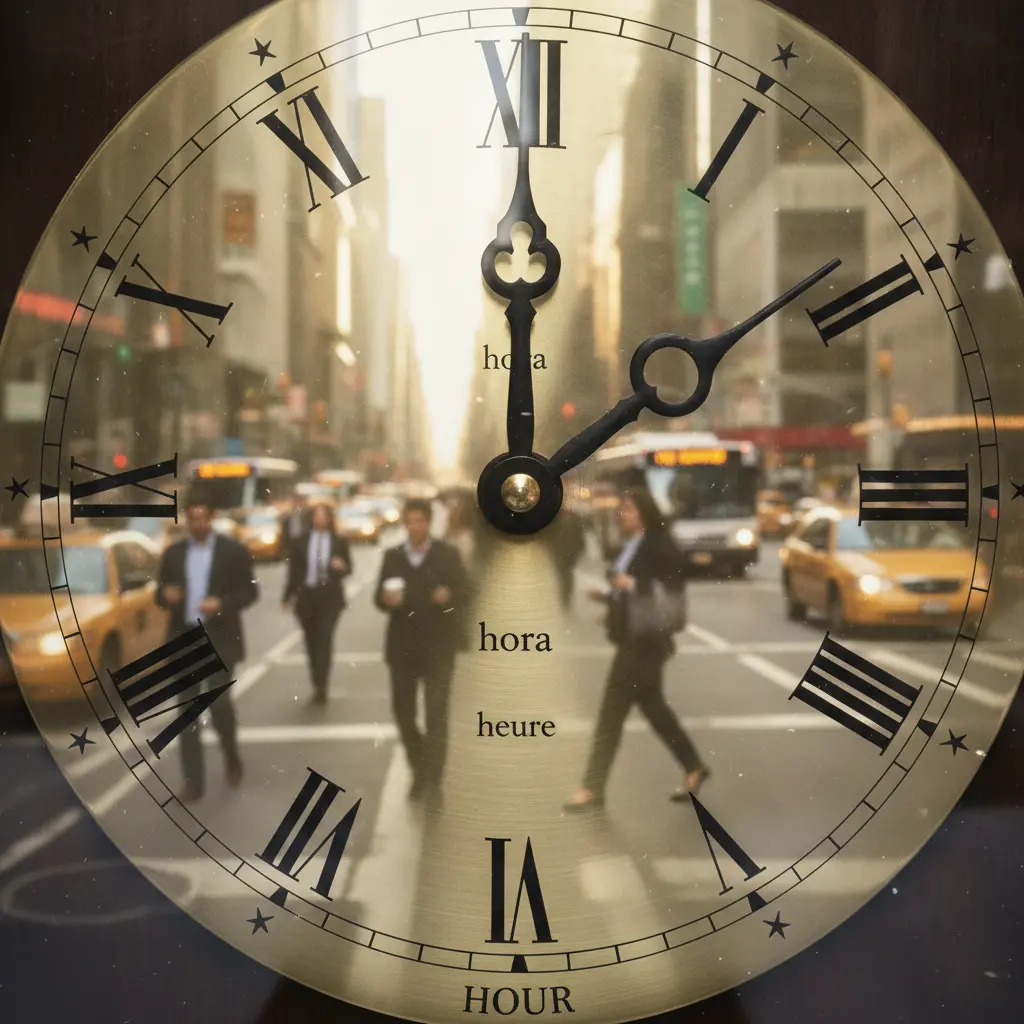
hour = 'hora' (Latin) + 'heure' (Old French) → English. Imagine a clock with hands pointing to a specific hour, indicating time passing during a busy day.
Note 1: These definitions and etymologies are not standard dictionary definitions, but extended explanations provided to help with memorization and understanding of the actual application of words. Through this background information, we strive to make words more vivid and easier to understand, and help you remember their meanings in real life.
Note 2: LexiTalk designs the learning flow around the linguistics principle of “Comprehensible Input.” When learners encounter material that is slightly above their level but still understandable from context, the brain naturally absorbs the language. That’s why we keep every word inside authentic contexts, using examples and associations to help you understand it and use it flexibly.
Read the FAQ explanation of Comprehensible InputI pull back my sleeve and look at the clock. The minute hand moves, and the hour seems to shift as I decide what to do next. I adjust my pace, keep my plan in check, and set a timer to keep the next hour on track. In that small, steady moment, the hour becomes a cue for how I act—where I place my tasks, what I push forward, and how I let time guide my day.
An hour is a unit of time equal to 60 minutes, but everyday speech treats it as a flexible block rather than a precise measurement. We talk about hours as durations or as points on a schedule, using phrases like 'in an hour' or 'two hours from now' and distinguishing the singular 'an hour' from the plural 'hours.' When telling time, we use clock expressions such as 'at 3 o'clock' or 'it's 2:15,' but for durations we say 'spend an hour' or 'wait for a couple of hours.' Learners often confuse hours with minutes, or misplace the word in questions like 'What time is it in an hour?'
English uses hour for both a clock time and a duration, with clear distinctions like 'in an hour' vs 'at 3 o'clock.' Learners often mix up singular/plural and confuse with minutes.
What is the definition of the word 'hour'?
Which sentence uses the word 'hour' correctly?
Which word is most similar in meaning to 'hour'?
Which word best represents an opposite concept to the length implied by 'hour'?
Can you give an example of a real-life scenario that reflects the meaning without using the word itself?
Download LexiTalk app for personalized learning experience
Download AppCookies
We use cookies for essential site functions, analytics, and ads. You can accept, reject, or manage preferences. Privacy Policy