
hydrogen - Master This Word
Master this word with our 5-step learning method – Learn English in English
Train English Through Brain Routes, Not Translation.
This page helps you stop memorizing isolated translations and start understanding a word through its shared mental image, native-style thinking, and practical training steps.
Master this word with our 5-step learning method – Learn English in English
Example sentences are the start of understanding. Don't rush to memorize. First feel how the word works in a sentence.
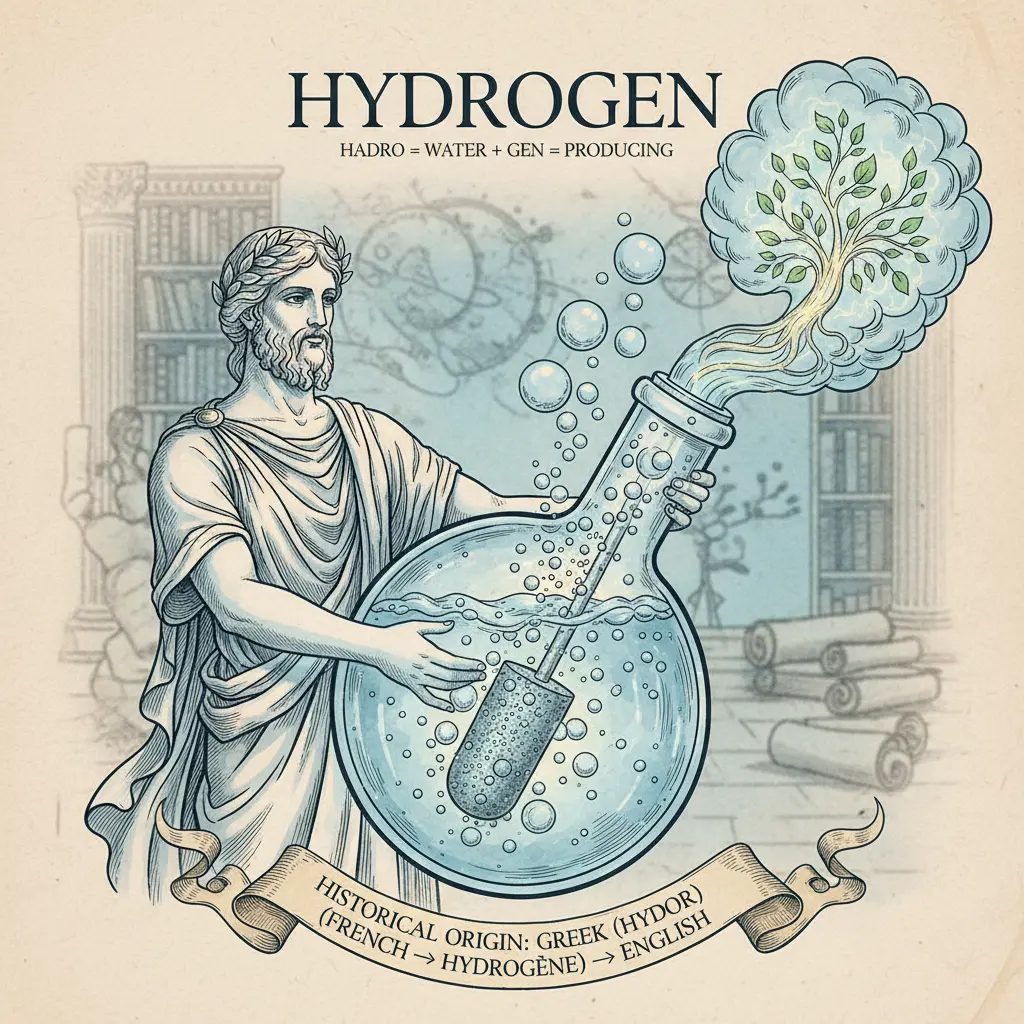
Root: hydro- = water, gen = producing. Historical origin: Greek (hydor) → French (hydrogène) → English. Memory image: Imagine water bubbling as hydrogen is generated, the essence of life, rising into the air.
Note 1: These definitions and etymologies are not standard dictionary definitions, but extended explanations provided to help with memorization and understanding of the actual application of words. Through this background information, we strive to make words more vivid and easier to understand, and help you remember their meanings in real life.
Note 2: LexiTalk designs the learning flow around the linguistics principle of “Comprehensible Input.” When learners encounter material that is slightly above their level but still understandable from context, the brain naturally absorbs the language. That’s why we keep every word inside authentic contexts, using examples and associations to help you understand it and use it flexibly.
Read the FAQ explanation of Comprehensible InputI cup my hands around an imagined puff and tilt my head, watching the invisible thing respond to my breath. I push and pull the air, shift the weight in my chest, and feel it slip free from water and rise toward space. I decide how to use it, like choosing a tool for a small fuel cell or a rocket burn. Holding the idea in mind, I adjust my grip and let the moment tell me what this word can do in real life.
Hydrogen is a colorless, odorless gas that is the lightest element in the periodic table. It primarily exists as H2 molecules and is highly reactive, especially at elevated temperatures. Because it is so light, hydrogen rises quickly and can be difficult to contain without specialized equipment. It is most abundant in the universe, making up stars and gas giant planets, and on Earth it is bound up in water and organic compounds. Hydrogen is a key element in water, organic chemistry, and many industrial processes. In modern technology, it powers fuel cells and is used as rocket fuel, offering potential for low-emission energy systems.
English speakers often focus on the chemical properties and the abstract idea of a light, reactive gas, so examples tend to emphasize H2, reactions with oxygen, and applications like fuel cells and rockets.
What is the meaning of 'hydrogen'?
In which of the following sentences is 'hydrogen' used correctly?
Which word is a synonym of 'hydrogen'?
Which word is an antonym of 'hydrogen'?
How is 'hydrogen' used in the context of renewable energy?
Download LexiTalk app for personalized learning experience
Download AppCookies
We use cookies for essential site functions, analytics, and ads. You can accept, reject, or manage preferences. Privacy Policy