
illusion - Master This Word
Master this word with our 5-step learning method – Learn English in English
Train English Through Brain Routes, Not Translation.
This page helps you stop memorizing isolated translations and start understanding a word through its shared mental image, native-style thinking, and practical training steps.
Master this word with our 5-step learning method – Learn English in English
Example sentences are the start of understanding. Don't rush to memorize. First feel how the word works in a sentence.
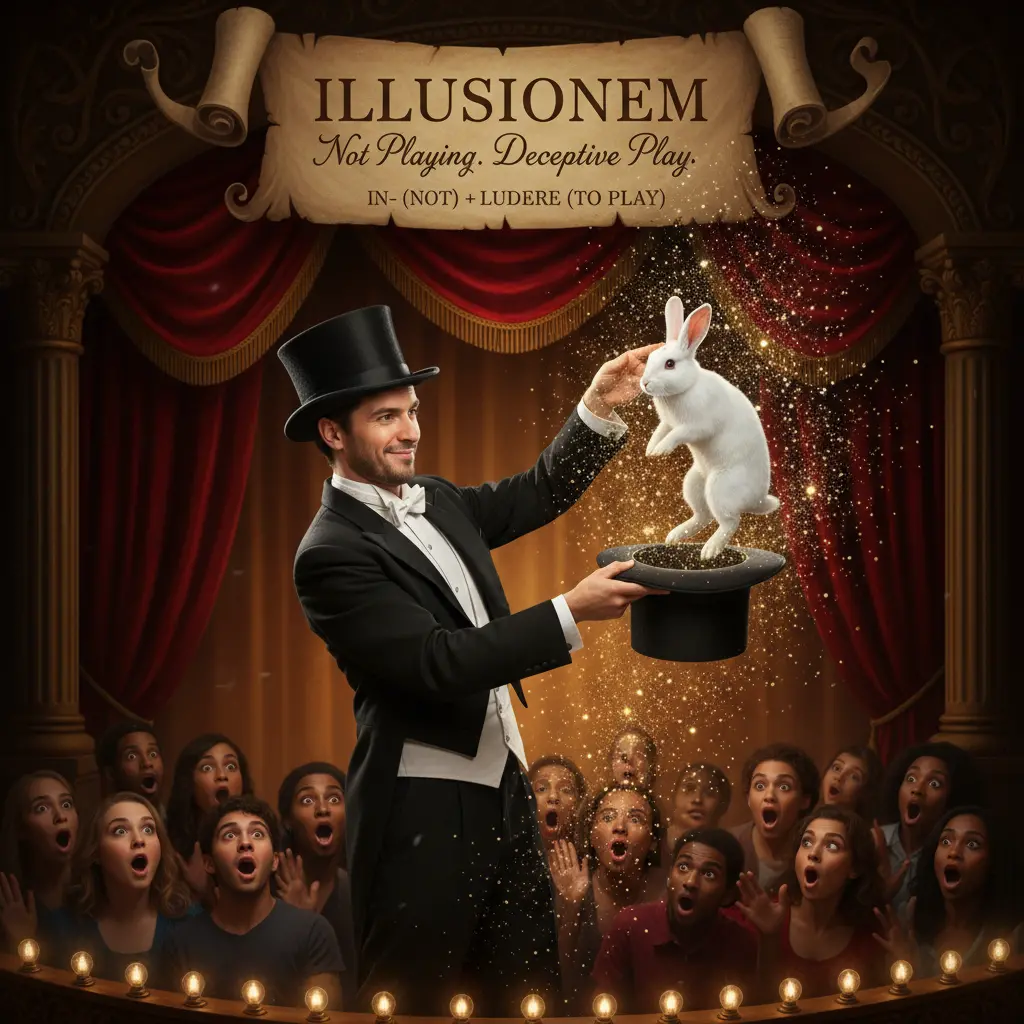
From Latin 'illusiōnem', which breaks down to 'in-' (not) + 'ludere' (to play), meaning 'not playing' or 'deceptive play'; derived through Old French into English. Imagine a magician pulling a rabbit from a hat, creating a stunning yet deceptive moment that tricks the audience's perception of reality.
Note 1: These definitions and etymologies are not standard dictionary definitions, but extended explanations provided to help with memorization and understanding of the actual application of words. Through this background information, we strive to make words more vivid and easier to understand, and help you remember their meanings in real life.
Note 2: LexiTalk designs the learning flow around the linguistics principle of “Comprehensible Input.” When learners encounter material that is slightly above their level but still understandable from context, the brain naturally absorbs the language. That’s why we keep every word inside authentic contexts, using examples and associations to help you understand it and use it flexibly.
Read the FAQ explanation of Comprehensible InputFirst I move my eyes over a simple image, and the shapes seem to tilt just enough to mislead me. I adjust my focus, push aside my first guess, and the scene changes again. The effort feels like a small pull and push inside my head, a sense of control that keeps the image shifting. When I breathe and let the moment settle, the view lingers as something my own mind creates, not a fixed truth.
An illusion is a deceptive perception that makes something seem real when it is not. It can be a visual trick, like a mirage, or a broader mental effect, such as believing a coincidence proves a connection. Illusions arise when our senses or expectations lead the brain to fill in missing information with plausible but false details. The word comes from Latin illusiōnem, via Old French, emphasizing the act of playing with perception rather than reality. In everyday life we talk about media illusions, staged tricks, or the illusion of progress, reminding us to question appearances and seek evidence rather than assume truth at first glance.
Illusion in English covers both perceptual tricks and mistaken beliefs. Learners often mix it with delusion or hallucination, and overlook its figurative uses (like 'illusion of progress'). Context is key to choosing the right sense.
What is the meaning of the word 'illusion'?
Which of the following sentences use 'illusion' correctly?
Which word is most similar to 'illusion'?
What is the opposite of 'illusion'?
Can you give an example of a real-life scenario involving false beliefs?
Download LexiTalk app for personalized learning experience
Download AppCookies
We use cookies for essential site functions, analytics, and ads. You can accept, reject, or manage preferences. Privacy Policy