
inclusion - Master This Word
Master this word with our 5-step learning method – Learn English in English
Train English Through Brain Routes, Not Translation.
This page helps you stop memorizing isolated translations and start understanding a word through its shared mental image, native-style thinking, and practical training steps.
Master this word with our 5-step learning method – Learn English in English
Example sentences are the start of understanding. Don't rush to memorize. First feel how the word works in a sentence.
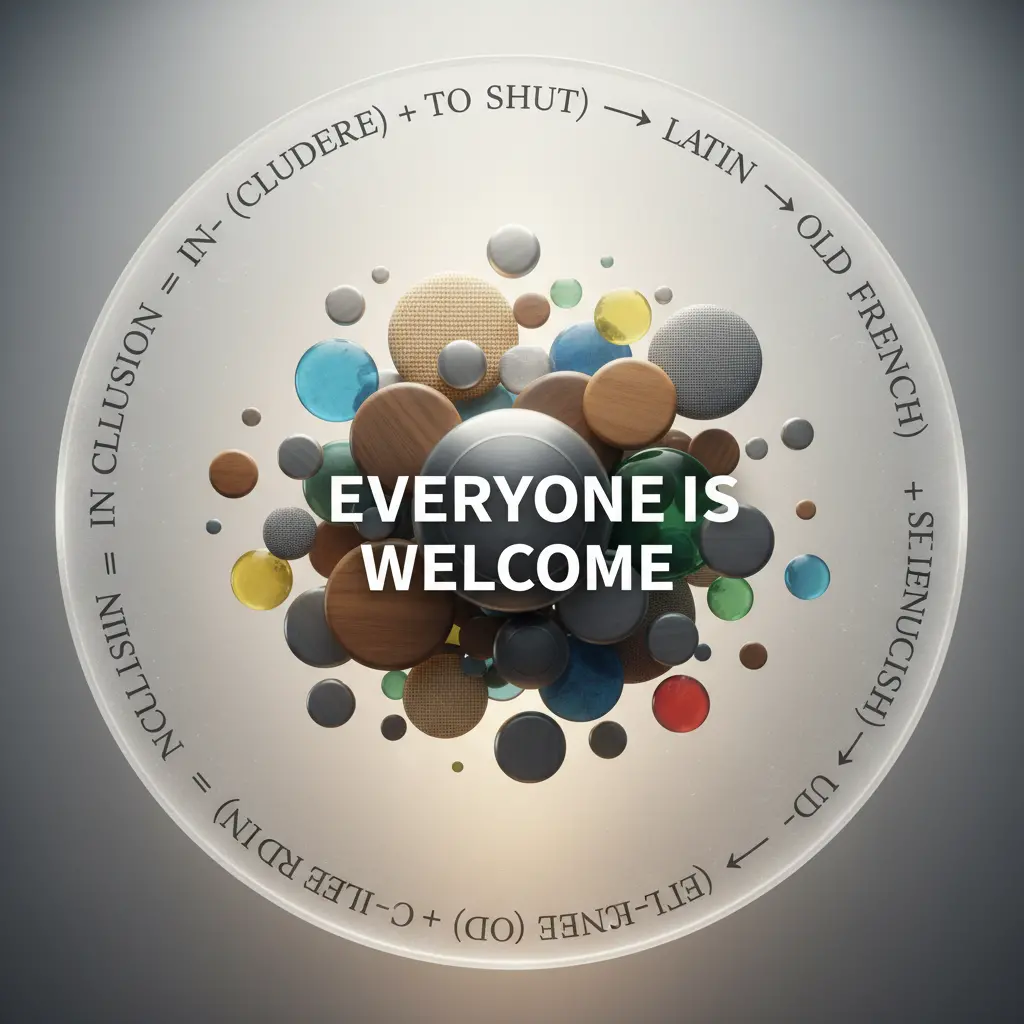
inclusion = in- (into) + cludere (to shut) → Latin → Old French → English. Imagine a large circle that not only holds many smaller circles within it, symbolizing diversity and unity, where everyone is welcome.
Note 1: These definitions and etymologies are not standard dictionary definitions, but extended explanations provided to help with memorization and understanding of the actual application of words. Through this background information, we strive to make words more vivid and easier to understand, and help you remember their meanings in real life.
Note 2: LexiTalk designs the learning flow around the linguistics principle of “Comprehensible Input.” When learners encounter material that is slightly above their level but still understandable from context, the brain naturally absorbs the language. That’s why we keep every word inside authentic contexts, using examples and associations to help you understand it and use it flexibly.
Read the FAQ explanation of Comprehensible InputI reach out, move a chair closer, and invite a new person to sit. The circle moves a bit as the person slides in beside you. You feel a small push to adjust the space so everyone can belong. In real life, inclusion happens when you let someone in and keep the circle open.
Inclusion is the act of including someone or something, or the state of being included. It is often discussed in education, workplace policy, and social policy as a commitment to representation and participation for people of diverse backgrounds. Inclusion goes beyond mere tolerance, aiming to give equal access, opportunities, and a sense of belonging to all groups. It contrasts with exclusion, which shuts people out. The etymology of inclusion traces to Latin includere (to shut in) via Old French and English, emphasizing inviting variety into a cohesive whole. Imagine a large circle that holds many smaller circles within it, symbolizing unity through diversity.
In English, inclusion emphasizes active belonging and access, not just counting people; learners often mix it up with diversity or equality.
What is the meaning of 'inclusion'?
Which sentence uses 'inclusion' correctly?
Select the synonym for 'inclusion':
In what situation would 'inclusion' be important?
How would you use 'inclusion' in a real-life context?
Download LexiTalk app for personalized learning experience
Download AppCookies
We use cookies for essential site functions, analytics, and ads. You can accept, reject, or manage preferences. Privacy Policy