incorrectly - Master This Word
Master this word with our 5-step learning method – Learn English in English
Train English Through Brain Routes, Not Translation.
This page helps you stop memorizing isolated translations and start understanding a word through its shared mental image, native-style thinking, and practical training steps.
Master this word with our 5-step learning method – Learn English in English
Example sentences are the start of understanding. Don't rush to memorize. First feel how the word works in a sentence.
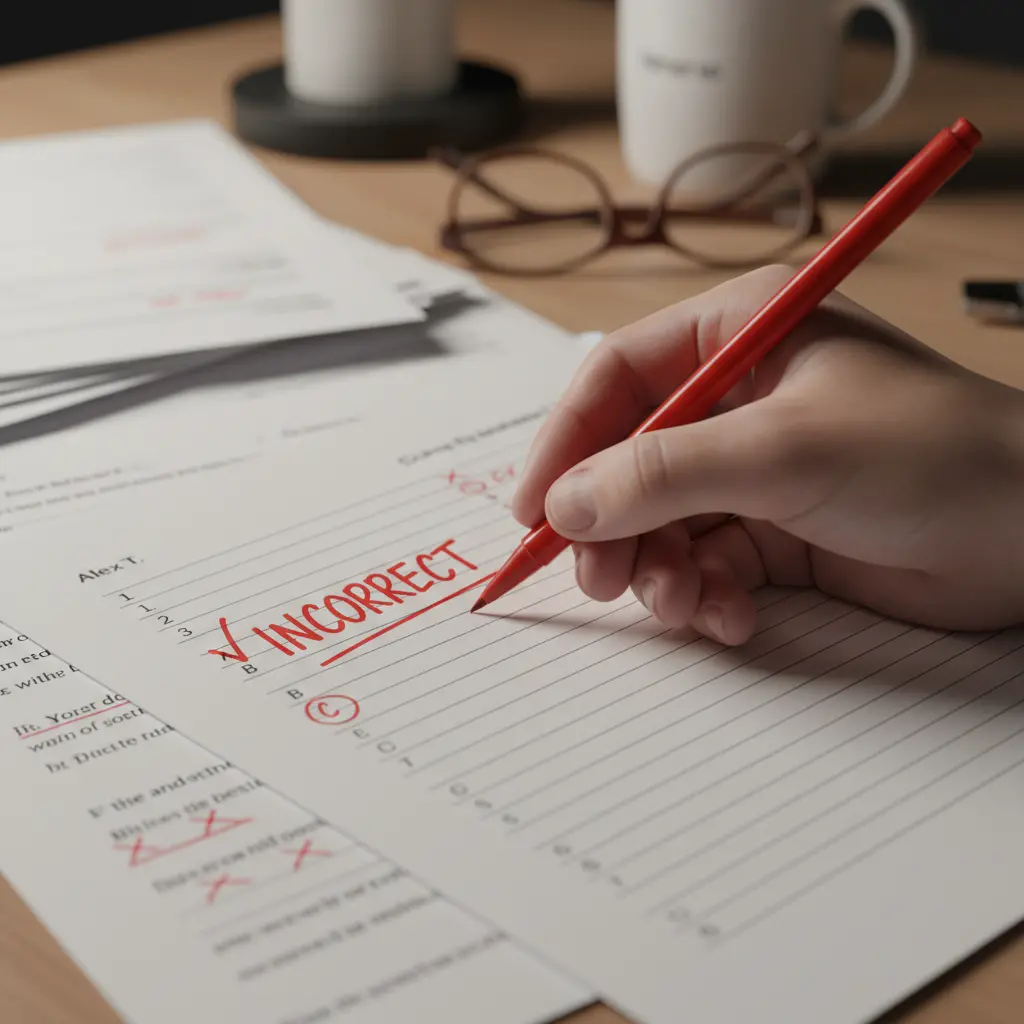
in- = not, correct = right; Origin: Latin → Middle English. Imagine a teacher marking a test with a red pen and writing 'incorrect' next to wrong answers, signaling something is not right.
Note 1: These definitions and etymologies are not standard dictionary definitions, but extended explanations provided to help with memorization and understanding of the actual application of words. Through this background information, we strive to make words more vivid and easier to understand, and help you remember their meanings in real life.
Note 2: LexiTalk designs the learning flow around the linguistics principle of “Comprehensible Input.” When learners encounter material that is slightly above their level but still understandable from context, the brain naturally absorbs the language. That’s why we keep every word inside authentic contexts, using examples and associations to help you understand it and use it flexibly.
Read the FAQ explanation of Comprehensible InputI pick up a pencil and move my wrist toward the page, watching the line wobble. I shift my grip and adjust my stance, trying again, but the letters come out incorrect in angle. The effort tightens my hand as I hold steady and push through the miss, changing course with each stroke. Soon I place a new line and keep going, letting the process show how wrong can feel, yet guide me toward something closer to right.
Incorrect describes something that is not right or accurate. It can refer to actions, statements, methods, or understanding that fail to meet a standard. In everyday use, it often appears with the adverb form incorrectly to describe how something was done. In formal writing, incorrect is a precise, slightly more formal alternative to wrong; it signals a factual error, a faulty assumption, or a misapplication of rules. The prefix in- means not and correct means right; the word entered English via Latin through Middle English. In classrooms, a teacher may mark a solution as incorrect with a red pen, inviting review and correction. Remember that incorrect emphasizes a lack of correctness rather than a moral judgment.
In English, speakers tend to favor clarity and precision. 'Incorrect' is common in formal or technical contexts, while 'wrong' can carry a more emotional or moral undertone; learners often overuse 'wrong' in academic writing or misplace it in factual statements.
What is the meaning of 'incorrectly'?
Which sentence uses 'incorrectly' correctly?
Choose the antonym of 'incorrectly'.
In what scenario would someone use 'incorrectly'?
Reflect on a time when you did something incorrectly. Share a sentence about it.
Technology & Social Media
Listen NowDownload LexiTalk app for personalized learning experience
Download AppCookies
We use cookies for essential site functions, analytics, and ads. You can accept, reject, or manage preferences. Privacy Policy