
institution - Master This Word
Master this word with our 5-step learning method – Learn English in English
Train English Through Brain Routes, Not Translation.
This page helps you stop memorizing isolated translations and start understanding a word through its shared mental image, native-style thinking, and practical training steps.
Master this word with our 5-step learning method – Learn English in English
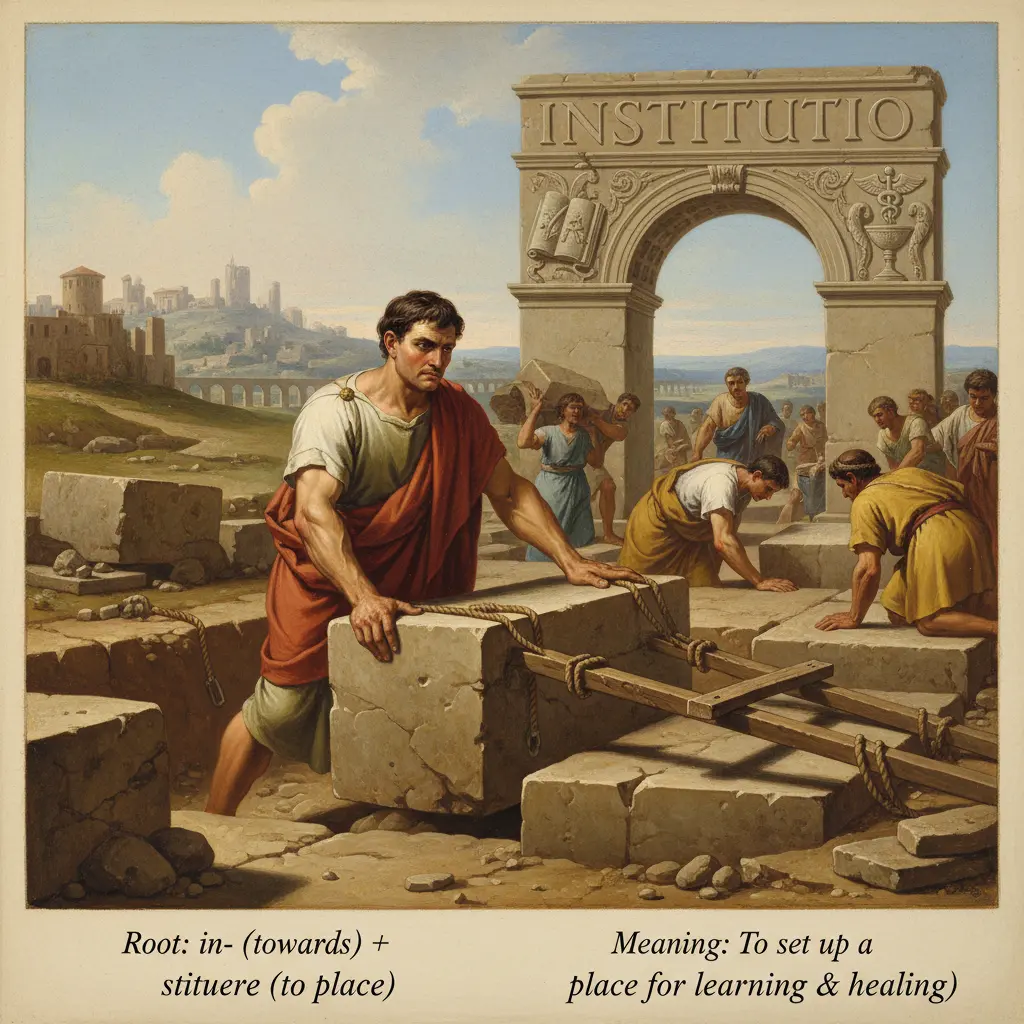
Example sentences are the start of understanding. Don't rush to memorize. First feel how the word works in a sentence.
Root decomposition: in- (towards) + stitution (from 'stituere' meaning 'to place or set up'). Historical origin: Latin → Old French → English. Memory image: Imagine a builder in ancient Rome placing the foundation stones for an institution like a school or hospital, establishing a place for learning and healing.
Note 1: These definitions and etymologies are not standard dictionary definitions, but extended explanations provided to help with memorization and understanding of the actual application of words. Through this background information, we strive to make words more vivid and easier to understand, and help you remember their meanings in real life.
Note 2: LexiTalk designs the learning flow around the linguistics principle of “Comprehensible Input.” When learners encounter material that is slightly above their level but still understandable from context, the brain naturally absorbs the language. That’s why we keep every word inside authentic contexts, using examples and associations to help you understand it and use it flexibly.
Read the FAQ explanation of Comprehensible InputFirst I loosen my shoulders and push myself to focus, turning a scatter of tasks into a clean routine. I move a file from pile to shelf, place a notice on a wall, and hold the image of an institution steady in my mind—an ordinary place that steadies education, service, or tradition. It feels like adjusting a compass, the direction shifting as people arrive, signs change, and the routine holds firm. By the end, the idea lands: a trusted place or practice that people lean on, built through time and care.
An institution is an established organization or foundation, often dedicated to education, public service, or a similar purpose. It can also refer to a significant practice or custom that a society maintains, such as a tradition or system of governance. The act of instituting or establishing something is another sense tied to formal creation, such as founding a university or a charity. In everyday use, 'institution' emphasizes structure, legitimacy, and enduring presence more than a single event. People may refer to respected organizations like universities, museums, or religious bodies as institutions, while phrases like 'the institution of marriage' point to long-standing social practices. Learners should distinguish organization from tradition and process contexts.
In English, institution often signals formality, longevity, and legitimacy, used for organizations and for enduring social practices. Learners should watch for distinctions from similar words like institute and establishment, and for collocations such as financial institution or educational institution.
What is the meaning of the word 'institution'?
In which of the following sentences is 'institution' used correctly?
Which of the following is a similar word to 'institution'?
What is the opposite of 'institution'?
In what real-life context would you encounter an 'institution'?
Download LexiTalk app for personalized learning experience
Download AppCookies
We use cookies for essential site functions, analytics, and ads. You can accept, reject, or manage preferences. Privacy Policy