
justification - Master This Word
Master this word with our 5-step learning method – Learn English in English
Train English Through Brain Routes, Not Translation.
This page helps you stop memorizing isolated translations and start understanding a word through its shared mental image, native-style thinking, and practical training steps.
Master this word with our 5-step learning method – Learn English in English
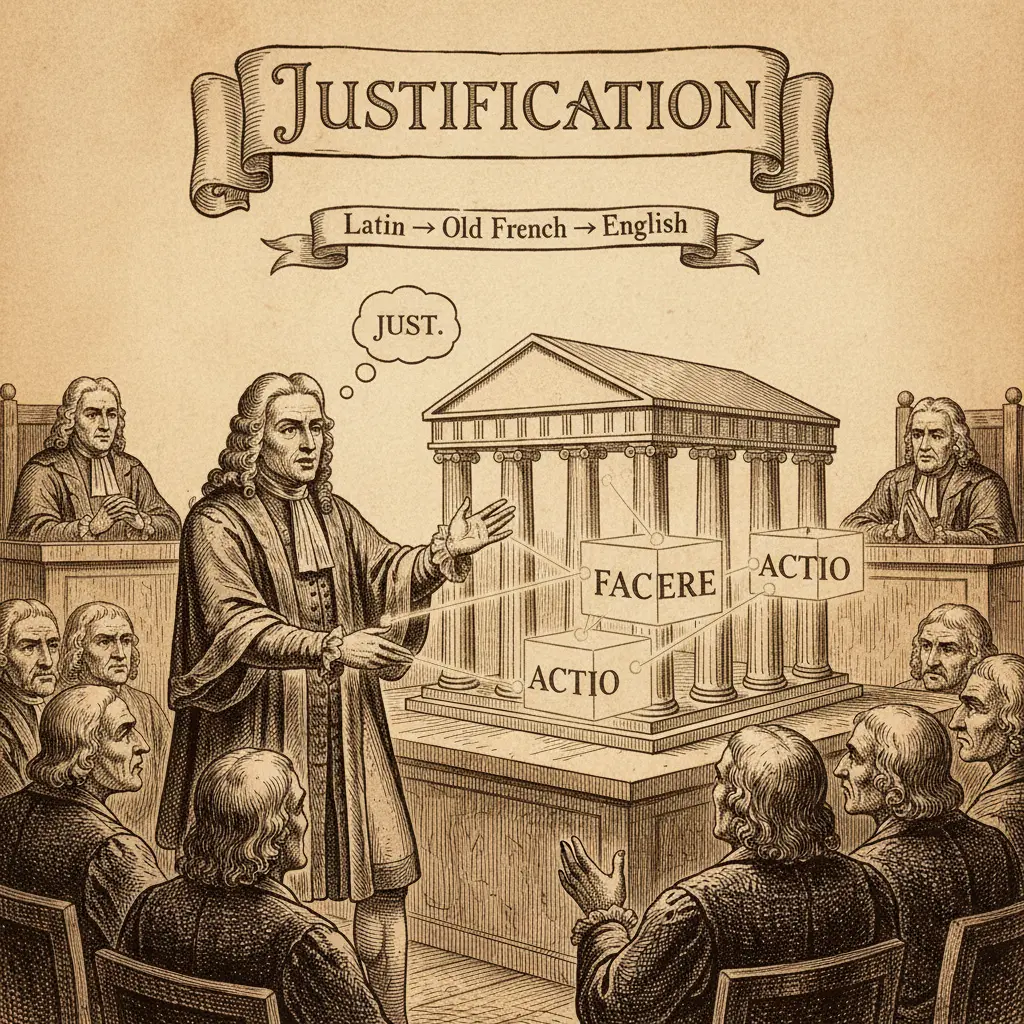
Example sentences are the start of understanding. Don't rush to memorize. First feel how the word works in a sentence.
justification = justus (just) + -ficare (to make) + -tion (noun suffix). Historical origin: Latin → Old French → English. Memory image: Imagine someone standing in a court, explaining why their actions are just, as if building a solid case.
Note 1: These definitions and etymologies are not standard dictionary definitions, but extended explanations provided to help with memorization and understanding of the actual application of words. Through this background information, we strive to make words more vivid and easier to understand, and help you remember their meanings in real life.
Note 2: LexiTalk designs the learning flow around the linguistics principle of “Comprehensible Input.” When learners encounter material that is slightly above their level but still understandable from context, the brain naturally absorbs the language. That’s why we keep every word inside authentic contexts, using examples and associations to help you understand it and use it flexibly.
Read the FAQ explanation of Comprehensible InputI set a page on the desk and move a sticky note from left to right. I push and pull ideas, adjust my stance as I weigh options. The effort in my fingers and the shake in my jaw tell me I’m turning a vague thought into a real path. When I speak or write, the justification feels like a chosen fit for the moment, something I can hold and carry.
Justification is the process of showing that something is right, reasonable, or necessary. It covers a good reason for doing something, a rationale that supports a decision, and in law, a defense or excuse offered in court. Use it when you want to explain why a choice was made or why an action is acceptable in a given situation. In everyday speech, you justify a purchase, a policy, or a course of action by pointing to evidence, principles, or consequences. The memory image of a speaker presenting a solid case helps you remember the core idea: a reason that makes sense and stands up to scrutiny.
English tends to separate the notion of justification (a reasoned, often formal grounds) from apology or excuse; learners may confuse what counts as a valid justification with an apology.
What is the meaning of 'justification'?
Choose the correct sentence using 'justification'
Select the antonym of 'justification'
In what real-life context would 'justification' be used?
Reflect on when you might need to provide or seek 'justification'
Download LexiTalk app for personalized learning experience
Download AppCookies
We use cookies for essential site functions, analytics, and ads. You can accept, reject, or manage preferences. Privacy Policy