lips - Master This Word
Master this word with our 5-step learning method – Learn English in English
Train English Through Brain Routes, Not Translation.
This page helps you stop memorizing isolated translations and start understanding a word through its shared mental image, native-style thinking, and practical training steps.
Master this word with our 5-step learning method – Learn English in English
Example sentences are the start of understanding. Don't rush to memorize. First feel how the word works in a sentence.
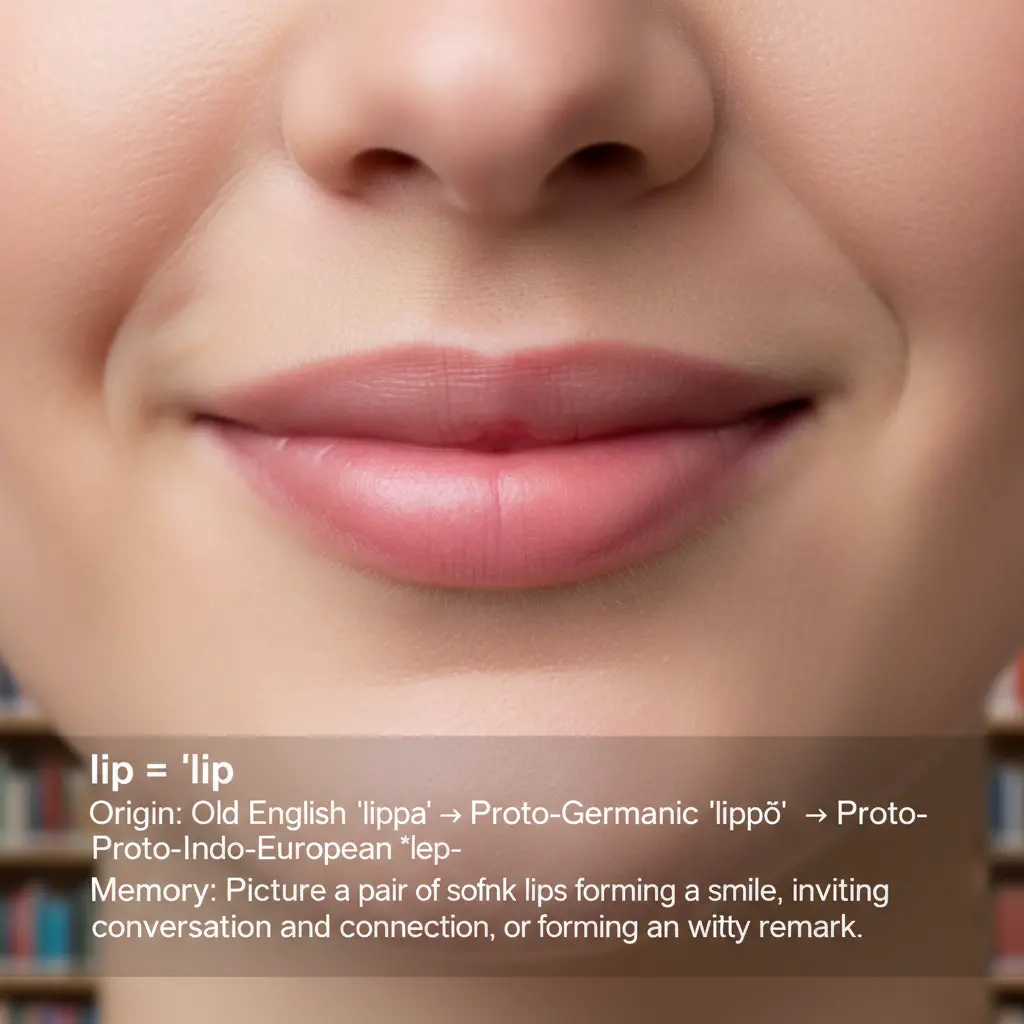
lip = 'lip'. Origin: Old English 'lippa' → Proto-Germanic 'lippō' → Proto-Indo-European '*lep-'. Memory: Picture a pair of soft, pink lips forming a smile, inviting conversation and connection, or forming a witty remark.
Note 1: These definitions and etymologies are not standard dictionary definitions, but extended explanations provided to help with memorization and understanding of the actual application of words. Through this background information, we strive to make words more vivid and easier to understand, and help you remember their meanings in real life.
Note 2: LexiTalk designs the learning flow around the linguistics principle of “Comprehensible Input.” When learners encounter material that is slightly above their level but still understandable from context, the brain naturally absorbs the language. That’s why we keep every word inside authentic contexts, using examples and associations to help you understand it and use it flexibly.
Read the FAQ explanation of Comprehensible InputFirst I lift the cup and move it toward my mouth, my fingers tightening and then loosening as I settle the rim against my lip. I push a little, pull a little, adjust the angle, and the heat makes the edge wake under my touch. The pause before a sip changes how I hold my breath, how I keep my expression steady. In that small balance, lip becomes more than a word; it’s the edge that meets me when I drink or when I tease with words.
Lip is a noun with several common senses: the edge or rim of a container or object, such as the lip of a mug; the fleshy border around the mouth, used for speaking and smiling; and a colloquial sense meaning a disrespectful remark or backtalk. In American and British English, a person who 'gives lip' speaks rudely or backtalks. The phrase 'lip service' means insincere verbal support. Other related terms include 'lipstick' and 'lipped' as an adjective. The word often relies on context to show whether we mean a physical edge, a body part, or a social behavior. Pronounce lip with a short 'i' sound, /lɪp/.
Learners of English often immediately map lip to the mouth, missing the edge/container sense. In many languages the edge or rim term is separate, so students may confuse 'lip of a cup' with 'mouth' or skip idioms like lip service.
What is the meaning of 'lips'?
Which of the following sentences uses the word 'lips' correctly?
Which word is most similar to 'lips'?
What is the opposite of 'lips'?
Can you think of a real-life context where someone might use 'lips'?
Download LexiTalk app for personalized learning experience
Download AppCookies
We use cookies for essential site functions, analytics, and ads. You can accept, reject, or manage preferences. Privacy Policy