misbehavior - Master This Word
Master this word with our 5-step learning method – Learn English in English
Train English Through Brain Routes, Not Translation.
This page helps you stop memorizing isolated translations and start understanding a word through its shared mental image, native-style thinking, and practical training steps.
Master this word with our 5-step learning method – Learn English in English
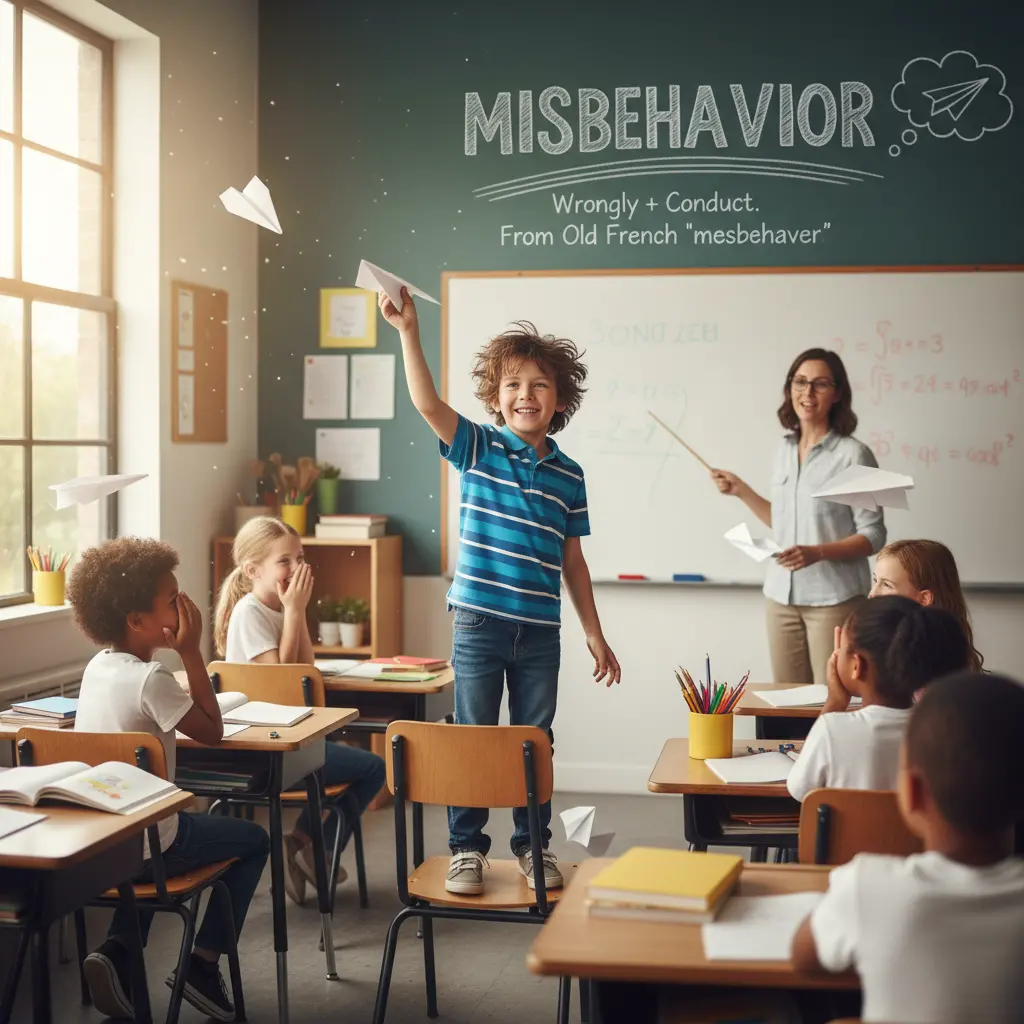
Example sentences are the start of understanding. Don't rush to memorize. First feel how the word works in a sentence.
(a) mis- (prefix meaning 'wrongly') + behavior (the manner of conducting oneself). (b) The term originates from Middle English 'misbeheve' from Old French, derived from 'mesbehaver' which itself comes from the Latin 'maleducare'. (c) Imagine a child in a classroom throwing paper airplanes instead of listening—a vivid illustration of 'misbehavior' that is instantly recognizable.
Note 1: These definitions and etymologies are not standard dictionary definitions, but extended explanations provided to help with memorization and understanding of the actual application of words. Through this background information, we strive to make words more vivid and easier to understand, and help you remember their meanings in real life.
Note 2: LexiTalk designs the learning flow around the linguistics principle of “Comprehensible Input.” When learners encounter material that is slightly above their level but still understandable from context, the brain naturally absorbs the language. That’s why we keep every word inside authentic contexts, using examples and associations to help you understand it and use it flexibly.
Read the FAQ explanation of Comprehensible InputMisbehavior refers to conduct that is wrong, inappropriate, or not socially acceptable, especially when it violates established rules or expectations. In everyday English, it often describes actions by individuals rather than broad character traits, and it is common in schools, workplaces, and public spaces. The noun pairs with verbs like 'commits', 'displays', or 'engages in', and the related verb is 'to misbehave'. It sits between casual ideas of 'bad behavior' and formal terms like 'misconduct', offering a neutral tone that signals disapproval without sensationalism. Note that it does not imply criminality, and in some contexts British speakers may prefer 'misbehaviour' with a 'u'.
For English learners, misbehavior sits as a middle-ground term: stronger than general 'bad behavior' but softer than 'misconduct' or criminal labels. It often signals disapproval without accusing a person of serious crime. Learners should note the collocations (serious misbehavior, instances of misbehavior) and spelling variants such as misbehaviour in British English.
What is the meaning of the word 'misbehavior'?
Choose the correct sentence that uses the word 'misbehavior'.
Which word is most similar to 'misbehavior'?
What is the opposite of 'misbehavior'?
Can you think of a real-life context where a child exhibits misbehavior?
Download LexiTalk app for personalized learning experience
Download AppCookies
We use cookies for essential site functions, analytics, and ads. You can accept, reject, or manage preferences. Privacy Policy